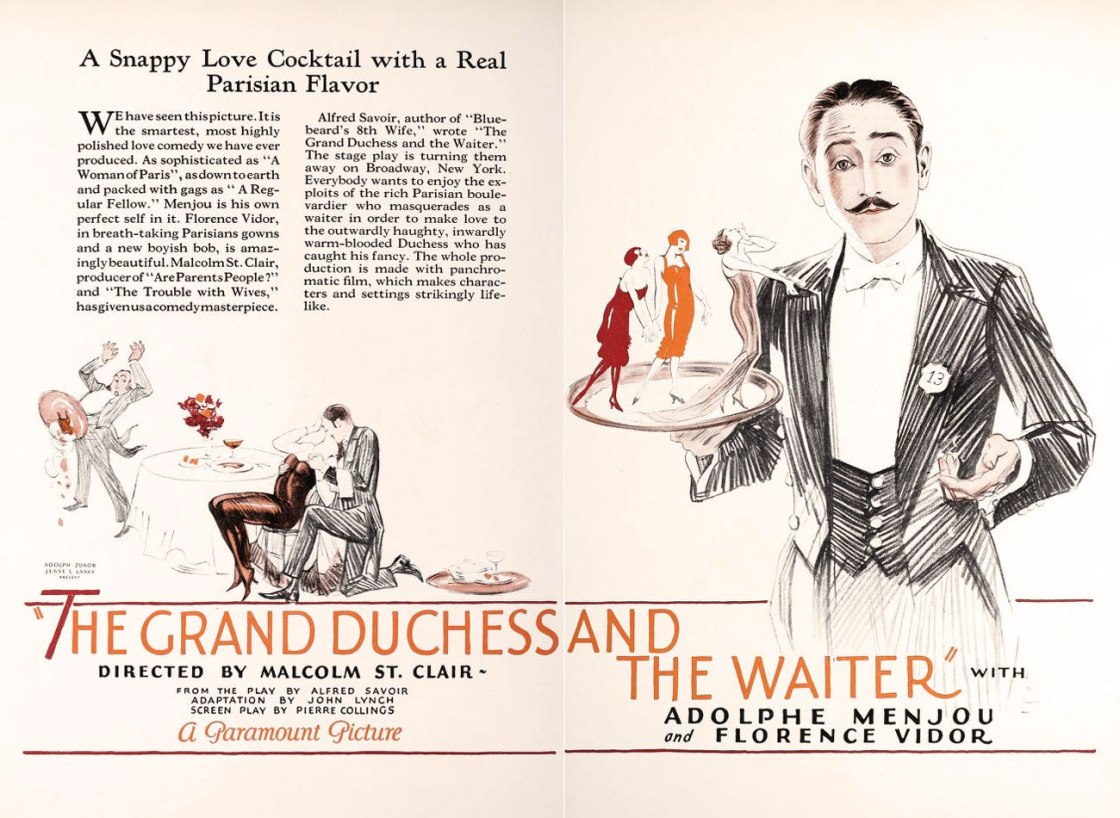
When a French man-about-town falls for a Russian aristocrat in exile, he will do anything to be near her, including posing as a waiter at the hotel where she resides.
Home Media Availability: Released on DVD by Grapevine.
Start the Revolution Without Me
Judging from the Red Scare pictures of the Cold War era, it would be easy to assume that Hollywood had always been in the red baiting business. However, prior to and during the Russian Revolution, the tsar was often used as a metaphor for brutality and major studios made their share of, if not fully communist, definitely sympathetic films portraying aristocratic violence and the vengeance of the proletariat. (For example, The Cossack Whip and The Dancer’s Peril.)
The 1920s was a decade of upheaval as the pro-tsar Whites schemed to regain power from the Reds. Of course, we have the benefit of hindsight and know that the Soviet Union would endure for seven more decades but at the time, the revolution was fresh and anything could happen. (Including the aristocrats in exile teaming up with the Germans to assert control over the Baltic states. Oh, so NOW they get along?)
Hollywood films found an eager audience in the Soviet Union and the market would not be cut off until after the rise of talkies. The recent revolution was too cinematic to ignore– fleeing aristocrats, sexy revolutionaries in open shirts, chaos– but Hollywood was selling to the whole world, so it took the same approach to the Russian Revolution that it was using for films about the Great War: keep it vague, keep politics out, focus on the romance, adventure and spectacle.
The result was a series of incredibly strange films, such as Cecil B. DeMille’s The Volga Boatman (1926) and Tempest (1928), in which the revolution seems to be less about politics and power and more about kinky whip-wielding aristocrats who couldn’t keep their eyes or hands off of equally lusty peasants. They are incredibly bad and incredible watchable.
The Grand Duchess and the Waiter takes a much lighter, Lubitschian approach the world events but it shares the same DNA as the other Hollywood revolution pictures, even if it presents it in a fluffier and glitzier manner.
Albert Durant (Adolphe Menjou) is a wealthy Parisian roué who has a new love of his life for every day of the week. All of that changes when, while attending the ballet, he spots Grand Duchess Zenia (Florence Vidor), an exiled Russian royal who has been camped out at the finest hotel in Paris patiently awaiting the end to the revolution so she can return to her rightful place as ruler.
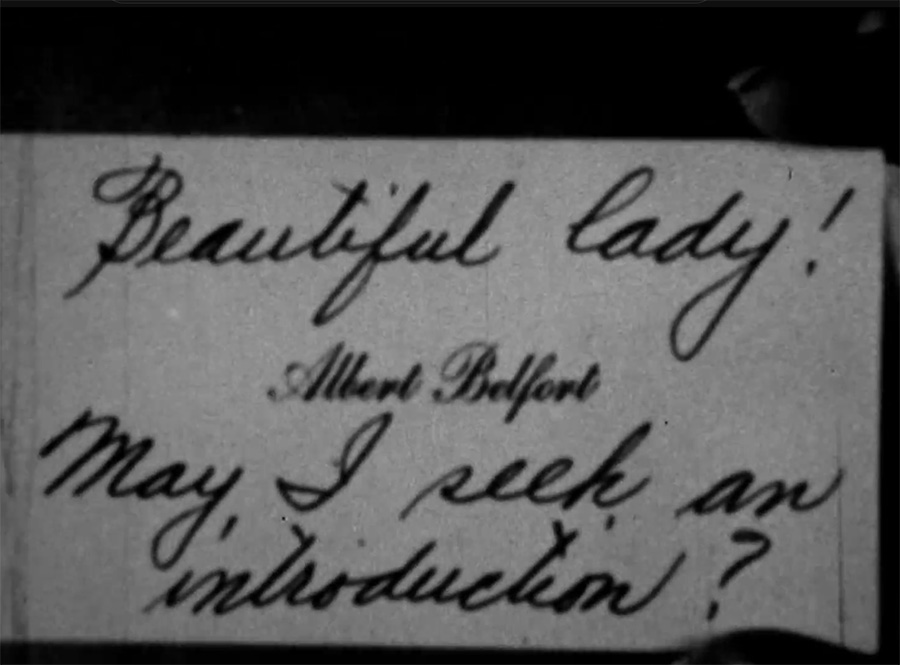
Albert attempts to send his card but can’t get past Zenia’s court: her lady-in-waiting, Countess Prascovia Avaloff (Dot Farley), her uncle, Grand Duke Peter (George Grant), and her cousin, Grand Duke Paul (George Beranger). Instead, Albert takes a room at the hotel below Zenia’s suite and bides his time.
Things are not going so well in Russia for the White Army and, despite being self-proclaimed rulers of Poland, Finland, and Estonia, the noble quartet cannot even afford to pay their extravagant hotel bill. Zenia sells her last big piece of jewelry, Catherine the Great’s necklace, in order to settle their finances.
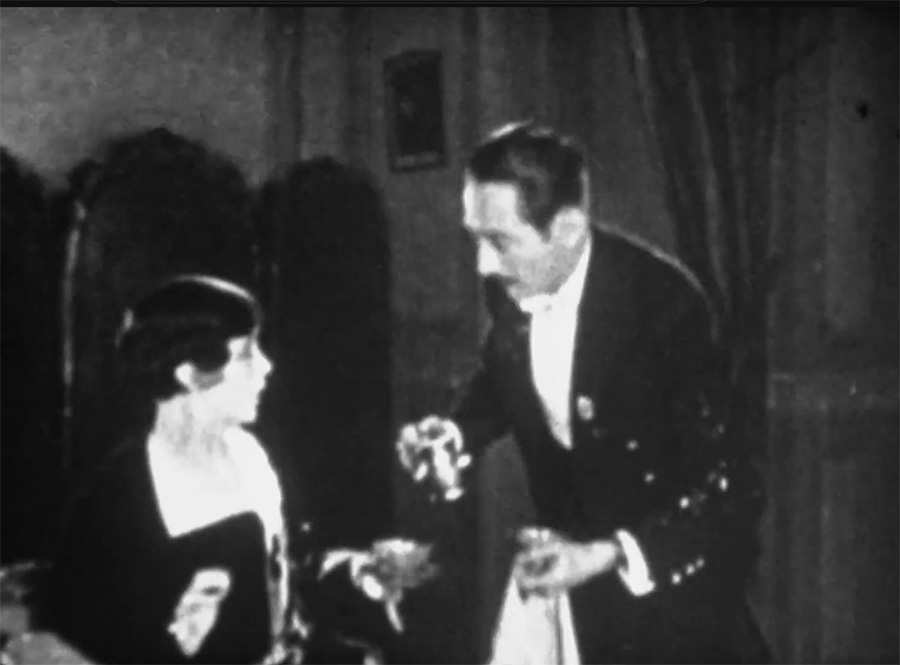
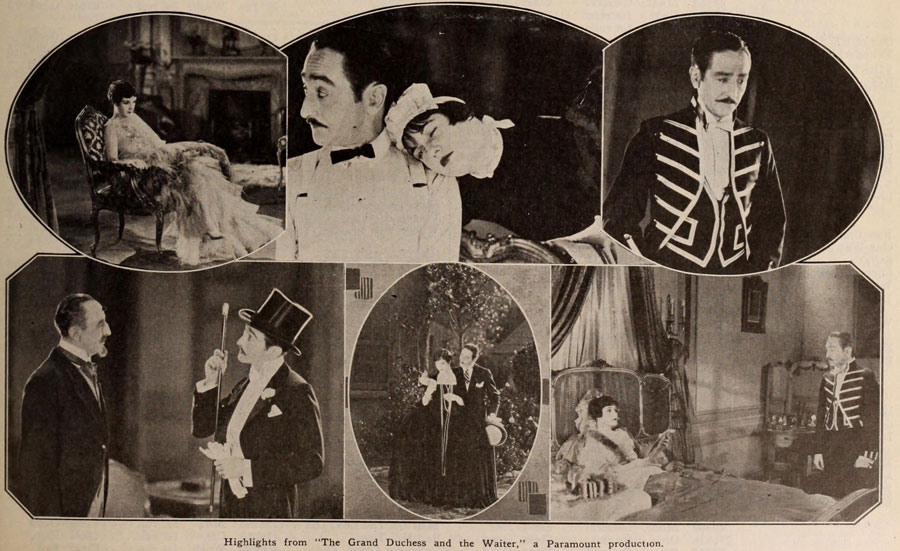
Meanwhile, Albert comes up with a plan: if he cannot be introduced to Zenia as himself, he will disguise himself as a waiter to gain entry. The plan backfires when he spills milk on Zenia’s dress but she decides she will add him to her entourage in order to teach him a lesson. He’s lucky: in Russia, he would have been flogged. (Told you Hollywood was kinky with that stuff.)
So begins a game of cat and mouse as the disguised Albert is called in to attend Zenia in her bedroom, in the bath, sleep outside her doorway– but she might shoot him if he comes in. Rawr. The whole time, Countess Prascovia is warning that this will all lead to trouble but it is extremely clear that Zenia more than welcomes that particular kind of trouble. She just likes to play with her food.
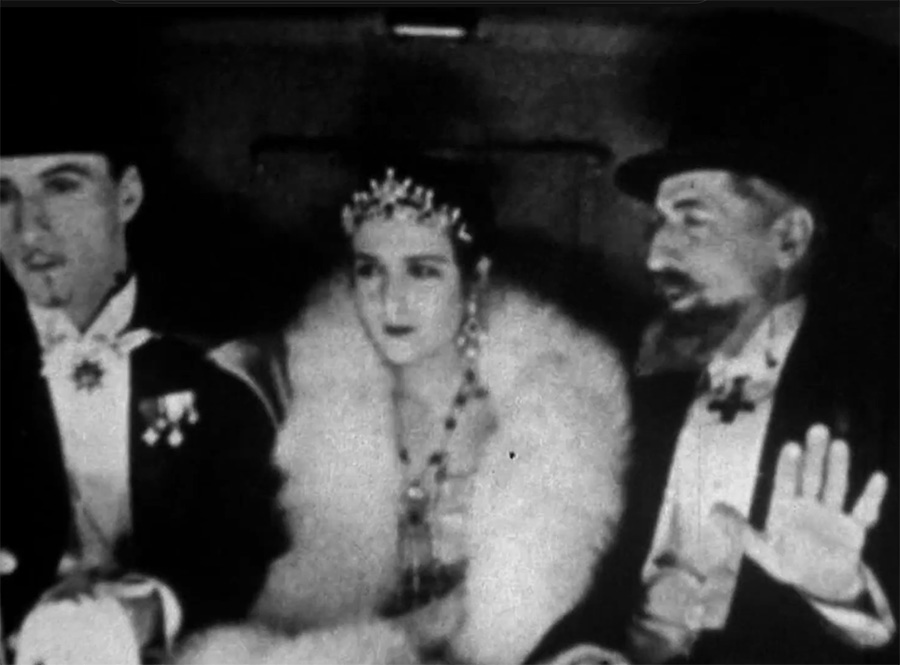
Will those crazy kids get together? Is this a Hollywood rom-com? See The Grand Duchess and the Waiter to find out!
Does this plot hold up to a moment’s scrutiny? No. But does it include the kind of cleverly constructed bedroom farce machinations that I enjoy so much? Also no. The plot of this film is an incredibly coarse and blunt instrument designed entirely to get the characters from Point A to Point B. I am guessing that the original French language version was probably a lot more oo la la but this was Hollywood with Hays in town, even if he had not yet officially launches his Code. (The English language stage version only ran for 31 performances but it starred Basil Rathbone as Albert and had a “negligees by” credit, some perhaps we can presume some oo la la there as well? It was certainly more political with a Swiss Albert becoming a subject of the Yugoslavian monarchy in order to win the Duchess.)
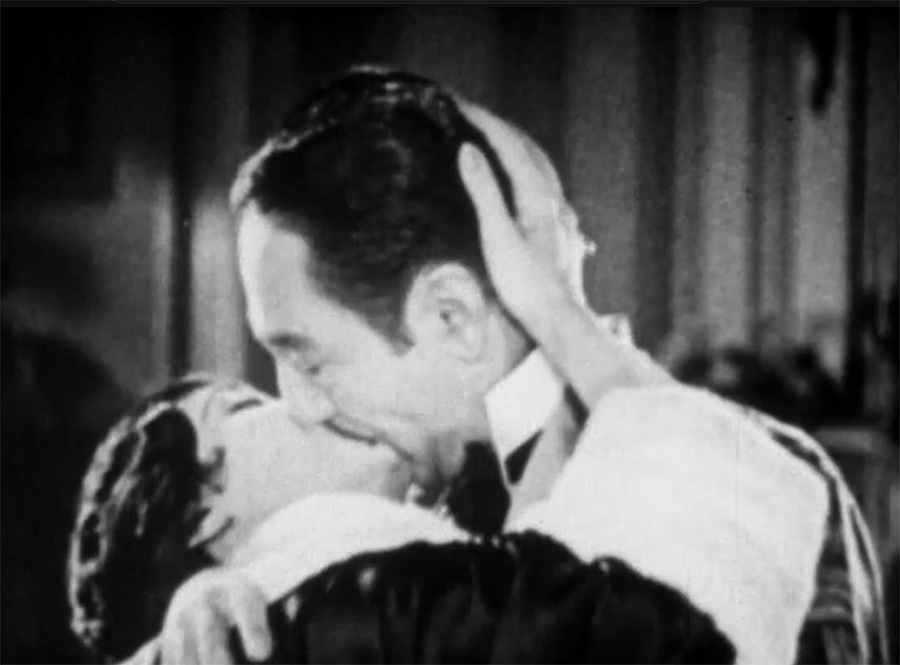
As for the main characters, Albert is a stalker, Zenia is a tyrant. With neither character in the main coupling particularly likable or appealing on paper, generally a deathblow to a rom-com, The Grand Duchess and the Waiter instead relies on the considerable charm of its leads and the cast, along with director Malcolm St. Clair, should be credited with the picture’s success.
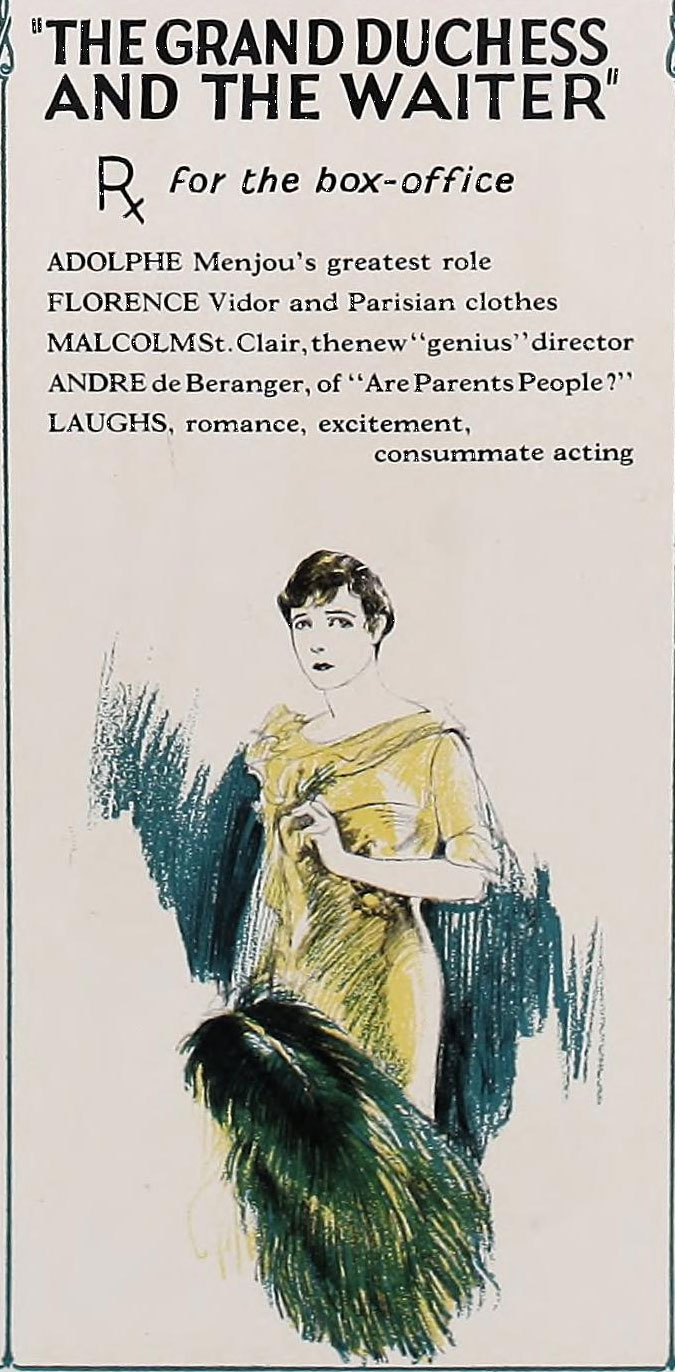
Adolphe Menjou could play these satin charmer roles in his sleep but he is wide awake here, bringing considerably more humanity to Albert than what was in the scenario. His gentle glances and genuine hurt at rejection put us in his corner. Florence Vidor always has an air of dignity about her but she also embraces the lustier side of Zenia, making it clear that she is very much a willing participant.
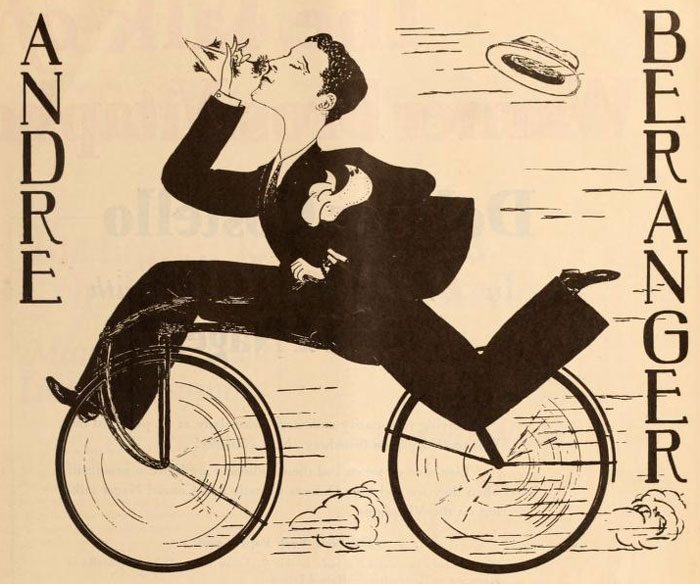
The character actors also enhance the film considerably. Dot Farley, best remembered today as a fixture in Sennett comedies, always does a wonderful Imperious and Slightly Ridiculous. Lawrence Grant, who later played a Russian duke again in Ninotchka, blusters gloriously. George Beranger never had a supporting role he couldn’t use to steal the show and he does it again here as the moody, piano banging Duke Paul.
(By the way, this was near the end of Florence Vidor’s film career. She chose not to fight it out in the talkies. She had just married Jascha Heifitz anyway (himself a refugee from the Russian Revolution) and who can begrudge her an early retirement, especially given Hollywood’s typecasting of Southern accents. Menjou enjoyed a long and successful career playing exactly the sort of man-about-town character he had mastered in the silent era. An outspoken conservative, he supported and was a friendly witness for the House Committee on Un-American Activities.)
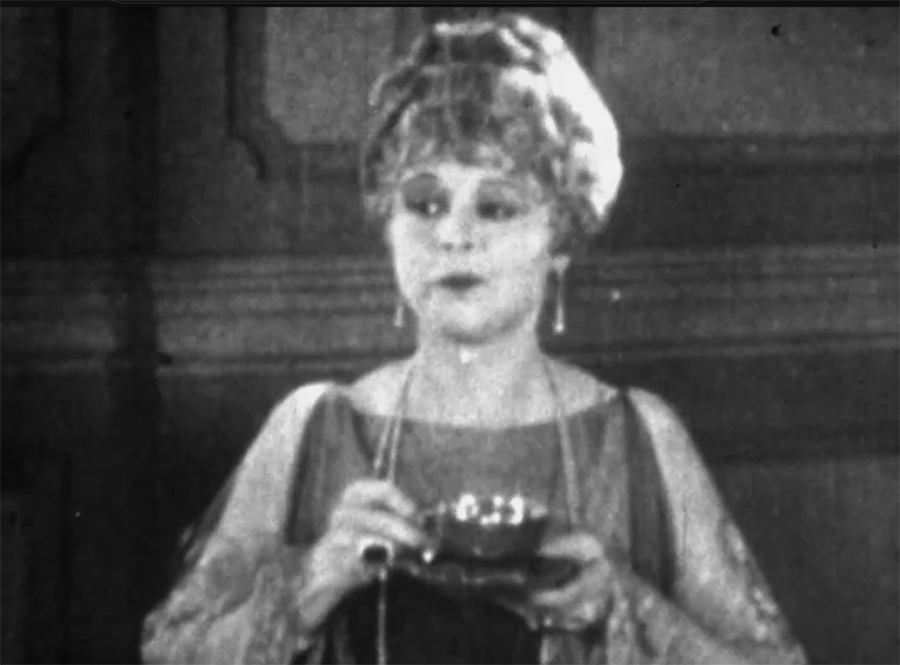
Malcolm St. Clair, meanwhile, keeps things kinetic and visually interesting, conveying the characters’ moods by showing how their footfalls shake the chandeliers on the flood below and filming through the ballet dancers so add dynamism to the meet-cute. Exceedingly handsome film, here’s hoping a 35mm print survives.
The Grand Duchess and the Waiter is absolute fluff and I don’t think even its makers expected anyone to take its ridiculous plot seriously. It relies entirely on style and the skills of its actors, which are enough to pull it through if you squint and don’t ask too many questions. If you’re in the mood for something light as air, this will suit you.
Where can I see it?
☙❦❧
Like what you’re reading? Please consider sponsoring me on Patreon. All patrons will get early previews of upcoming features, exclusive polls and other goodies.
Disclosure: Some links included in this post may be affiliate links and I earn from qualifying purchases.


I ordered a Blu-ray from Grapevine in March and still haven’t received it. They don’t respond to emails and don’t answer the phone.
Sorry to hear that! I am not affiliated with them beyond being a customer.