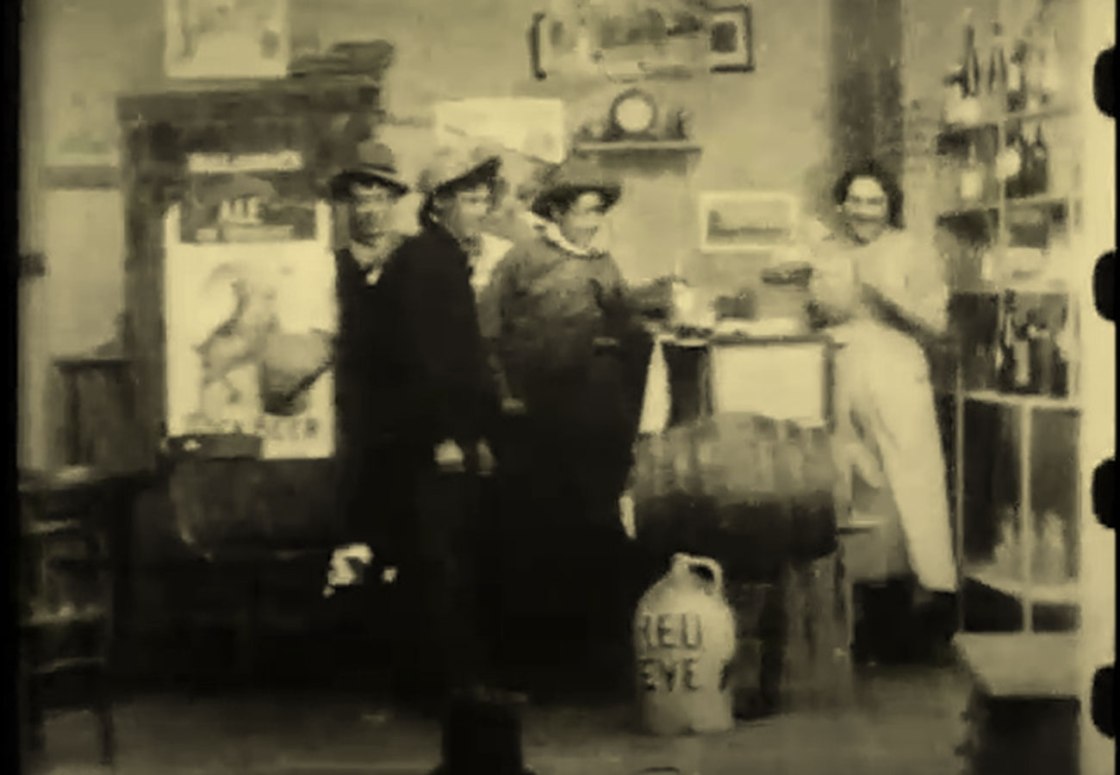
In the gold rush town of Cripple Creek, Colorado, a rowdy bar patron is soon put in his place by the brawny barmaid. This Edison production was an attempt to cash in on the town’s infamy.
Home Media Availability: Stream courtesy of the Library of Congress.
Trouble in the Old Black Maria
The film industry of 1899 was almost unrecognizable compared to 1893, the year the Edison motion picture division started shooting movies in the cramped tarpaper studio nicknamed the Black Maria. Films had gone from a peepshow novelty to projected mass entertainment. Thirty-second clips of dancers, athletes and other celebrities simply wouldn’t cut it anymore, multi-scene stories were in demand and in production.
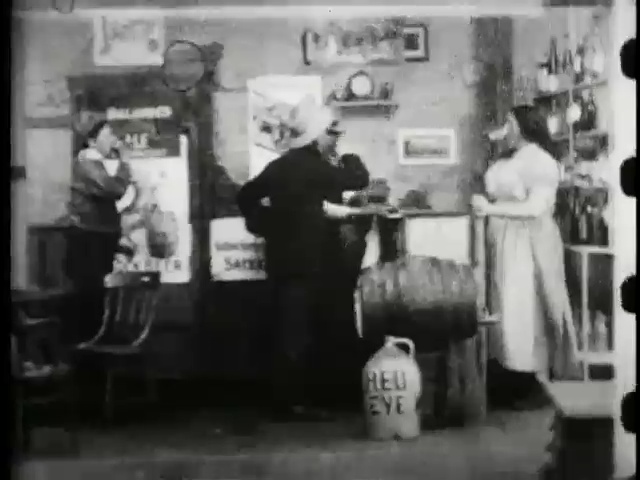
The Black Maria productions were a bit more sophisticated by 1899, backdrops and scenery instead of the plain tarpaper background, but its time was rapidly running out and the studio would be retired in 1901. Edison filmmakers had been fanning out across the globe to capture on-location actuality footage and a larger replacement studio was later built for set-bound productions.
Still, the Edison team got maximum use out of their old studio, including dressing it as a Colorado public house for Cripple Creek Bar-Room Scene, a brief, one-minute comedy.

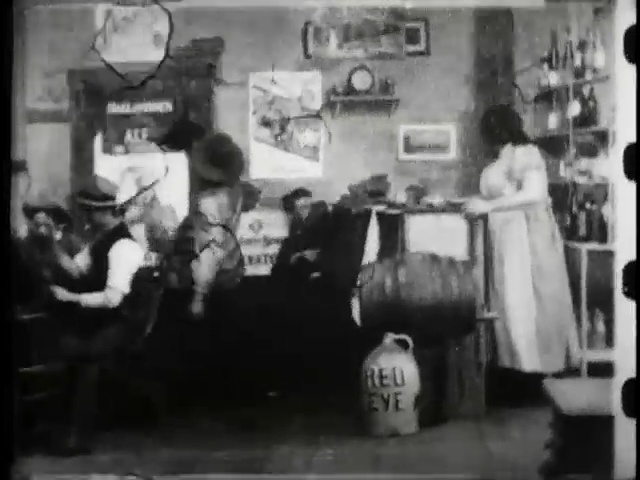
As far as plots go, this film has only a wafer-thin story: a customer in the Miners Arms becomes drunkenly belligerent and knocks the hat from a fellow patron’s head. The bartender grabs a bottle of seltzer and manages to chase the miscreant out as she sprays him with soda. The disturbance gone, she pours drinks on the house for the cheering regulars.
The seltzer-wielding bar or restaurant employee was ubiquitous in early film. A similar scenario played out in Alice Guy’s Wonderful Absinthe, also released in 1899. In that picture, a patron accidentally drinks undiluted absinthe and becomes frenzied before the waiter steps in with his trusty seltzer.

Women enforcing order against out-of-control men was another common theme in the first two decades of cinema. The 1909 comedy Mr. Flip (often erroneously cited as the first comedic pie in the face) centers around women laying down the law against an obnoxious masher. In addition to the pie, the staff of a barroom use seltzer to drive him away.
As was the case with most Edison productions of this period, the woman tending the bar was played by a male Edison employee in drag. This was standard operating procedure for the era, even in films that called for a more femme performance. (See: The Gay Shoe Clerk.) It’s hard to say for sure because this film was preserved on photo paper rather than nitrate but the bartender may even be the picture’s director, James H. White. There is a resemblance to my eye and White did seem to prefer comedy when he did try his hand at acting.

So, we have the tiny set, the seltzer, the drunk getting his just desserts, a violent western town… it seems like that’s all we have to talk about with this picture. Except…
Why Cripple Creek? It seems really specific to select a town by name for the setting of this picture, especially since it takes place 100% indoors. Couldn’t it have just been any frontier bar? What was the meaning of all this?
Cripple Creek was the site of a rich 1890 gold strike and, naturally, a subsequent rush of prospectors and a population explosion, peaking around 10,000 in 1900. Hundreds of mines started operating, East Coast old money poured in to cover operating expenses and tales of sudden wealth took the fancy of the national press.

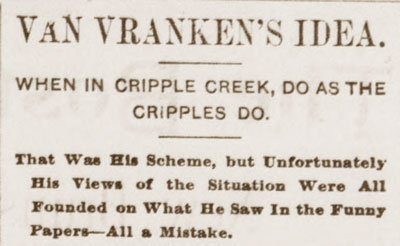
Newspapers nationwide breathlessly reported on the amount of gold being extracted and its value. The news wasn’t entirely financial either. The New York Journal published a humorous story around the same time Cripple Creek Bar-Room scene was shot. It tells the tale of Clarence Van Vranken (Dutch jokes were the Polish jokes of blond jokes at the time) who decides to fit in with the savage locals by wearing chaps, a sombrero and some pistols while going by the name Cactus Clarence.
Our hero whoops and yeehaws and brandishes but is politely corrected by the eloquent locals. The moral of the story is that Clarence learns not to perform his research by reading the funny papers. And, of course, the city slicker going west and trying (and failing!) to fit in became another beloved trope in the movies with an unbroken line from Douglas Fairbanks to Jackie Chan.
There was also a dark side to this coverage. Amongst the sea of articles breathlessly discussing the wealth of the mine and the value of its shares, there were a few pieces that painted Cripple Creek as the murder and suicide capital of the United States of America.
This rather grisly charge was breathlessly repeated across the country and, as is still usual in these matters, concern was feigned so that readers could gawk at the gory details without feeling too much guilt.

A piece published in the Dakota Farmers’ Leader a few weeks before Cripple Creek Bar-Room Scene was shot stated that living in the town was more dangerous than serving as a soldier in the Civil War: soldiers were killed at a 1 in 34 rate while Cripple Creek denizens were dying at a 1 in 25 rate. The suicide rate was likewise off the charts and, the piece was careful to state, the murders had not resulted in any judicial or vigilante action.
I don’t know whether these numbers were accurate—the tone of the article is more on par with a not-to-accurate “historical” internet post or video—but for our purposes, the facts don’t matter. Whether or not Cripple Creek was the murder capital of the country, what was important was that it was perceived that way: a tough and mean little town with too much money and pistol lead for its own good. The film industry ate that up.
For example, the French covered greed and murder on the American frontier in the 1912 film, The Railway of Death. William S. Hart famously burned the sin center to the ground in Hell’s Hinges (1924), while Charles Ray set a Wile E. Coyote deathtrap for Wallace Beery in the gold rush picture Dynamite Smith (1924). And I will always recommend the gold rush comedy Support Your Local Sheriff from 1969.
This sort of coverage is likely what inspired Clarence Van Vranken. In any case, Cripple Creek Bar-Room Scene keeps things light with nothing more violent than seltzer but the 1904 Selig picture Tracked by Bloodhounds; or, A Lynching at Cripple Creek takes a far more violent approach. In that picture, a wife home alone is murdered by a tramp (tramps were the go-to movie villain pre-WWI and pre-Chaplin) and her killer is pursued and, well, the title is a bit of a spoiler, isn’t it? It’s quite lurid and the main interest is the fact that it was shot on location, as opposed to a tarpaper box in Orange, New Jersey.

Still, what it lacks in originality and authenticity, Cripple Creek Bar-Room Scene makes up for with enthusiasm. On the surface, it seems like a silly little comedy from a simpler time in filmmaking and can be appreciated in that spirit.
However, upon digging a little deeper, it’s clear that this film also had connections to multiple beloved cinematic story elements, some of which are still being used today. Gold Rush Bar Seltzer Attack by Woman is pretty much an amalgamation of Things Gilded Age Audiences Liked and for that reason, it’s a valuable little picture.
Come on in, the seltzer’s fine!
Where can I see it?
Stream courtesy of the Library of Congress.
☙❦❧
Like what you’re reading? Please consider sponsoring me on Patreon. All patrons will get early previews of upcoming features, exclusive polls and other goodies.
Disclosure: Some links included in this post may be affiliate links to products sold by Amazon and as an Amazon Associate I earn from qualifying purchases.
 Movies Silently
I really appreciated this interesting and informative post, Fritzi! I enjoyed checking out the film — I wonder if I would have known that the barmaid was a man if you hadn’t mentioned it! (Or would I have thought she was just a really beefy lady!) LOL
Thank you! Some of the Edison guys were extremely convincing, the cast of The Gay Shoe Clerk, for example. They seemed to be having a blast!
I love the idea of a studio (the Black Maria) built on a turntable so it could catch the daylight for shooting. Interesting that they carried on the old Shakespearean tradition of having female characters played by men; I’d thought that taboo had died long before.
Edison was the only company doing it with any regularity (other than films that consciously featured drag). I actually think it was just plain cheapness, he didn’t want to pay for actors so he used his staff.