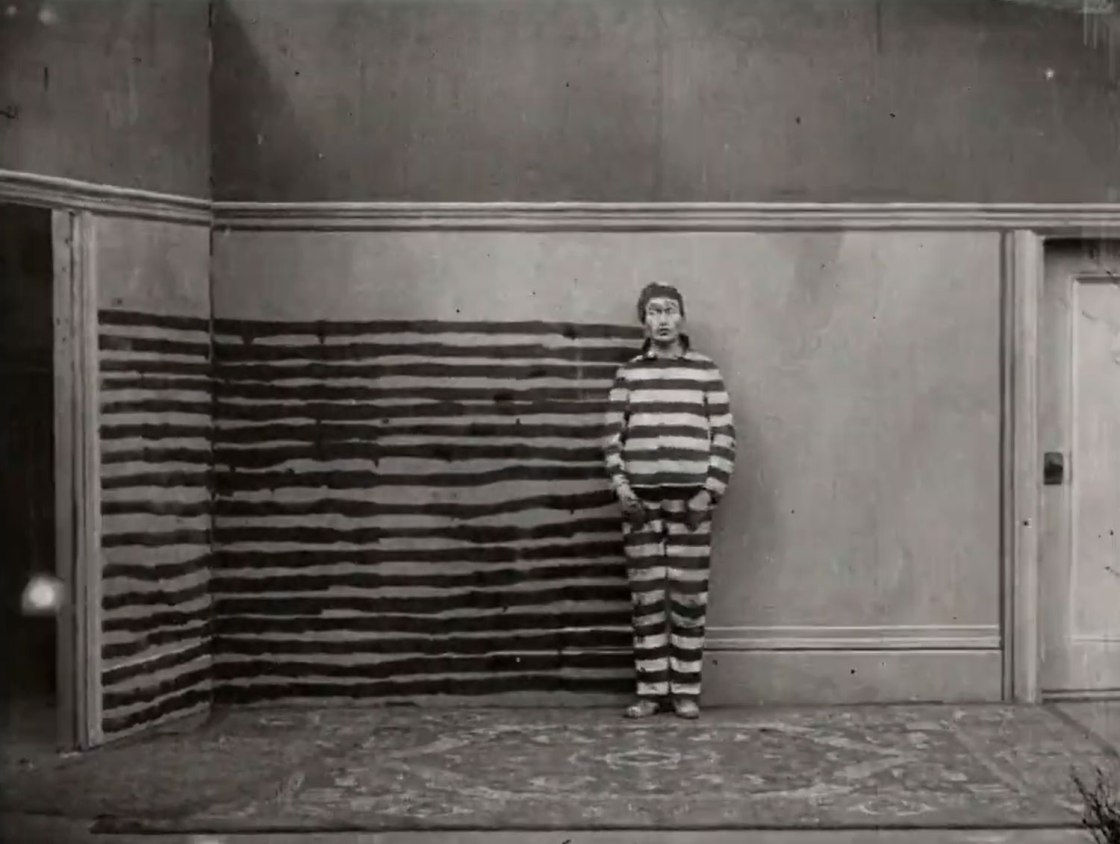
After brutally beating a prisoner, the police leave him alone in his cell but soon they (and the audience) learn of the man’s powers to change form and bend the laws of physics to make good his escape.
Home Media Availability: Released on Bluray.
Mr. Fantastic
Audiences of the 1900s particularly loved two genres: special effects-laden “trick” films and chase pictures, the more kinetic the better. Combining them was an obvious winning idea and it had already been done in the UK with The “?” Motorist (1906). Vitagraph continued the trend with The Disintegrated Convict the following year, imagining a chase that did more than showcase special effects, it bent matter itself.
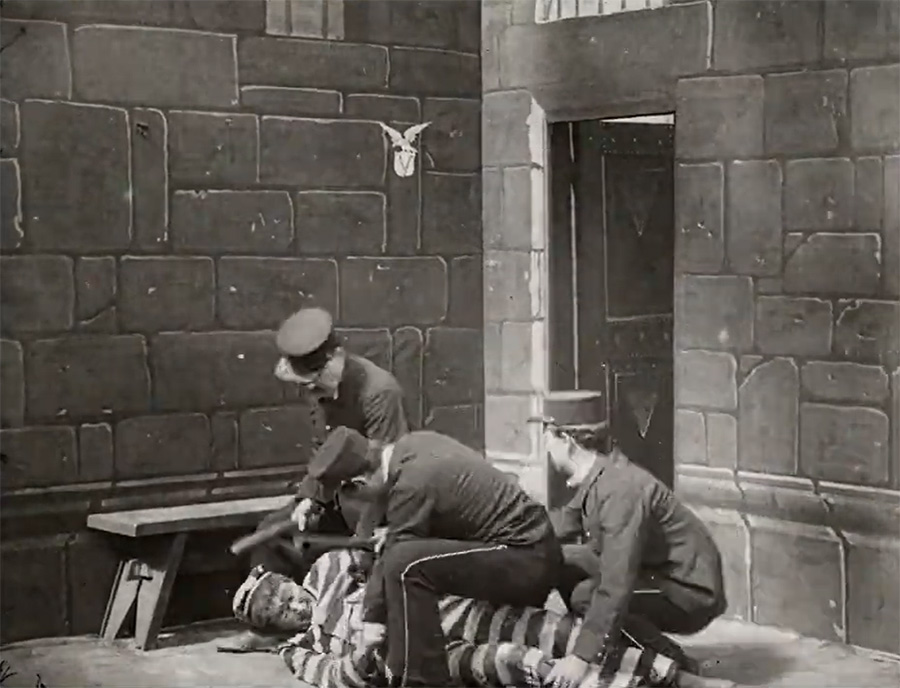
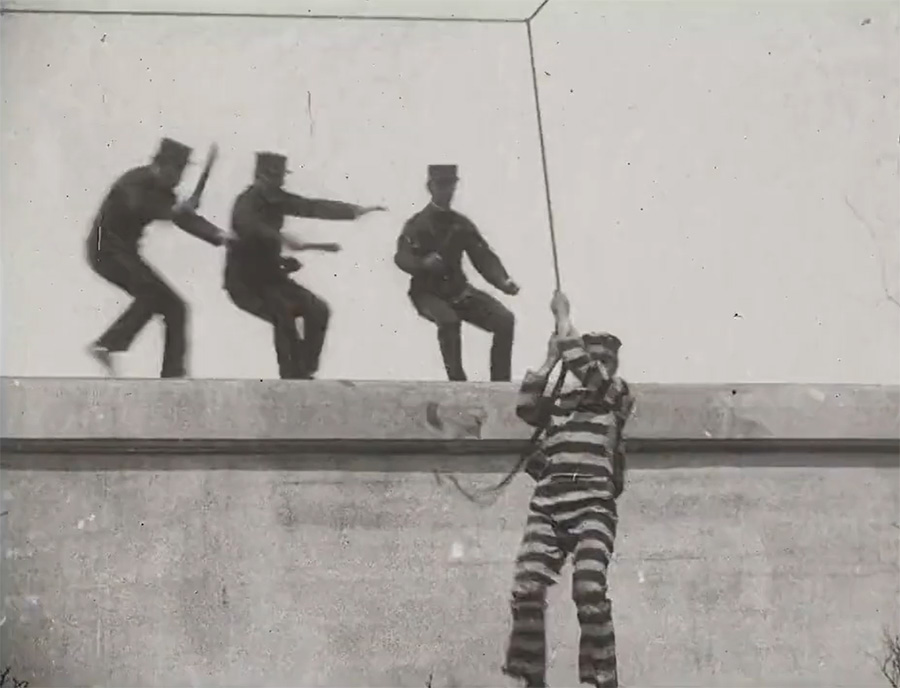
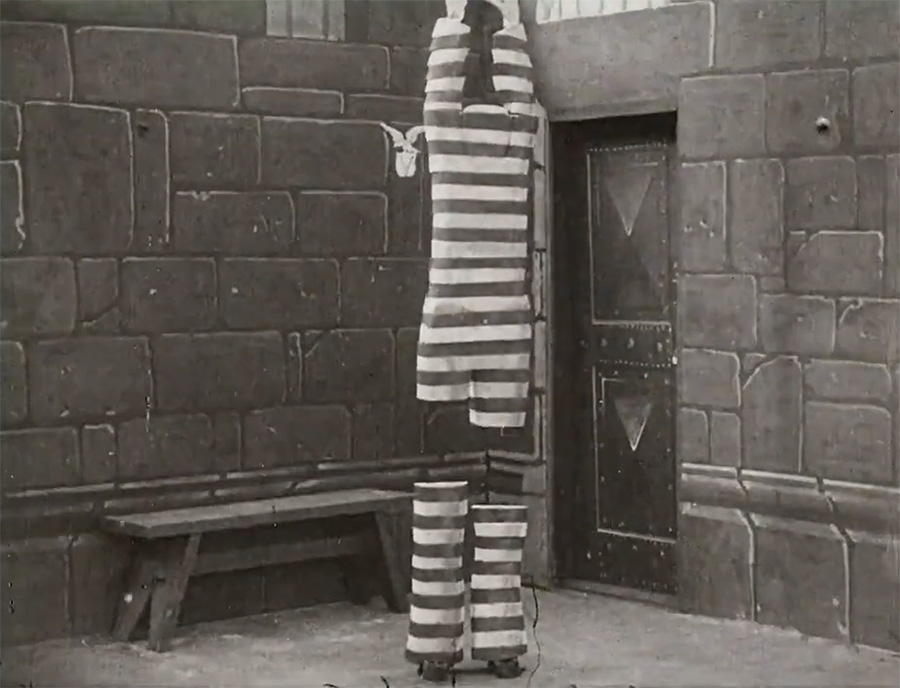
The film opens with a group of police officers beating a convict in a striped uniform. They hang him from the ceiling by his thumbs and then leave him alone in the cell with the door unlocked. After all, it’s not like he can just get down and open it for himself, right? This turns out of have been a mistake because the convict transforms himself into a wooden mannequin and slides down one stripe at a time. This is accomplished by means of a substitution cut and the slices of the mannequin being held together with vertical wires. Vitagraph would frequently use puppetry and articulation alongside in-camera effects during this period. (You can see even more elaborate examples in The Haunted Hotel, released the same year.)
The convict runs out of his cell and, with the police in hot pursuit, swings into a dining room on a rope. He dashes into the next room but the police will soon catch up. What to do? What to do? Once again, the substitution cut comes to the rescue as the convict begins to roll along the wall, printing the stripes on his uniform in what looks like a loud wallpaper pattern. The uneven paint job gives away the fact that the special effects team would have the actor roll a bit, then the camera would stop and they would paint the stripes behind him, filming would resume, repeat and repeat. Once the wall is fully painted, the convict disappears with his perfect camouflage.
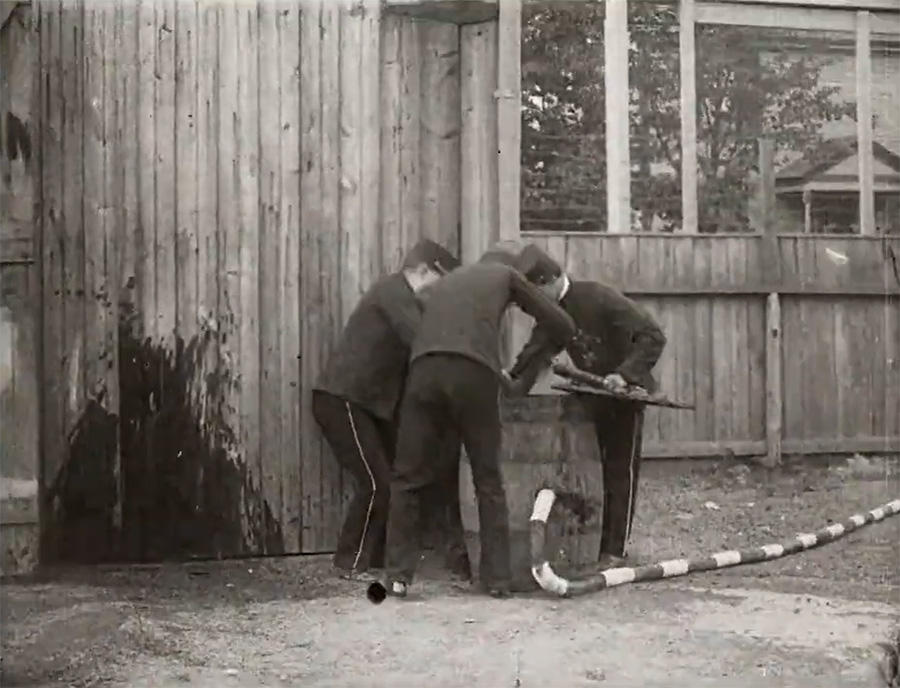
The police run right past him and he manages to escape the room but they are quickly on his heels again, so he dives into a water barrel. Surely the police have him this time! They surround the barrel and begin to bail out the water but the convict transforms himself into a looooong rope and slithers his way out of a hole in the bottom of the barrel. This is my favorite section of the film because the rope is so visually striking, the way it winds through the windows of a multi-story home is particularly memorable. There is a slight loss of continuity with a cut of the police struggling with the rope between the barrel and house sequence but I am not sure if this can be accounted for by lost footage.
The convict evades his pursuers once again and slithers back to the barrel to regain his original form. This time, the police catch up with him, so he transforms into black and white blocks. The police gather him up into a crate and return him to his cell, where he reconstitutes himself via stop motion. But why do I get the feeling that the whole scenario is about to repeat again and again?
Well, that was fun! This is a split reel picture (less than 500 feet, 6 minutes long, give or take, depending on who was cranking the projector) so the gimmick never wears out its welcome and we don’t need any kind of elaborate plot, this is just pure kinetic action. Really, what more do you need in a chase picture?
Movie reviews were not as extensive in 1907 but the picture was praised by the industry publication Moving Picture World: “A comic which has numerous surprises. A broken up man returning to himself again new conception of the film maker which attracts favorable attention.” Certainly worth the 12 cents a foot Vitagraph was charging for the picture! (Movies were still being sold outright and by the foot at this time.)
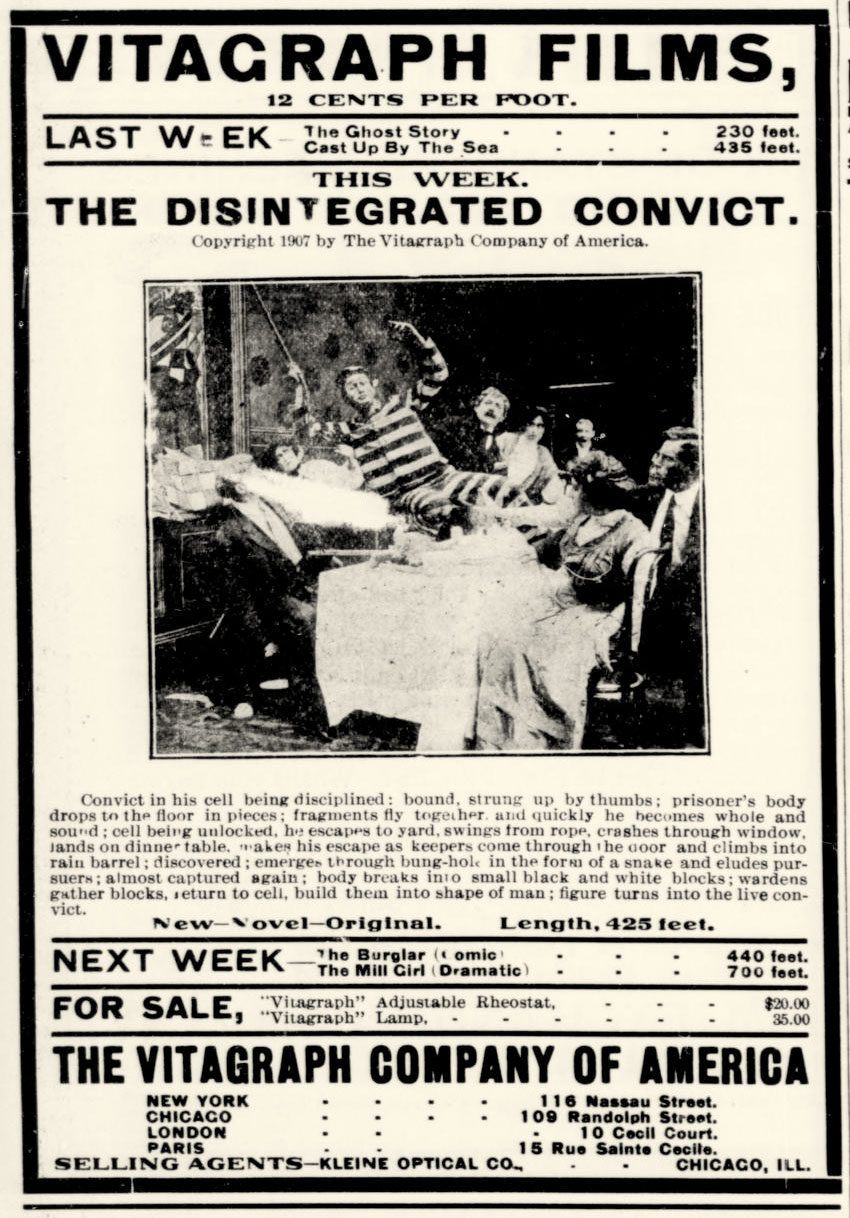
While researching this film, I found an item about it being incorporated into the variety act of the Murray Hill Theatre in New York City. It was projected alongside A Brave Maid (which I could not dig up information about but could have possibly been Indigenous themed), along with live acts that included an acrobatic terrier, a “Hebrew character impersonation,” a chorus in “handsome gauzy costumes,” and a minstrel performance of “coon songs.”
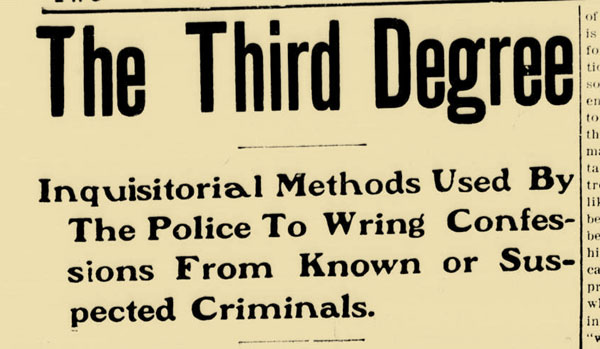
Regarding potential political content in The Disintegrated Convict, police brutality and coercive interrogations called “the Third Degree” were a subject of strong debate in 1900s United States. Some newspaper items condemned it as brutal and compared it to the Spanish Inquisition, while law enforcement personnel defended the practice as necessary for public safety. These viewers were also reflected in motion pictures at the time and The Disintegrated Convict does open with its title character being brutalized by uniformed police officers in his cell. However, the narrative makes no effort to portray the police as particularly silly and does not condemn their brutality in the narrative in any meaningful way.
That said, the film fits neatly into the well-established cinematic tradition of making monkeys out of the police. The “?” Motorist is about a motoring couple who run over a traffic cop and then escape into outer space. One of Georges Méliès’s first films, evading and On the Roofs, involves burglars evading and humiliating a hapless police officer. And, of course, the chaotic and incompetent Keystone Cops still have name recognition today. It’s no coincidence that early censorship efforts focused on the portrayal of the police and other officials. (Chicago’s infamous censorship board was originally the province of the police department.) Will Hays released his Don’ts and Be Carefuls in 1927 and included portrayals of “third degree methods” in the latter column.
So, while I do not think The Disintegrated Convict was making any statement on police violence stronger than “Hitting people is funny,” it likely would not have been terribly popular in Chief Shippy’s Chicago.
The Disintegrated Convict is a delight for all non-censors, though. The zippy pace and the creative use of established special effects ensure that the audience is kept on the edge of their seats to see just what mad bit of magic the convict will attempt next. Highly recommended.
Where can I see it?
Released on Bluray as part of Kino’s Vitagraph Comedy set.
☙❦❧
Like what you’re reading? Please consider sponsoring me on Patreon. All patrons will get early previews of upcoming features, exclusive polls and other goodies.
Disclosure: Some links included in this post may be affiliate links and I earn from qualifying purchases.

