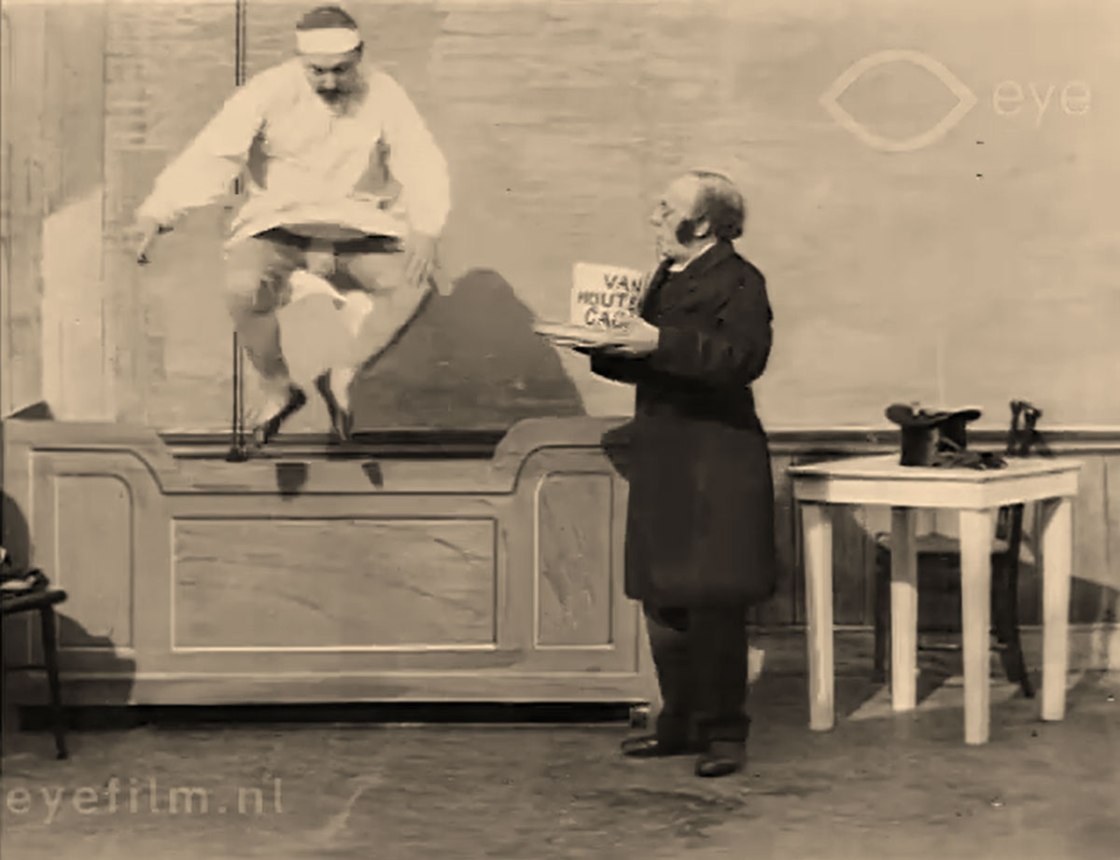
An ailing man is immediately cured when his physician shows up with a large, branded cup of hot chocolate. Early advertising film showcases how the more things change…
Home Media Availability: Stream courtesy of EYE.
Chocoholics Anonymous
One of the more surprising things about cinema of the 1890s is how early advertising films were introduced and how modern their structure. One of the earliest, the 1897 film Admiral Cigarette, uses the classic “we all have a problem together but then a company mascot shows up and distributes a product that helps all of our woes!” structure, while the ad film Dewar’s Scotch Whiskey presents a company of kilt-wearing Scotsmen merrily drinking and dancing– stereotypes and advertising have always gone hand-in-hand.
The Dutch (and much of the world) soon got in on the advertising film action, with the Netherlands arm of the American Mutoscope and Biograph Company showcasing an even more extreme version of the “this product will cure our ills” structure displayed in Admiral Cigarette. It is also an example of how projected motion pictures were being incorporated into live entertainment soon after their introduction.
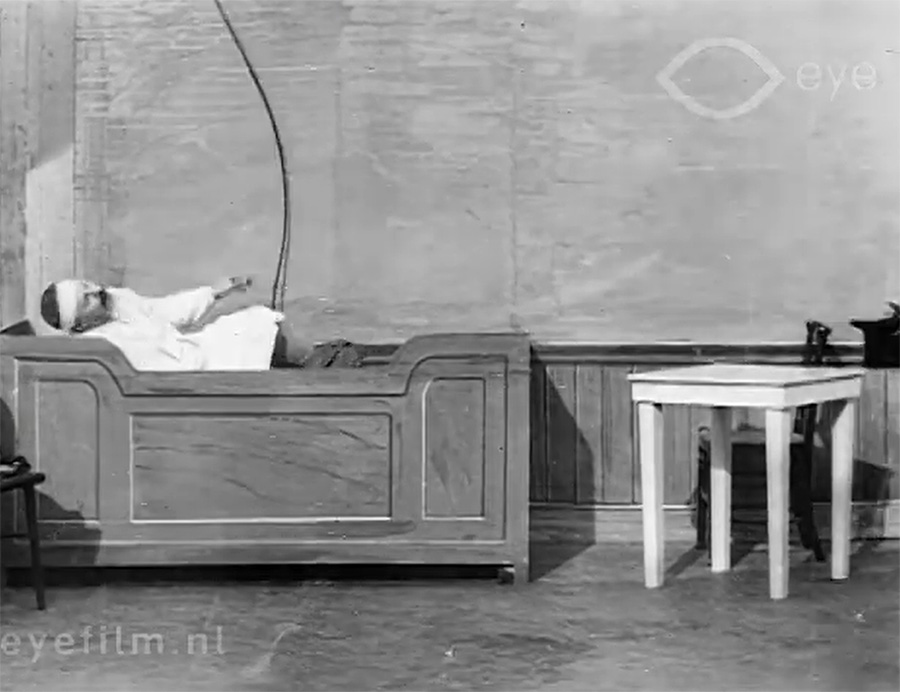
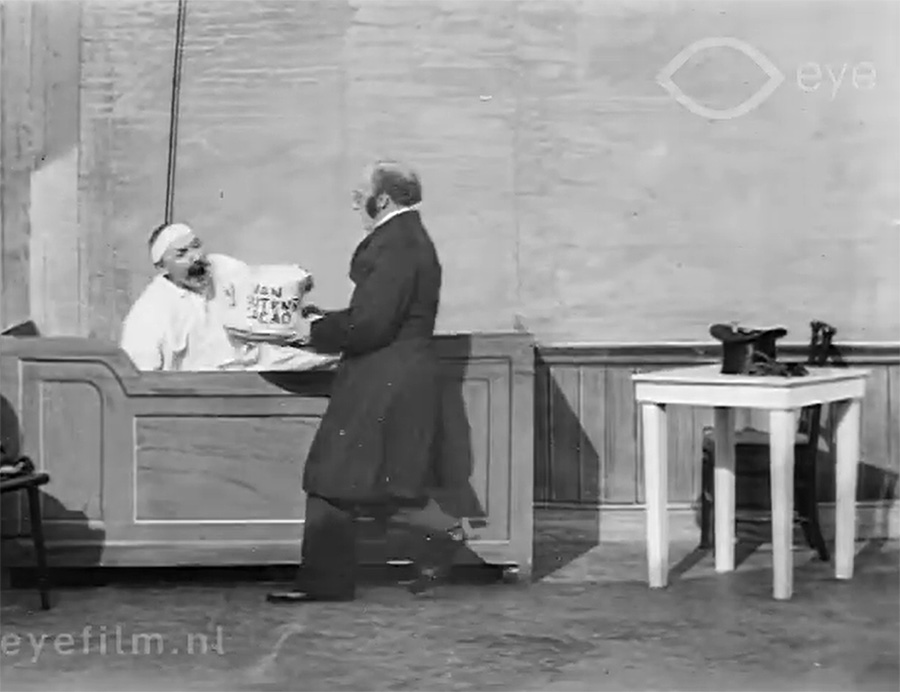
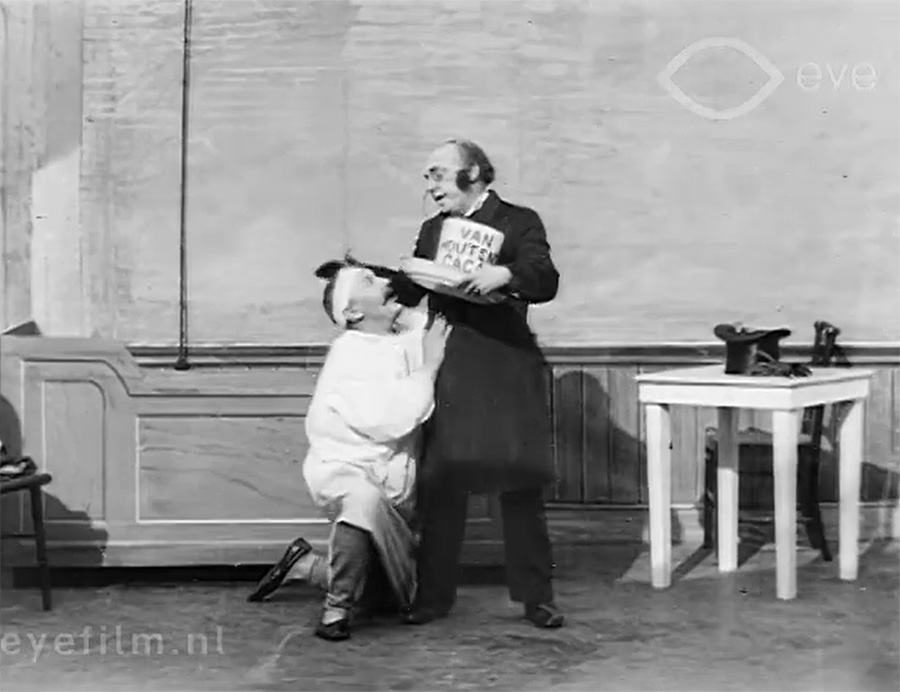
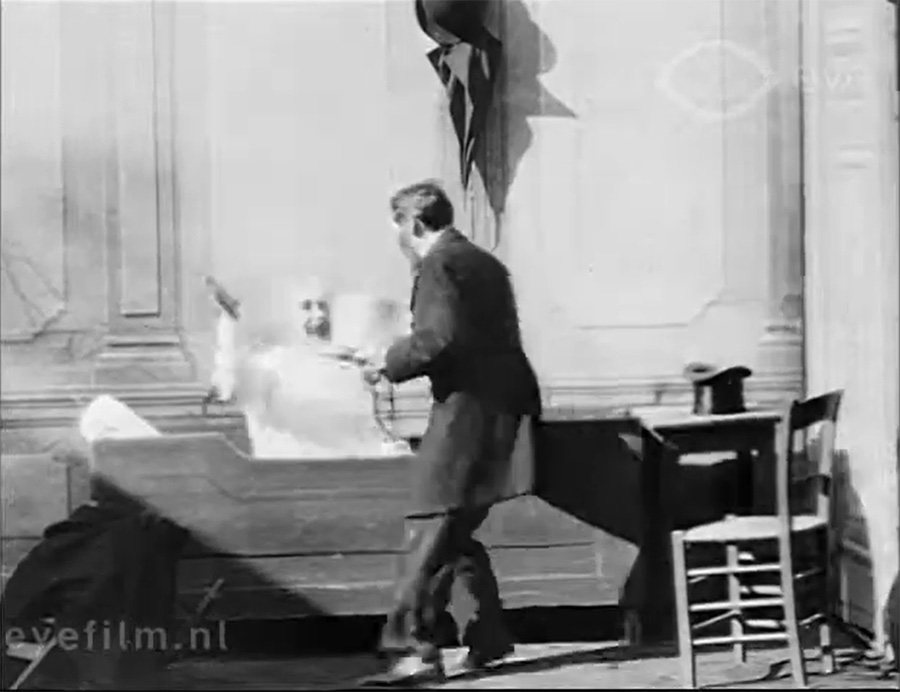
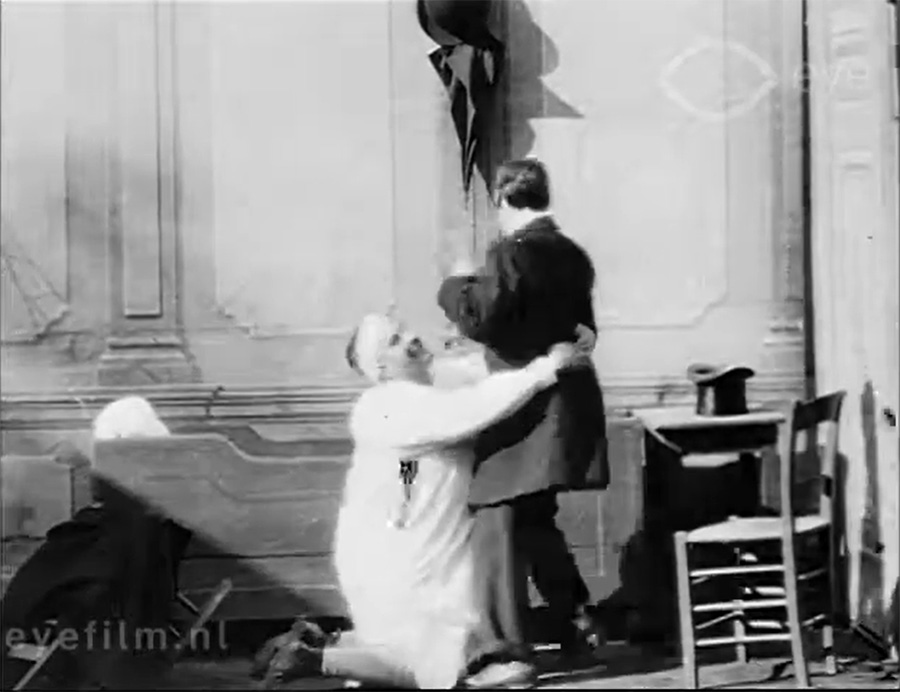
The Sick Civil Servant (1899) was shot by cameraman Emile Lauste. It opens by showing an ill man in bed suffering from his condition. A doctor arrives and sees the man’s distress. He listens to the patient’s heartbeat and then rushes out to fetch his medicine. His prescription? A two-liter branded mug of Van Houten’s Cocoa. The patient downs the chocolate, licks the equally branded saucer clean and leaps out of bed to embrace the physician. All in a day’s work!
This medical miracle was not designed to be screened solo or even as part of a dedicated picture show. It was one of seven films shot by Biograph for an “illustrated postcard congress” sequence included in the revue De nieuwe prikkel (The New Stimulation). The play tells the tale of a bachelor trying to get into a manly club that requires its members to resist the charms of women. That’s a challenge because no woman wants to look at him, so the hapless protagonist obtains a love potion– and in his adventures discovers that romance is nicer than club membership.
Tableaux were popular with professionals and amateurs alike and these short films, each of which addressed to a different official of Amsterdam, seem to be presented in that spirit. The other films in the review include brief sequences starring the main actors of the revue in character, actuality footage of local sights, and, of course, our little cocoa ad. This direct incorporation of film elements with stage goings-on proved to be popular and was used in L. Frank Baum’s Oz extravaganza The Fairylogue and Radio-Plays. We should also remember that Gertie the Dinosaur was originally intended to interact with Winsor McCay, who stood before the movie screen in the flesh. There were also less formal blends, with each theater curating its own selection of live and filmed acts.
(On a side note, I cannot imagine it would be financially viable for any theater, but I would love to see one of these hybrid movies-and-revue performances live just once.)
The Sick Civil Servant was so nice, Biograph made it twice. The 1899 film The Doctor Has the Answer is almost identical in structure but features an even more distressed patient, who lies in bed with his tongue twitching. The Van Houtens Cocoa branding does not seem to be present (this print is far fuzzier), so this seems to be a gag film rather than a commercial film. (Perhaps it is a bit of a reach, but I am reminded of the GEICO Cavemen breaking containment as commercial mascots and even getting their own short-lived television show.) Given that there is no indication of what, exactly, the miracle cure was, I wonder what audiences of the time made of it.
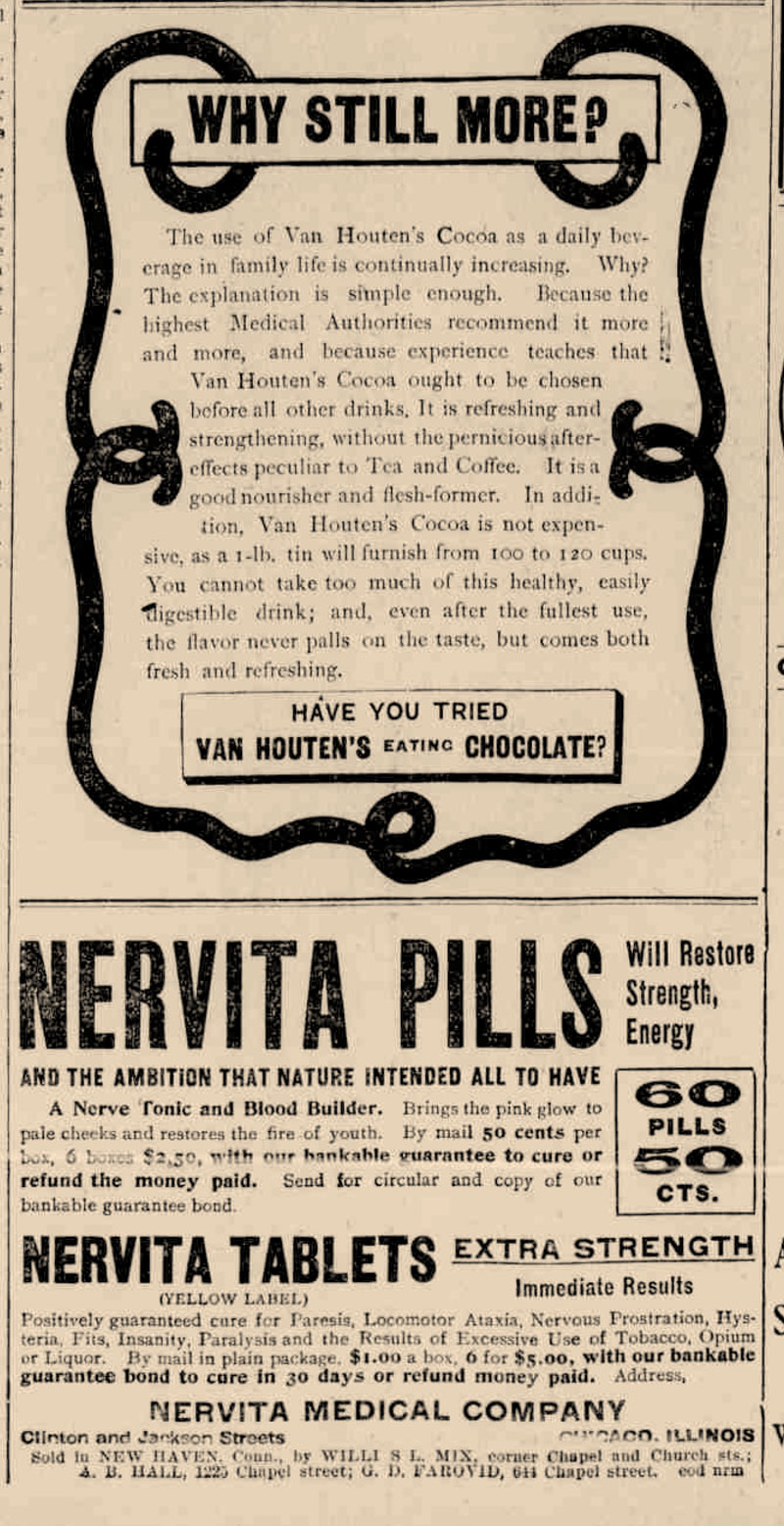
The Van Houten ad comes off as playful exaggeration to modern viewers and I am certain that it was being played for intentional comedy but at the time, the company was making health benefits a central part of its cocoa marketing. National ads printed in the United States gushed over the cocoa’s healthfulness in 1899-1900:
“The highest Medical Authorities recommend it more and more, and because experience teaches that Van Houten’s Cocoa ought to be chosen before all other drinks. It is refreshing and strengthening, without the pernicious after effects peculiar to Tea and Coffee. It is a good nourisher and flesh-former… You cannot take too much of this healthy, easily digestible drink; and, even after the fullest use, the flavor never palls on the taste, but comes both fresh and refreshing.”
The Van Houten brand had also expanded into solid chocolates and it printed similar boasts about the quality of its eating chocolate in 1899:
“Every day much harm is done by the excessive consumption of cheap confectioneries and chocolates of inferior quality, doubtful taste and doubtful composition. Why not abstain from these altogether, and substitute the digestible, wholesome Van Houten’s Chocolate (for eating)?”
At the time, food purity and safety were of paramount concern and food purity laws were the subject of both debate and legislation. Scientific cooking was gaining traction, with people believing that clean industrialization was the answer to permanent health. In short, a cocoa brand claiming that it was a medicine was only a slight exaggeration of the claims they were already using to sell their wares. Of course, my resources are American newspapers of the period, so any Dutch readers with insight into the ad campaigns running in the Netherlands should feel free to chime in.
(And, in fairness, hot chocolate, in addition to other calorie-dense foods, was subsequently used by Arctic explorer Roald Amundsen to keep his polar team plump and healthy. They actually gained weight during their successful push.)
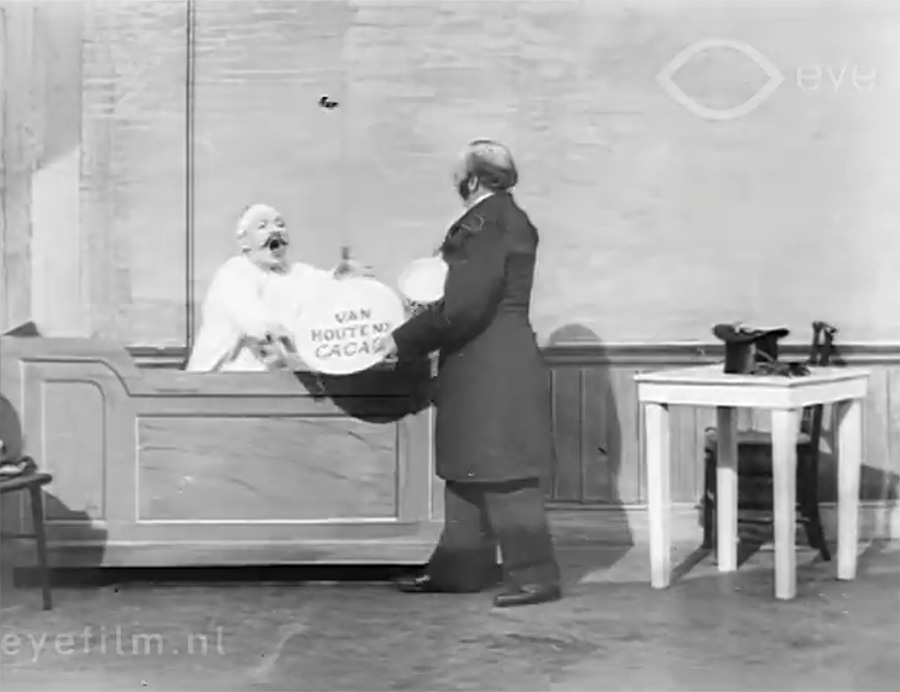
A lot of things have changed in the three decades since The Sick Civil Servant and the other 1890s advertising films were released but there is some comfort and much amusement in seeing how little the filmed ad has changed since. Instead of purity and health, modern brands might brag of their low carbs or high protein (or whatever trendy nutrient has captured the public imagination) but The Sick Civil Servant could easily be used today by simply substituting a different product.
Or keep the Van Houten branding, as they are still in the chocolate and cocoa business.
Where can I see it?
Stream both the branded and the unbranded versions courtesy of the EYE Filmmuseum.
☙❦❧
Like what you’re reading? Please consider sponsoring me on Patreon. All patrons will get early previews of upcoming features, exclusive polls and other goodies.
Disclosure: Some links included in this post may be affiliate links and I earn from qualifying purchases.

