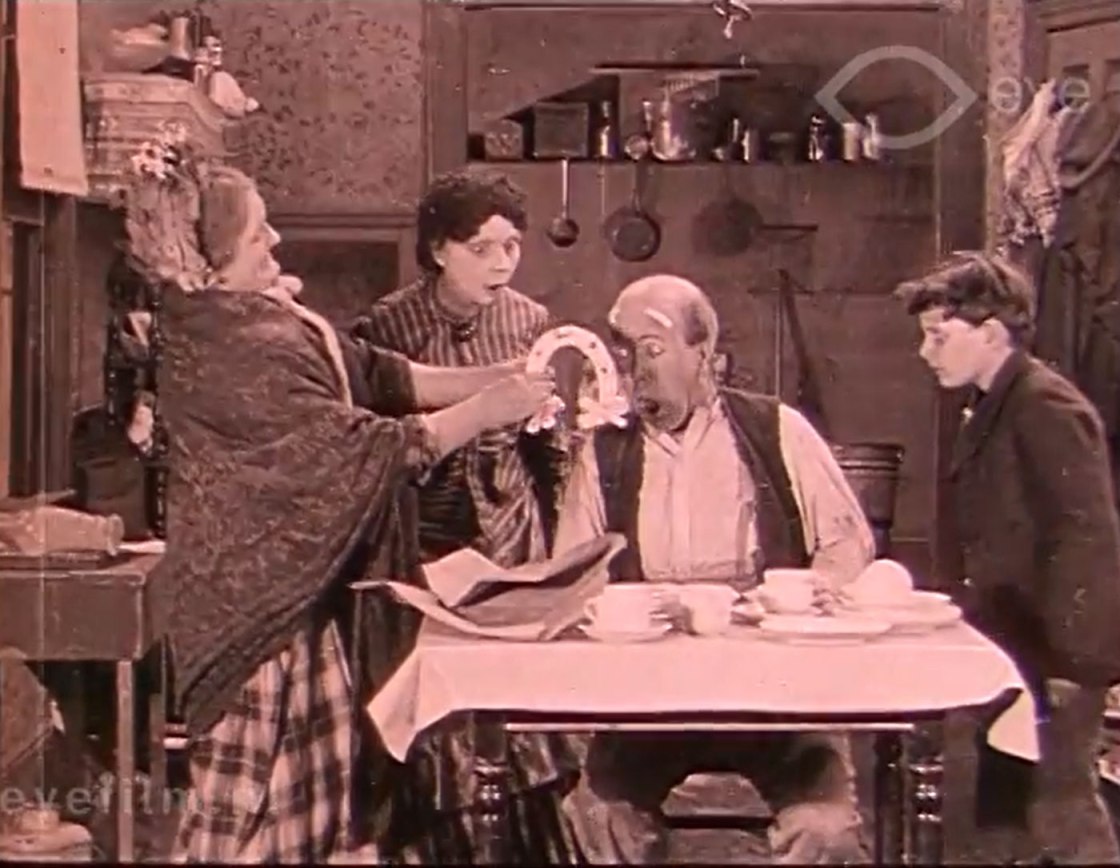
An Irish American woman finds a lucky horseshoe and brings it home, only to discover that it has lots of luck– bad luck!
Home Media Availability: Stream courtesy of EYE
Wild, reckless, indolent, uncertain and superstitious
The American film industry had its own Irish Question in its first few decades of production. Irish stereotypes were socially acceptable and commonplace but Irish Americans and Irish Canadians, including Mary Pickford and Mack Sennett, were rising in cinematic prominence. Irish audiences had money to spend and liked seeing themselves on the screen. But the siren call of an ethnic gag was sometimes too much to resist.
This push and pull would persist into the feature era and into the talkies as well. (I cover Irish jokes as movies in my review of How Bridget Served the Salad Undressed, Irish activists fighting stereotypes in my review of Castles for Two, and the long tail of the Irish-Jewish wedding novelty song onscreen in my review of The Shamrock and the Rose.)
How a Horseshoe Upset a Happy Family was released by the Edison film company in 1912. To place this in context, the American Kalem company was actively sending a film team annually to Ireland in order to capture local color and take footage of the old country for eager Irish immigrant audiences back home. How a Horseshoe Upset a Happy Family was a split reel comedy, meaning it shared a reel with another film. (He Swore Off Smoking, a pro-nicotine comedy, in this case.) At the same time, Edison was heavily marketing its own version of Kathleen Mavourneen in two reels. That film, as described in Edison’s copyright application, portrayed an Irish peasant woman abused and betrayed by an aristocratic lover. It looks as though Edison, like most of the film industry, was hedging its bets.
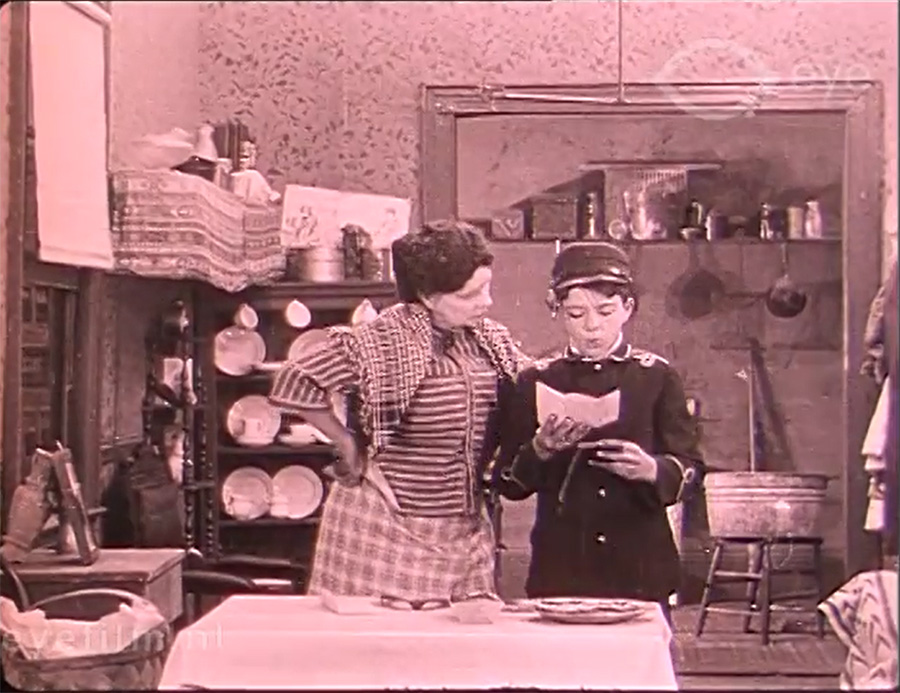
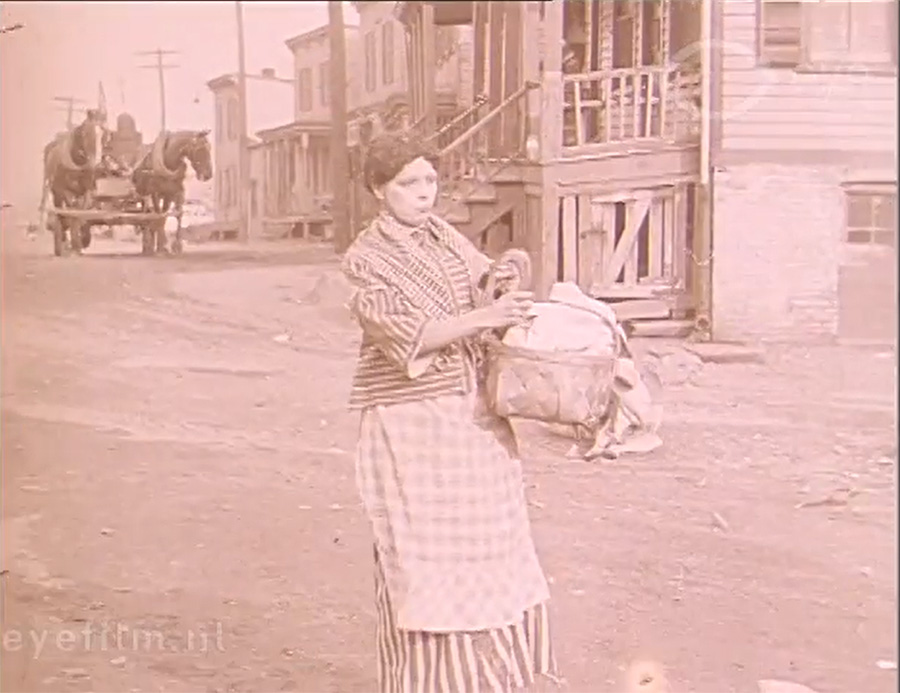
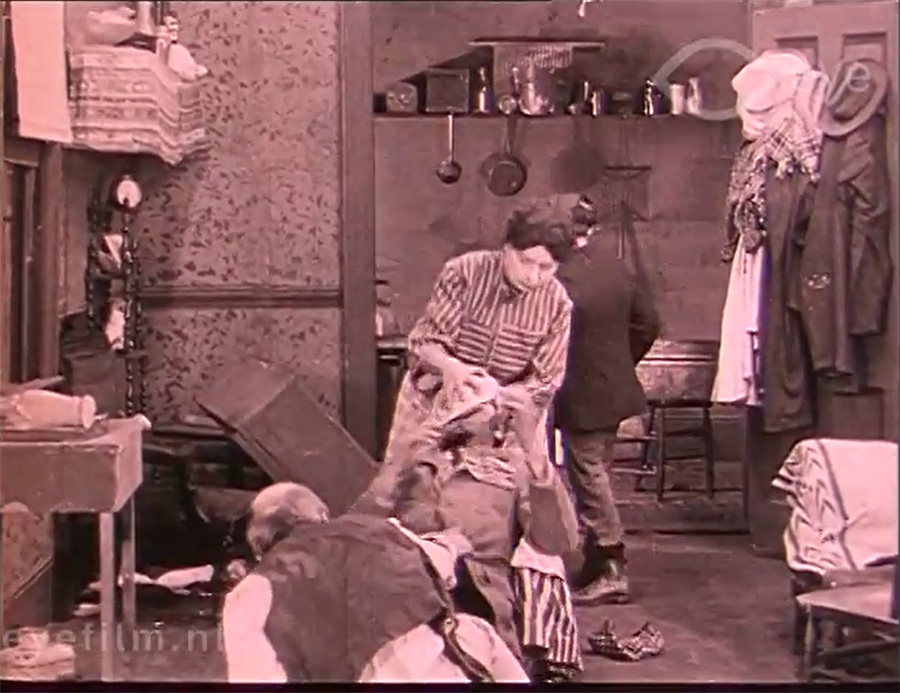
The film opens with Mrs. Murphy (Alice Washburn, not to be confused with the architect) finding a horseshoe while out doing her shopping. A lucky find! She brings it home intending to hang it in the small family apartment. A messenger arrives with a telegram. The first stroke of luck? Hardly. The messenger boy has to read the telegram as Mrs. Murphy is illiterate and her face falls as she listens. It’s her mother saying she is coming for a visit.
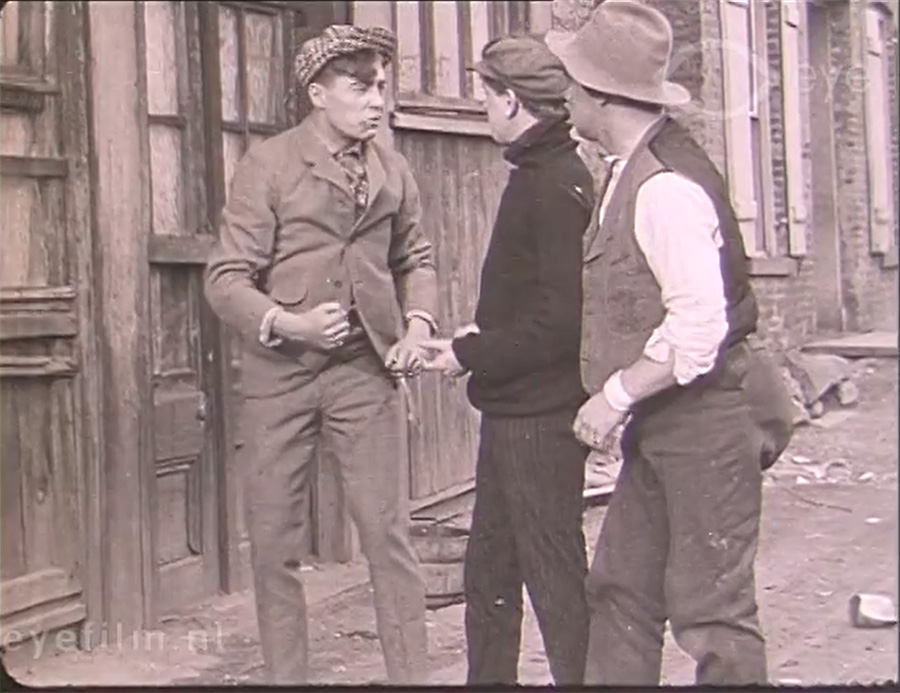
Mr. Mike Murphy (Edward O’Connell) arrives home and is annoyed by both the upcoming visit and his wife insisting on hanging the horseshoe, especially when she breaks a mirror in the process. Mike throws the horseshoe out the window and it hits Flanagan (future Laurel and Hardy regular drunk actor Arthur Housman), who is shooting craps on the sidewalk below. Flanagan storms up and fights Mike, knocking over the apartment china cabinet. Mike doesn’t stand a chance but Mrs. Murphy attacks Flanagan with a frying pan and smashes a pie into his face, running him off. As the Murphy family cleans up the mess, mother-in-law (Mrs. William Bechtel) shows up with a gift… a horseshoe festooned in ribbons.
How a Horseshoe Upset a Happy Family is pretty typical rough slapstick for the era, even using the classic weapons of comediennes: a frying pan and a pie. The only thing missing is a rolling pin! Everyone plays their parts broadly but that is to be expected in this genre of comedy. The Sennett company was already tearing up the place with their antics, the only option was to match them pie-for-pie or go for counterprogramming with subtler domestic humor.
The family in the film is unambiguously Irish even without the intertitles providing their names. A somewhat disheveled woman in an apron and out-of-fashion Victoria-esqye slicked down, middle parted hair was code for an Irish character in the movies. (You can see this with the Irish domestics portrayed in The Suburbanite and A House Divided.) Add to that the temperamental Mike Murphy and Flanagan and we have basically hit most of the stereotypes in then-current use.
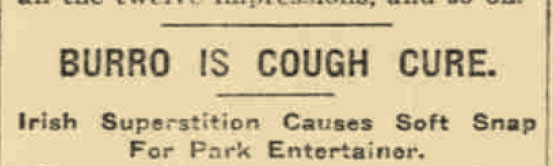
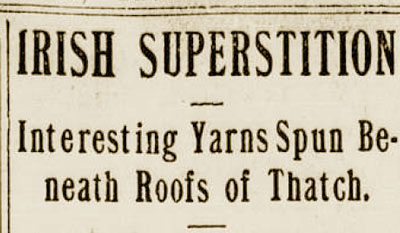
The centerpiece of the film is, of course, superstition. I think it’s fair to say that all of Europe and North America were having quite a time with the strange, eerie and occult at the time but the stereotype of Irish superstition was far older. Benjamin Disraeli listed superstitiousness in his infamous anti-Irish letter to the Times and, seven decades later, American newspapers included regular items detailing the folk superstitions of Ireland. These included gathering fern seeds to render oneself invisible, fasting and sitting on the church steps to experience visions of who would die in the coming year, and passing over and under a donkey three times will cure whooping cough.
(The last one seems to have been invented by the owners of a small donkey named Bube, who could be hired out for riding in New York’s Central Park but had gone into semi-retirement as a whooping cough cure.)
As with most things related to the Irish in the United States, the craze for Irish folklore and superstition seems to have been equal parts admiration and scorn, depending on who was doing the writing. It’s worth nothing that How a Horseshoe Upset a Happy Family was written by an English actress in the Edison employ, Louise Sydmeth. Edison did not credit anyone it didn’t have to but it prominently advertised her authorship of the scenario.
We don’t know Sydmeth’s attitude toward the Irish but we do know the popular English sentiment toward the Irish and superstition. Seumas MacManus, author, poet and advocate for the Irish folklore tradition, wrote a piece on the subject in 1906 that was picked up by American newspapers. The pertinent passage:
“To the English mind, Ireland is ever the home of superstition, and any tale howsoever wild told anent our Irish barbarous beliefs finds ready credence in the English press. Good, upright superior people, however, might turn their eyes inward. Superstition has not quite died out in England yet. There are tracts of that highly cultivated country wherein the belief in witches is as living a thing today as was when the forefathers of the present English peasantry danced round witches at the stake. The police court sometimes brings this to light, and sometimes the coroner’s court. At Scarborough the other day an inquest was being held upon a child that died of neglect. The mother testified that the child was bewitched by one of the neighbors and never thrived after. If a poor Irish woman had been found guilty of allowing her child to die upon the score of its being bewitched every English paper from the Times downward would be turning up their editorial eyes in horror at Irish barbarity and superstition, and reading us homilies several columns long.”
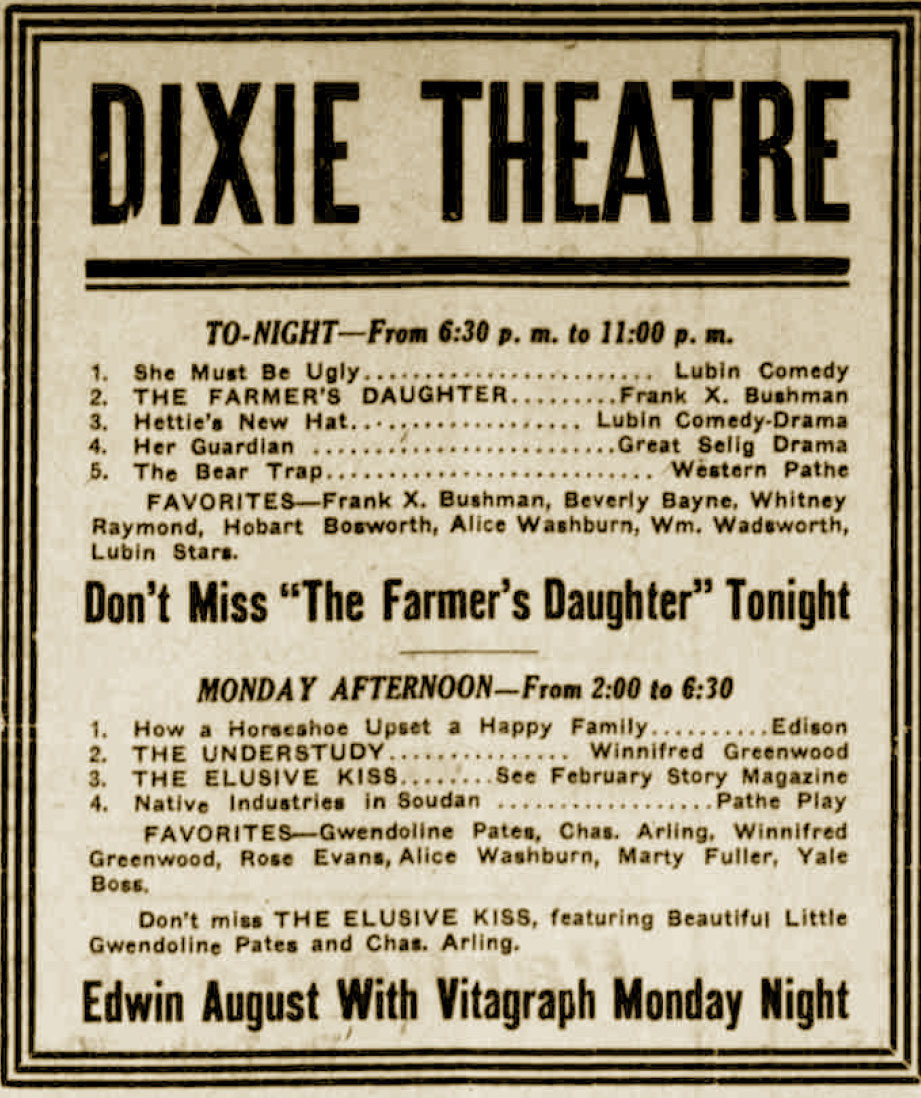
How was the comedy of How a Horseshoe Upset a Happy Family received? Unfortunately, there is no record of audience response and split reel comedies were not heavily covered beyond a brief synopsis in the trade press. It was shown across the United States as part of a film program and one Texas theater relegated it to the less prestigious afternoon matinee. (The evening crowd saw Francis X. Bushman.) The surviving print is Dutch and it retains the Irish surnames of its characters, notably.
How a Horseshoe Upset a Happy Family is fairly typical of the era’s slapstick output: a bit of smashed crockery, a pie to the face, and a punchline, plus a dose of ethnic humor that doesn’t exactly translate to the modern palate. It was always intended to be ephemeral and its survival was a matter of sheer luck, ending up as it did in the biggest Dutch silent film collection. I wouldn’t say go out of your way to see it but if you wanted to take a peep at what non-Keystone American slapstick was up to in 1912, this is a good choice.
Where can I see it?
Stream for free courtesy of the EYE Filmmuseum. The intertitles are in Dutch but the plot is easy enough to follow.
☙❦❧
Like what you’re reading? Please consider sponsoring me on Patreon. All patrons will get early previews of upcoming features, exclusive polls and other goodies.
Disclosure: Some links included in this post may be affiliate links and I earn from qualifying purchases.

