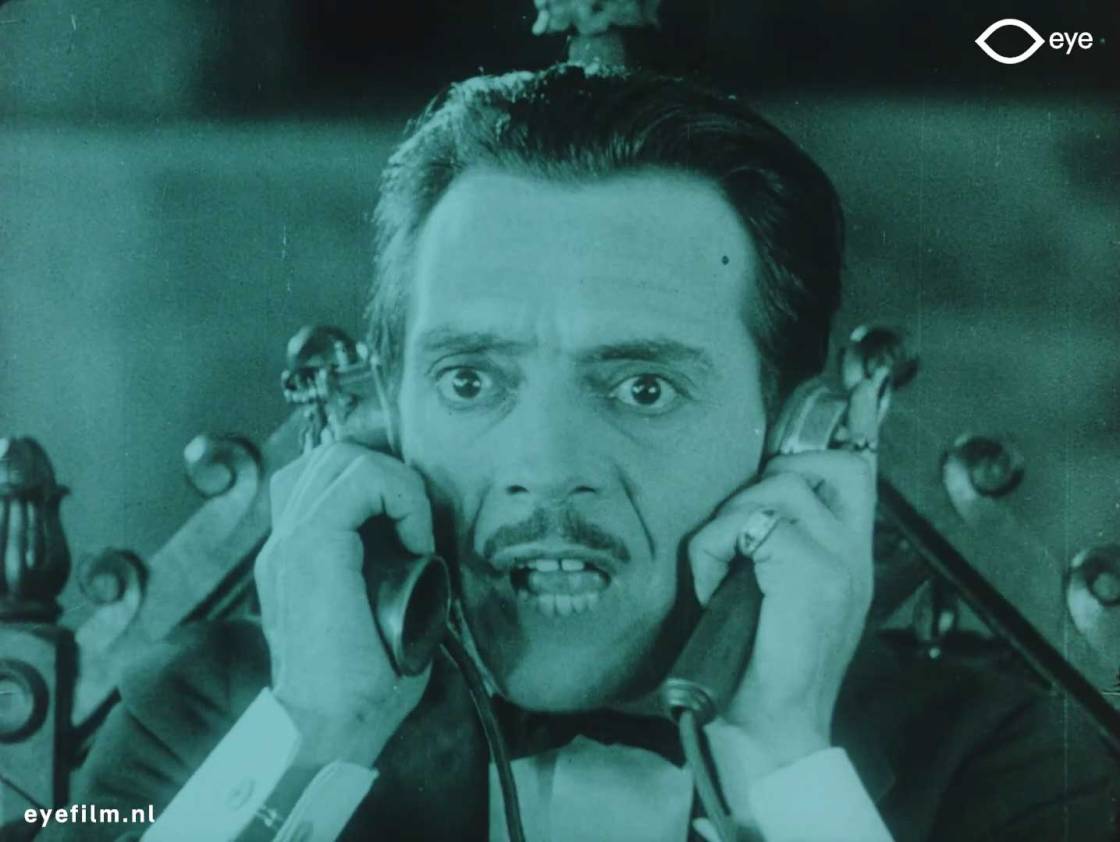
Max Linder and Abel Gance join forces for a quick and cheap horror-comedy about a man who bets he can spend a night in a haunted mansion. Experimental and off-the-cuff, a chance to see Gance attempting humor.
Home Media Availability: Stream courtesy of EYE.
Push the button, Max!
It was a French silent era dream team: Max Linder, one of the very first film stars, and Abel Gance, revered director, were friends and one evening, while dining together, they got onto the subject of haunted houses. Gance recounted in The Parade’s Gone By that Linder was open to making such a film with his friend but felt it would be too expensive. Gance countered that they could make it in six days for the fun of it.

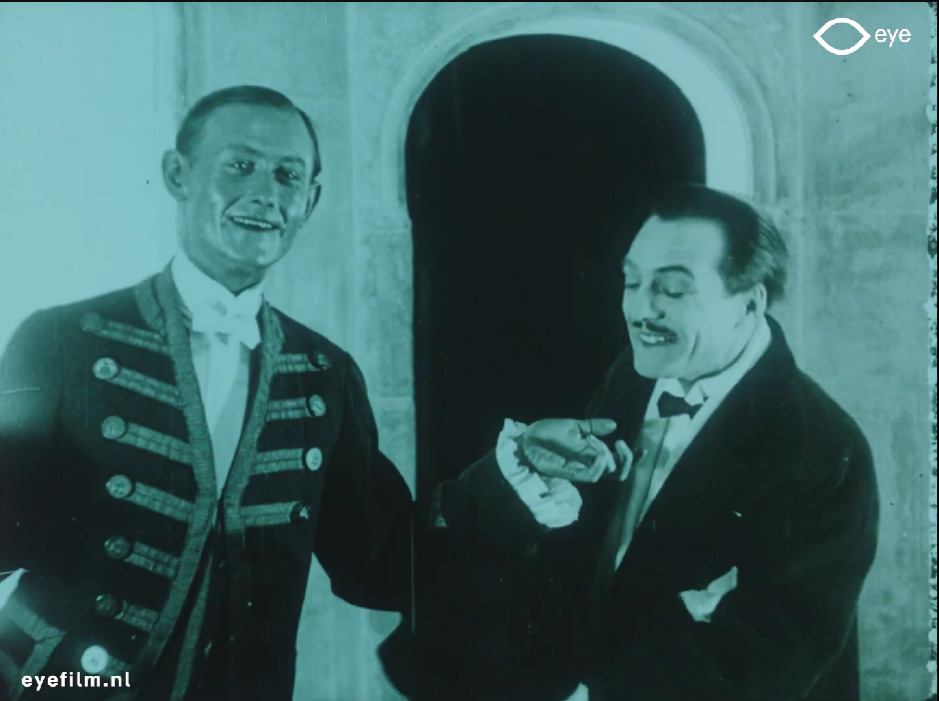
Help! was the two-reel result of this collaboration.
The short film has a classic plot: Max Linder accepts a challenge from Count Maulette (Jean Toulout) to stay overnight at his chateau alone. A telephone will be provided but if Max uses it even one minute before the deadline, he will lose and forfeit his wager of 5,000 francs. Max declares that the bet will be for 10,000.
(For anyone curious about the amount of money being wagered, 10,000 French francs are about $8,600 in modern dollars, give or take. So, for the purpose of the narrative, about the same amount. More than an average householder would wager but chump change for the smart set.)
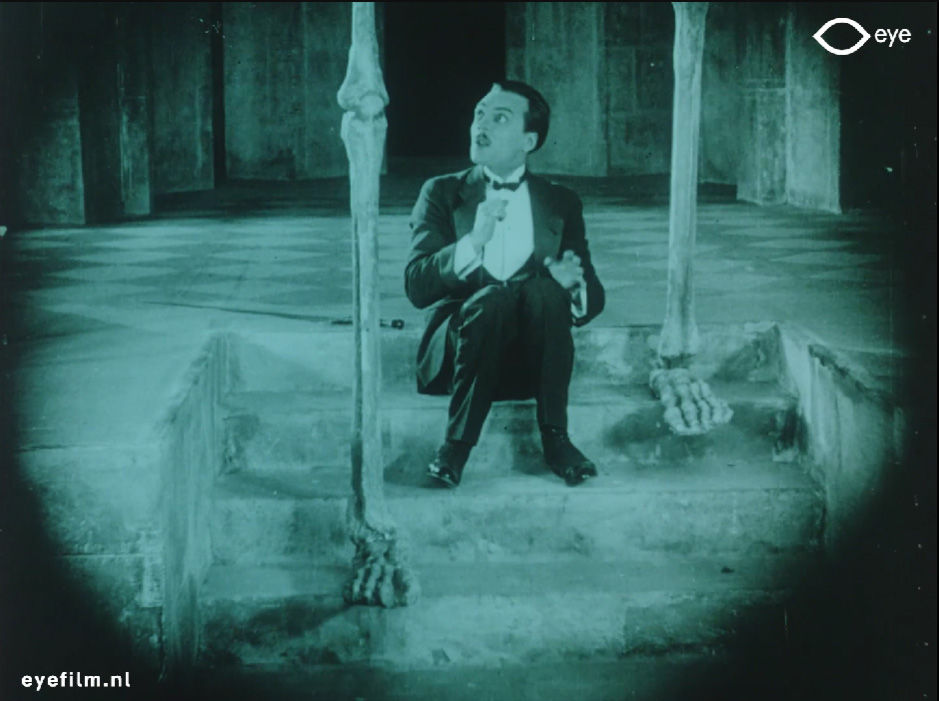
Max enters the chateau and is met with horrors and cinematographic wonders as the camera distorts and undercranks, tossing our hapless hero to and fro. There are living mannequins, skeletons, headsmen and swords falling from the ceiling. (Max tries to shield himself with a handkerchief.) However, he is able to hold out for the entire night, until he receives a call from his wife (Gina Palerme) telling him that there is a man in her room trying to kill her.
Watching Help! I inevitably thought of another Gance attempt at genre comedy, The Madness of Dr. Tube. It’s a long story but briefly, in 1915, Gance was given carte blanche to make any film he liked and he chose a sci-fi comedy. The studio didn’t actually mean “anything” as it turned out and Gance was deeply disappointed by their dismissal of his picture. The nasty sting to the story is that The Madness of Dr. Tube is a bad movie, aggressively unfunny and tedious.

Sympathy for Gance mixed with the realization that he was truly bad at what he attempted makes The Madness of Dr. Tube a strange viewing experience. It was easy to see why Gance wished to try his hand at the genre: France was a haven for science fiction and contemporary filmmakers like Jean Durand mixed slapstick and sci-fi with ease. René Clair would conduct a similar, more serious experiment with The Crazy Ray and The Phantom of the Moulin Rouge.
Gance had completed the massive La Roue when he made Help! and he was about to embark on his most ambitious film yet, Napoleon. (Skipping over all of his planned projects that did not come to fruition.) Sandwiched between these behemoths, there was an itch that he had to scratch. The genre comedy still beckoned.

I absolutely love the Old Dark House genre, so did silent era audiences and clearly so did Gance. Early filmmakers in general and French early filmmakers in particular embraced it wholeheartedly with titles like Georges Méliès’s The Haunted Castle (1896) and Albert Capellani’s The Bride of the Haunted Castle (1910). Old Dark House comedies were equally popular with Harold Lloyd and Buster Keaton both making their own spins on the tropes in the early 1920s.
The genre was a hit on the stage as well, with George M. Cohan satirically scaring the pants off his audience with Seven Keys to Baldpate, which he personally brought to motion picture screens in 1917. Cohan wasn’t the only creepy mystery monger (Mary Roberts Rinehart was just as successful with her iconic The Circular Staircase/The Bat) but his play and film were likely somewhat of an inspiration for Gance and Linder.

Like Help!, Seven Keys to Baldpate was designed to deliver thrills and humor in equal measure, a kind of self-aware sendup of popular horror cliches that every subsequent generation is sure they invented. And, like the French production, Seven Keys to Baldpate opens with a time-limited bet, $5,000 dollars at stake if the protagonist can write a popular novel in twenty-four hours.
We have discussed Abel Gance at length but Max Linder was no stranger to dark comedy. The Man Who Hanged Himself (1906) involves Linder dangling from a noose for the majority of the picture while incompetent authorities flail around. Much later, his 1922 comedy Be My Wife portrays him attempting to shoot his partner when he mistakenly believes she is unfaithful. These journeys into the bleakest corners of human nature had a real world parallel as Linder and his wife died in either a double suicide or a murder-suicide a year after Help! was released.
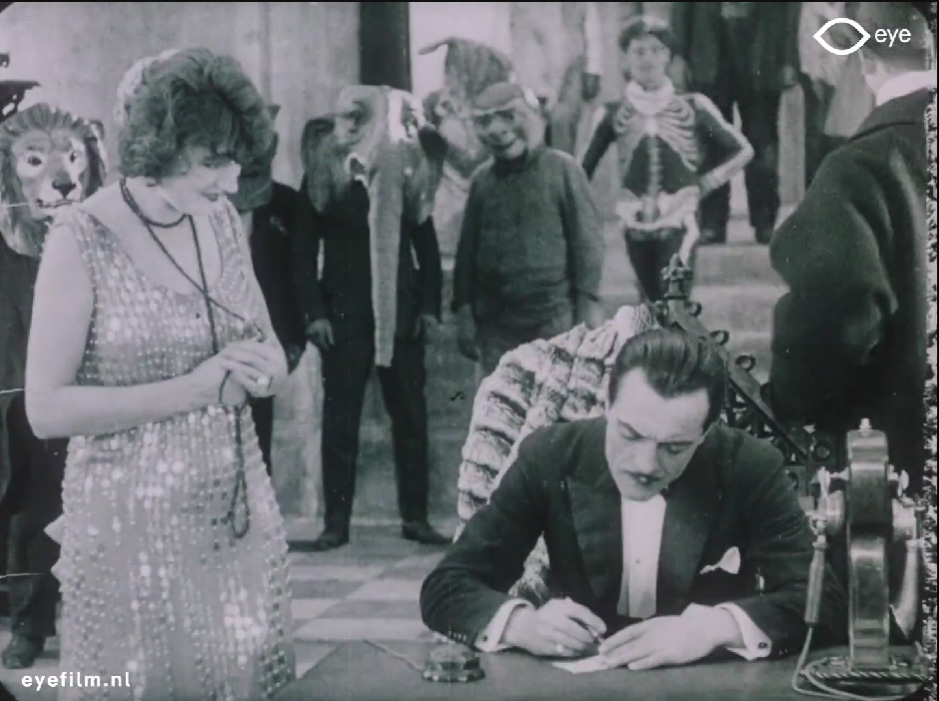
Themes of paranoia and manipulation are rife in Help!, as is often the case with comedic Old Dark House pictures. While earlier examples gleefully embraced the supernatural, the later silent era demanded either a Scooby-Doo reveal or the revelation that it was all a dream. In this case, Maulette has stacked the deck against Max, with all the ghosts and ghouls being well-paid performers, as is the man sent to terrorize his wife.
I think the main flaw of Help! is that it is neither here nor there. It doesn’t really commit to being fully surreal madness—its frame story is too normal, too Baldpate—but it also is too weird for everything to be explained within its own narrative logic or lack thereof. Some cuts of the film include the count confessing that his house is a white elephant and this is how he pays for its upkeep.
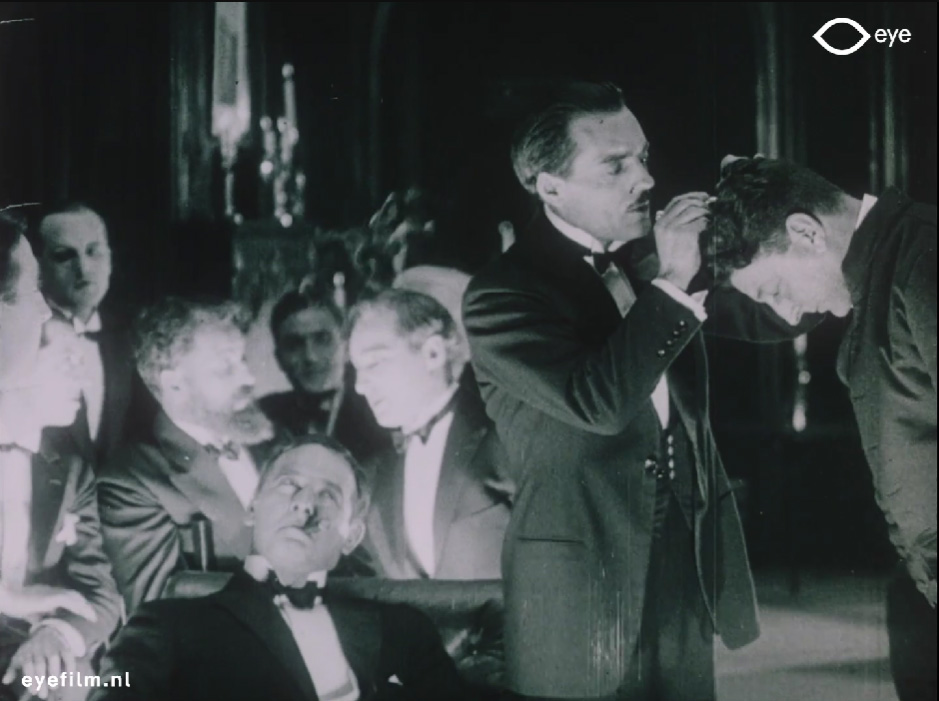
I am very much in favor of madness for the sake of madness but this just seems like an awful lot of work on the part of Count Maulette—not to mention the cruelty of staging an attack on Max’s wife— when he could simply open a themed cabaret with all the actors, props and sophisticated special effects he has rigged up. Far more profitable with no death threats needed. I never thought I would long for a hoary “it was all a dream” denouement but here we are.
For all its narrative flaws, the picture is quite lovely with some moody shots, an especially nice approach to the castle, as well as a few laughs provided by goofy sight gags such as a giant skeleton ghost stalking off with a tiny mini ghost scampering behind. Linder himself has some moments of humor as he tries to explain away the bizarre sights that surround him but generally, he was at his best when he could be light as a feather and the more trivial his troubles, the funnier he was. I was not amused seeing him terrorized by threats to his wife but seeing him lose his cool over cooking a chicken in Troubles of a Grass Widower slayed me.

That’s not to say Linder couldn’t handle the genre, just that the way the genre is presented doesn’t make the most of the Max we know and love. Max fleeing from being decapitated is simply not as funny as Max perturbed by a mannequin coming to life and turning to wax once again.
A rushed production is often considered a hindrance but some directors had to put their skates on out of necessity (Oscar Micheaux, for example) and created memorable and personal works that screen almost like a stream of consciousness. Gance’s theory was sound, as was his six-day production schedule. There wasn’t a lack of talent. It just doesn’t really work.
In the end, my opinion of Help! is very similar to my opinion of The Madness of Dr. Tube: I understand what Gance was doing and why, I sympathize with his motives and his desire to create the kind of cinematic cream puffs that were so very popular among his contemporaries. I understand it all. The issue at hand is that Gance’s comedies are simply not funny. A few jokes land but most are just tedious. Jean Durand couldn’t have made Napoleon but Abel Gance clearly could not have made Onésime vs. Onésime.
This is a significant picture, two major French artists at play. It’s an interesting picture. It’s a technically impressive picture. But good? No, I can’t say it is either fun or enjoyable. It just… is. Gance completists will find a lot to interest them. Max fans will want to watch his penultimate effort. However, for more casual viewers, I am not sure how much value this film will provide them.
Where can I see it?
Stream courtesy of EYE. It’s a shorter cut that many of the available prints but has its tinting intact.
☙❦❧
Like what you’re reading? Please consider sponsoring me on Patreon. All patrons will get early previews of upcoming features, exclusive polls and other goodies.
Disclosure: Some links included in this post may be affiliate links to products sold by Amazon and as an Amazon Associate I earn from qualifying purchases.
 Movies Silently