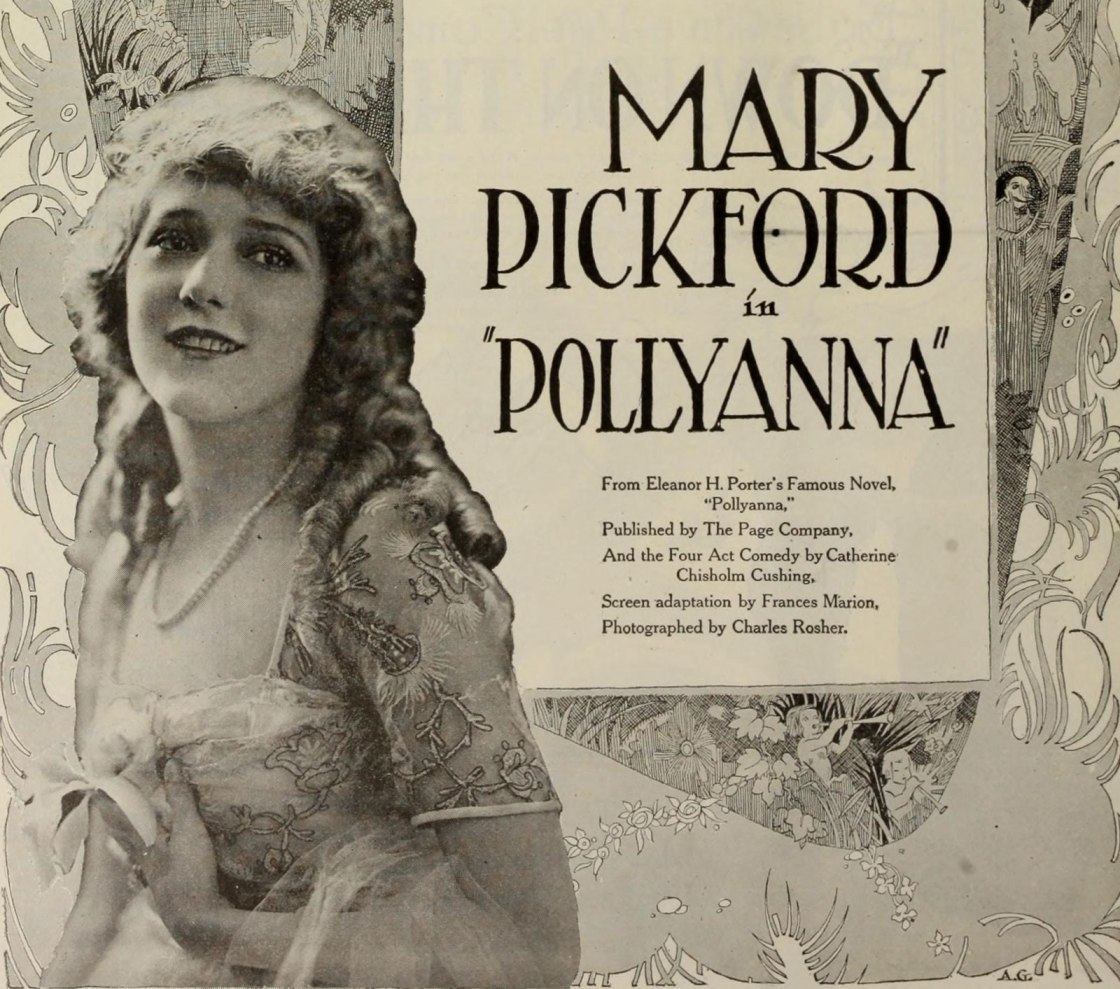
The infamously upbeat story of a child who is glad of everything adapted for the screen by producer-star Mary Pickford and screenwriter Frances Marion, with both attempting to tone down the sugar.
Home Media Availability: Released in the bargain DVD space
I’m glad I broke my legs!
When Mary Pickford, Douglas Fairbanks, Charlie Chaplin, and D.W. Griffith co-founded United Artists in 1919, it was an unprecedented opportunity for four of the biggest names in American cinema to make movies under their own terms and on their own dime. The problem was that all had been under contract with other studios with various expiration dates and, of the four, the only one at liberty to make movies in the first year was Douglas Fairbanks. With Doug plugging away in his popular adventure comedies and a couple of Griffith films purchased for distribution, United Artists was a working studio but hardly full steam ahead.
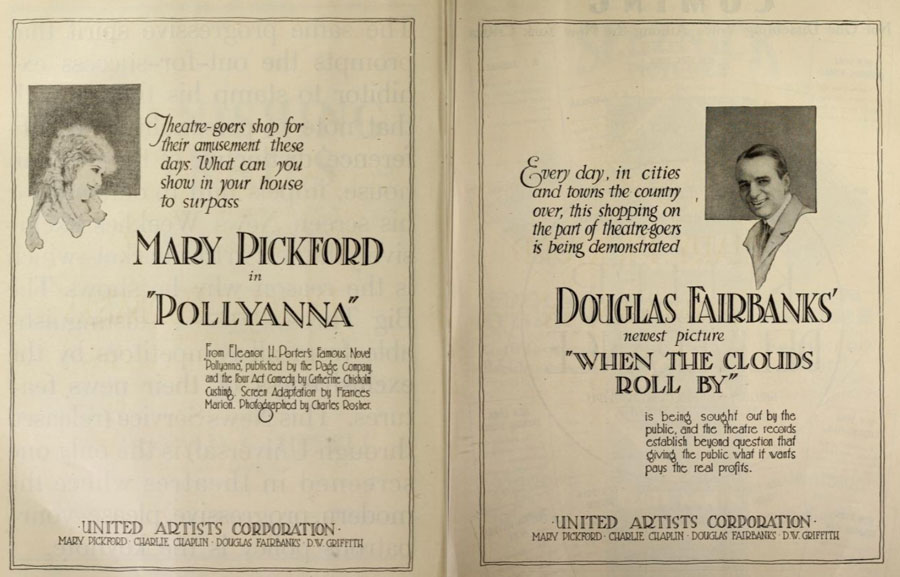
Mary Pickford was the next to be freed and she immediately set to work to support the studio and lend a hand to Fairbanks. Pickford had scored a major hit playing a child in The Poor Little Rich Girl back in 1917 and the public loved to see her as a little girl but she hoped to expand her skills. She had played double roles as a beautiful invalid and a homely avenging angel in Stella Maris and running her own studio would provide further opportunities.
However, that kind of thing would have to wait because United Artists needed money and Pickford could get the public to give them fistfuls of it if she would just keep her hair in curls and wear pinafores. Pickford was a businesswomen, she knew what had to be done, she put on the pinafore. “One for them, one for me” was a stardom strategy even in that first decade of movie stars and, as her own boss, Pickford saw the wisdom of continuing.
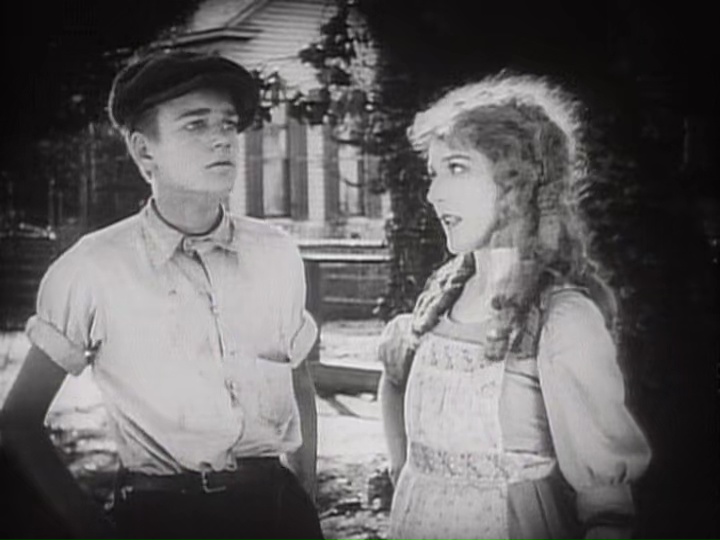
Paul Powell, who had directed Fairbanks in the frenetic comedy The Matrimaniac, leans into the comedy of the story but the film starts with a tragedy. Pollyanna (Pickford), the eleven-year-old daughter of a missionary in the Ozarks, sits at her father’s side as he dies. She is sent to live with her Aunt Polly (Katherine Griffith) in New England. Aunt Polly is a commanding woman who dislikes children and has only taken in Pollyanna out of a sense of duty. She quickly becomes irritated at the child’s uninhibited enthusiasm and optimism. Nancy (Helen Jerome Eddy), the maid, is charmed and becomes Pollyanna’s ally.
Pollyanna quickly tries to spread her gospel of good cheer, which she calls the Glad Game, throughout the town. She wins over her mother’s ex-suitor, the wealthy John Pendleton (William Courtleigh), as well as Aunt Polly’s ex-suitor, Dr. Chilton (Herbert Prior). She befriends a homeless orphan named Jimmy Bean (Howard Ralston) and spends much of the film trying to convince the adults in her life to adopt him.
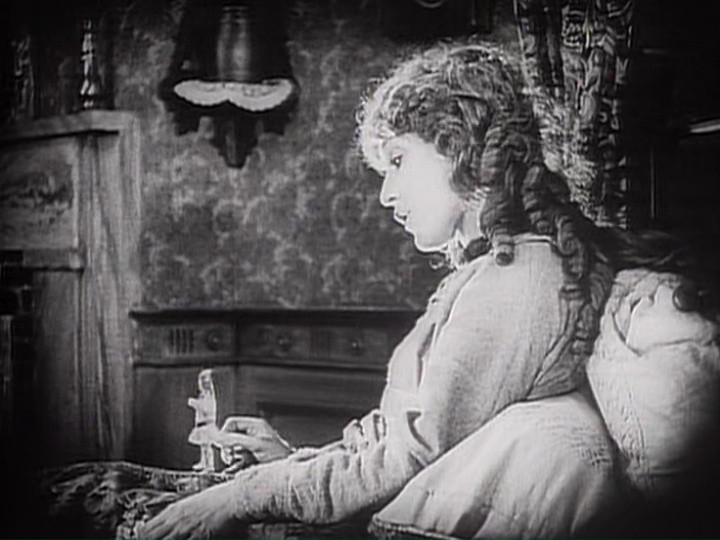
Most of the film is taken up with Pollyanna’s antics and Aunt Polly’s growing affection for the child. Naturally, there is a tragic moment that brings everyone together and it’s no spoiler to say that there is a happy ending in the cards. After all, this is Pollyanna the Movie, we aren’t expecting tragedy.
So, I suppose I should come right out and say I strongly dislike the novel Pollyanna by Eleanore H. Porter. I am not a fan of the Child Messiah genre in general. You know, the old Shirley Temple “Gee, Mr. Khan, I think it’s awfully mean of you to fight the British Army!” saw and then the adults are so moved by the child that they change their ways and peacefully grant independence to the Indian Sub– What’s that? I am told that did not happen in 19th century India, despite Temple dancing in a wee kilt.
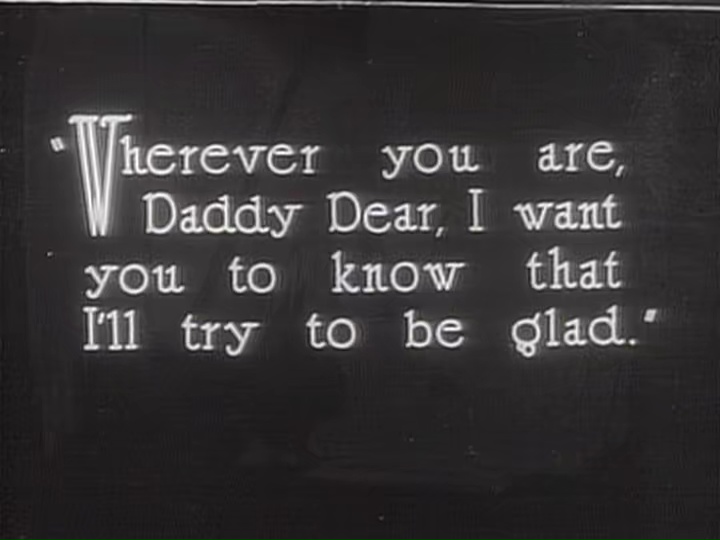
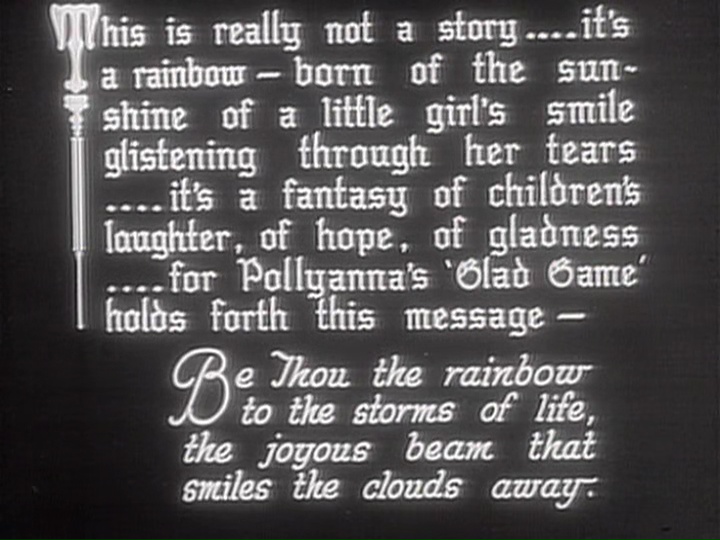
The center of the novel is the Glad Game, which Pollyanna’s father taught her to play. No matter how bad the circumstances, find something to be glad about! If you get sent a crutch instead of a doll, be glad you didn’t need the crutch! If losing your legs means your aunt gets back with her boyfriend, well, you’re glad! And, like all toxic positivity, there is a grain of truth to be found in the syrup: attitude does matter. But forcing a grieving and impoverished child, the only surviving sibling of parents who endangered their family by insisting on remaining at their religious mission, to declare herself glad at any horrible event that comes her way smacks of a very American Protestant form of sadomasochism.
This is borne out in a 1920 Photoplay piece by religious author and writer for screen, radio and movie magazines Margaret E. Sangster. Sangster praises the Glad Game and encourages people to emulate both Pollyanna and Lillian Gish’s character in Broken Blossoms, who, let’s remember, physically forces a smile with her fingers on pain of beating from a violent father who eventually murders her. “Be moderate and sensible and real in your gladness. Be glad when it’s humanly possible to be glad — but don’t be inhuman in your happiness. Only try to smile in the face of adversity — only try to push up the corners of your mouth, as the child did in “Broken Blossoms” when real trouble comes.” Sangster later wrote about a childhood rife with sexism and being unambiguously told she was not as important as her brothers. We can tell.
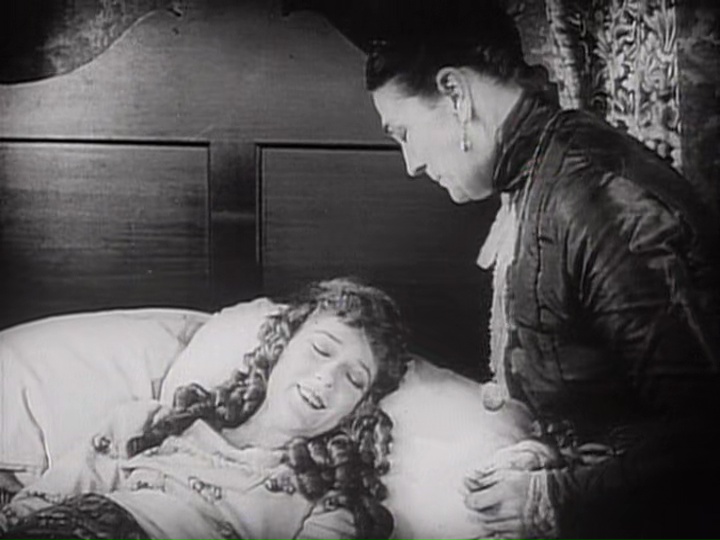
To recap, it’s okay and healthy to be sad for a while sometimes and putting on a happy face is not always healthy. (You may think this was covered in Pixar’s Inside Out but I raise you Ren & Stimpy with the Happy Helmet sequence in Stimpy’s Invention.) However, being sweet, compliant and happy under any circumstance is a prized attribute in American fundamentalism, which the novel and, to a lesser extent, the film reflect.
We can see from the Sangster quote above that the Glad Game was used as a cudgel against children (“why can’t you just be glad like Pollyanna?”) and the term Pollyanna quickly entered the lexicon to describe an unrealistically optimistic person. We may think of ourselves as jaded and cynical but Pollyanna was regularly described as “saccharine” almost immediately after the book’s release. In short, if you find Pollyanna’s sweetness to be a bit sickening, you are in good company.
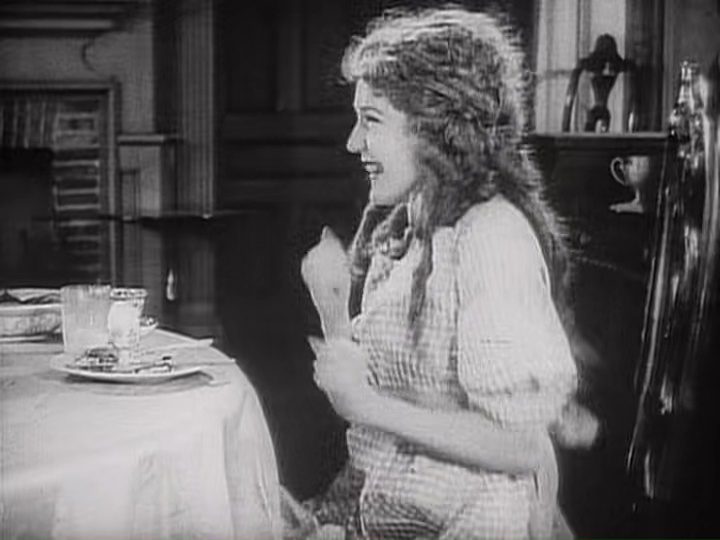
In fact, you are in agreement with Mary Pickford herself. With Pickford’s child roles a big hit, her mother purchased the rights to Pollyanna and filming commenced but the unrelieved saintliness of the character soon began to grate. Pickford’s best characters were made of fire and vinegar, spicy little hellions under perfect golden curls, whether she was a child, teen or woman in the scenario. She found Pollyanna to be a chore and insisted on adding a scene in which her character asks a fly if it wants to go to heaven before squashing it.
Screenwriter Frances Marion, who had saved her share of dire novels with dissections, amputations and even executions, added in a few flourishes here and there, making Pollyanna’s relationship with Aunt Polly more adversarial and including scenes of her scuffling with Jimmy Bean. These help relieve the tooth-aching sweetness but Pollyanna still had to be recognizably Pollyanna. Pickford, after all, was in no position to experiment.
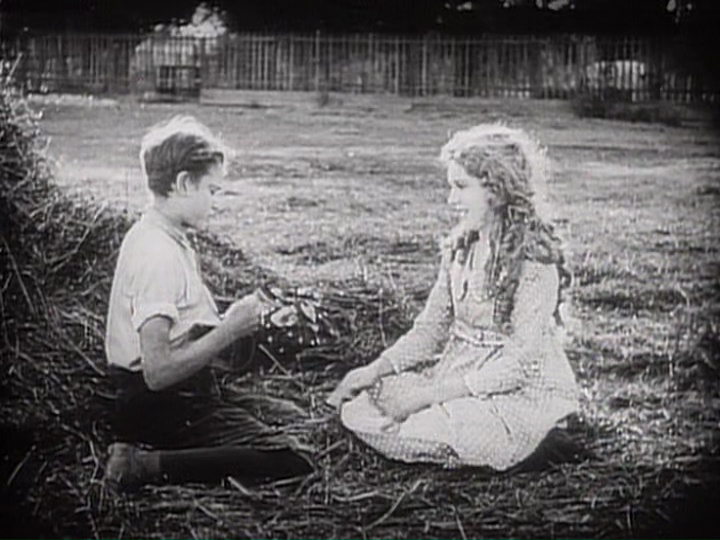
Pollyanna did what it was supposed to do: it was a mammoth hit with the public (and, inexplicably, Russia), a much-needed infusion of cash and prestige for the nascent studio and it freed up Douglas Fairbanks to experiment himself. He released his first costume swashbuckler, The Mark of Zorro, in November of 1920. He had a modern adventure film teed up as a backup plan but there was no need, audiences loved swashbuckler Doug even more than modern Doug and he never made another modern silent film beyond cameos.
Pickford also took advantage of her position, continuing the “one for them, one for me” pattern with child roles interspersed with attempts to embrace more adult roles. She and her audience were never quite as pleased with these attempts and Pickford remained in child roles until her final one, Sparrows in 1926. She understood the business and the risks and knew that she would have to deliver more Pollyannas if she was going to keep making pictures like Suds. (Fairbanks stuck to swashbucklers but mixed things up with scale, setting, and technology like Technicolor.)
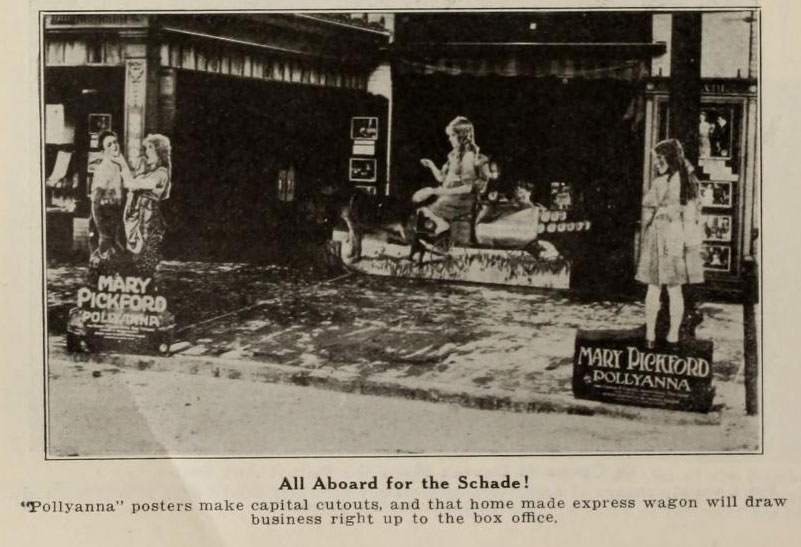
In short, as a movie, Pollyanna is a mixed bag. However, as a business decision, it was a smart and savvy one that helped United Artists get its footing at a time when its success was by no means certain. Pickford and Fairbanks underwrote Charlie Chaplin’s incredibly slow film process (though his box office returns were nothing to sneeze at), as well as Griffith’s flailing for his next hit, and they kept the lights on at the studio.
(Griffith played fast and loose with the money earned by Way Down East, using the funds to pay off his own debts instead of paying into United Artists. His subsequent box office record can be charitably described as spotty and he parted ways with the studio after Isn’t Life Wonderful. He headed to Paramount, which was itself parting ways with Cecil B. DeMille, but was let go from there even more quickly, returning to United Artists as an employee. You can check out my review of One Exciting Night if you want more detail on the odd things he got up to during his United Artists stint. Chaplin, of course, kept cranking out mammoth hits every few years throughout the silent era and beyond.)
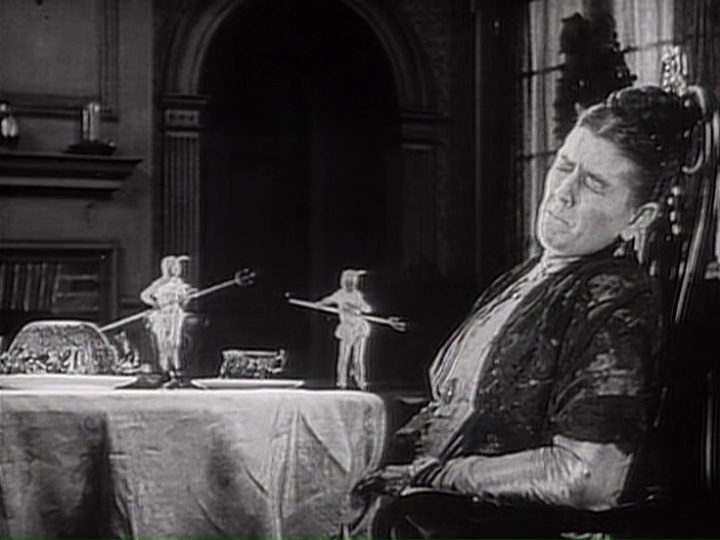
Pollyanna herself would live on in sequels, with the first, Pollyanna Grows Up, being written by Porter, the rest picked up by other authors and the final entry published in 1951. Pollyanna Grows Up includes a time jump to twenty and includes a squicky “will they, won’t they” with John Pendleton, who, you will recall, was in his fifties in the first book. Fortunately, he is really interested in an age appropriate character and Pollyanna ends up with Jimmy Bean but the fact it was even entertained wasn’t great. I felt I had done my duty with two books in the series and respectfully quit the field of battle for entries three through fourteen in the Glad Books series. My family has a history of diabetes. (Though I have to admit I giggled a little at a reviewer complaining one of the later entries turned the Glad Game into a religious thing. Did they not read the original?)
Is Pollyanna a good film? Well, it very much depends on your tolerance for Pollyanna, the book. If you liked that, you will like this. But if you found the book a bit much, this film mitigates some of the syrupy onslaught but it does not stop it entirely. It’s an important film, it was a smart film to make, Pickford does her best but would I call it good? No.
Very, very, very much “your mileage may vary.”
Where can I see it?
There have been bargain home media releases but no major labels have touched it lately. A shame as this film could do with a transfer that showcases Charles Rosher’s cinematography.
☙❦❧
Like what you’re reading? Please consider sponsoring me on Patreon. All patrons will get early previews of upcoming features, exclusive polls and other goodies.
Disclosure: Some links included in this post may be affiliate links and I earn from qualifying purchases.


Just watched Sparrows for the first time and thought it was quite wonderful( although the last 10 minutes drag a little).
Probably Pickford’s best after My Best Girl.