
An old countess has a secret: she knows the three cards to play in order to win every time she gambles. When a military officer learns of this, he becomes obsessed with gaining the knowledge and will stop at nothing.
Home Media Availability: Official DVD release is out of print but there are unofficial versions online.
Joker in the Deck
Pre-Revolution Russian film was, unsurprisingly, full of adaptations of Alexander Pushkin’s prose and poetry. Hailed as Russia’s greatest writer, Pushkin also was eminently filmable with colorful characters and scenes that lent themselves to visual mediums.

While he is mostly known for his poetry, Pushkin’s 1834 short story The Queen of Spades proved to be a popular subject for the screen. A tale of seduction, greed, conspiracy and death, all wrapped up in an elegant package, what filmmaker could resist? Yakov Protazanov certainly could not and his version, starring frequent collaborator Ivan Mosjoukine, was released in 1916. (If you wish to read along at home, Novels, Tales, Journeys: The Complete Prose of Alexander Pushkin translated by Richard Pevear and Larissa Volokhonsky is highly recommended.)
One of the issues that does come up with Russian Pushkin pictures is a slavishness to the master that makes filmmakers hesitant to change a single word. The 1982 adaptation of The Queen of Spades falls into this trap, with a narrator carefully speaking every word as Pushkin wrote it with no attempt to open up the story. So, the trick with Pushkin is to respect his craft but not so much that the picture becomes stale and stodgy. (Hollywood had no such qualms and, while their massacred Tolstoy pictures are pretty rank, the Valentino adaptation of Pushkin’s Dubrovsky, The Eagle, is quite delightful.)

Both The Queen of Spades story and 1916 film open with a gambling party. A group of young officers have spent the evening dining and playing faro, a card matching game. One of the officers, Hermann (Ivan Mosjoukine), always watches but never plays. He declares that he is intensely interested in the game but will not risk the necessary in the pursuit of the frivolous.
One of his friends, Tomsky, says that the person whose refusal to play is truly odd is his grandmother, the Countess. In the story, Pushkin has Tomsky continue to narrate his tale but Protazanov makes his first move to open up the story and inserts scenes of the Countess in her youth.

The Countess (Tamara Duvan) went to Paris as a young woman and had every man at her feet. She also took to gambling and lost a fortune at the faro table. Her husband (Polikarp Pavlov) decided to have his own French Revolution, stood up to her for the first time in their marriage and refused to pay, which left her at risk for humiliation and ostracism.
So, the Countess called on her admirer, the legendary Count St. Germain (Nikolai Panov), adventurer and mystic. He taught her three cards that she must always play in succession in order to win. The Countess returned to the faro table, won back her money but has never told anyone her secret, not even her family.

While everyone else treats this as a charming anecdote of the old days, the story takes over Hermann’s imagination and he can think of nothing besides obtaining the identity of those three cards. He finds the Countess’s house (the older countess now played by Yelizaveta Shebueva) and watches her enter and exit, trying to find a way to speak to her.
The opportunity arrives in the form of Lizaveta Ivanovna (Vera Orlova), the Countess’s penniless and much put-upon ward. Hermann spots her and begins to profess his love by letter until Lizaveta agrees to a rendezvous. The servants are not attentive and he can sneak into her room, just up the hallway from the Countess’s chambers, while they are away at a ball that night.

Hermann confronts the Countess but she refuses to tell him the names of the cards. He draws a pistol but the frail woman dies from fright without telling him anything. Lizaveta is disgusted but helps him escape.
Hermann’s invasion of the Countess’s chambers is intentionally ambiguous as Protazanov once again inserts flashbacks of her youthful escapades. The room has a secret hallway that the Countess had used to smuggle in lovers under the nose of her husband. As she returns from the ball, she daydreams of these happy days and the scenes of Hermann’s entry are intentionally ambiguous as the past and present blend together.

These scenes are handle chronologically in Pushkin’s story but Hermann does muse as he escapes about the purpose of the Countess’s secret hallway and how she has now joined her long dead lovers.
Hermann is cold but does feel guilt about the death of the Countess. In the story, he attends her funeral and is startled when the corpse opens her eyes. This scene is not present in the movie, I am not certain if this was due to a creative decision or censorship of a macabre sequence, but we do see the aftermath: Hermann drinks and drinks and then returns home.
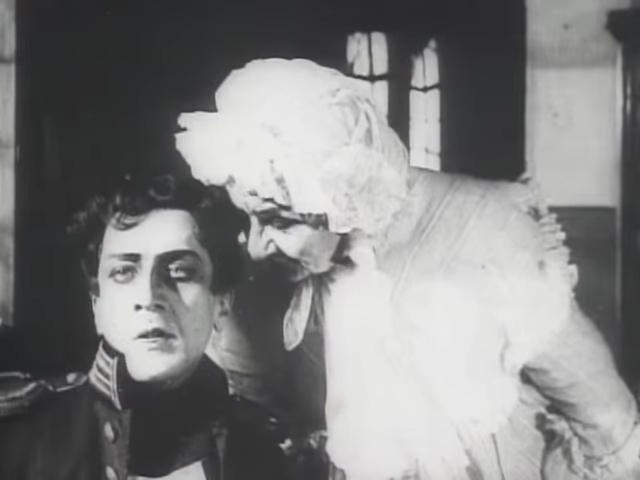
Someone enters his room. Not a ghostly figure, just an old woman in a dressing gown and nightcap. It is the Countess just as he saw her at her death. She tells Hermann that she has been compelled to tell him her secret: the cards to play are three, seven, ace.
Hermann enters a wealthy game of faro and bets his life savings on three. He wins. (In the story, the Countess stated that the tactic would only work if he played three times only on three separate occasions at least a day apart and he could never gamble again. This, of course, precludes a test run.) The next night, he bets all of his winnings on seven. He wins again. The third night, he bets his winnings on the ace and the ace comes up but his own card has turned into the queen of spades. The queen on the card turns into the Countess and she smiles at him.

Hermann goes mad. He visualizes himself entangled in a spiderweb and sees playing cards everywhere. The film ends with him institutionalized and obsessing over cards: three, seven, ace, three, seven, queen of spades.
Protazanov’s body of work frequently delved into the realm between fantasy and reality, as seen in A Narrow Escape and Aelita Queen of Mars, both of with feature prolonged dream/vision sequences that allow the characters to sort out their lives. The Queen of Spades has a darker fate for Hermann and, in fact, a major element of the original story is the question of whether supernatural forces were at play or if it was all a figment of the obsessed officer’s imagination.

In the film, Protazanov wisely keeps that ambiguity. The Countess’s daydreams about her old lovers merge with the present and Hermann’s obsession with the secret of the three cards leads him into either hallucinations or a run-in with a vengeful ghost.
The film’s direction is not quite as flashy as Protazanov’s later work or the films Evgeni Bauer was releasing at the same time but is has some haunting moments. The eerie shots of the Countess’s secret hallway, scenes of Lizaveta staring longingly out her window, a lovely tracking shot as Hermann approaches the gaming table for the third night, Hermann tangled in the spider webs of madness. However, most of the film’s power is derived from simply allowing Ivan Mosjoukine’s scenes to linger.

Mosjoukine is best known today for the spectacular pictures he released in France as part of the émigré Alabatros company but he was one of the most popular stars in Imperial Russia and The Queen of Spades goes a long way toward demonstrating why. (Mosjoukine was no stranger to Pushkin, starring in the delightful The House in Kolomna in 1913.)
Mosjoukine was a versatile powerhouse who could work in every genre from comedy to drama to action and could tune his performance up and down as needed for the film. Here, he portrays Hermann as locked up and morose, most of his emotions coming from his eyes, which are heavily painted for emphasis. The Queen of Spades calls for a bit of stylization—this is an ambiguously supernatural historical work, after all—but Mosjoukine and the rest of the cast keep their performances dialed back, as befits the straitlaced culture of 1830s Saint Petersburg.

Tamara Duvan as the young Countess also deserves praise. Playing a famous beauty and belle of Paris is not an easy assignment to live up to but she is vivacious and charismatic, the very picture painted by Pushkin.
Lizaveta is not given quite as much attention as she was afforded in the short story, where she was as much a central character as Hermann. Vera Orlova does portray her melancholy life as an ignored poor relation but Pushkin’s portrait of her lonely life under the Countess’s petty demands is so poignant that I wish she had been given more time onscreen.

This is a minor quibble, however, and The Queen of Spades is a most impressive, entertaining and watchable picture. It maintains the charm of Pushkin’s story while still succeeding as a film in its own right.
Where can I see it?
Released on DVD as part of the Early Russian Cinema collection from Milestone, now out of print. There are no official releases in print now and I would love to see this picture with a fresh transfer. Unofficial online versions are everywhere.
☙❦❧
Like what you’re reading? Please consider sponsoring me on Patreon. All patrons will get early previews of upcoming features, exclusive polls and other goodies.
Disclosure: Some links included in this post may be affiliate links to products sold by Amazon and as an Amazon Associate I earn from qualifying purchases.
 Movies Silently
I’d love to see this ! I remember seeing a British version from 1949 starring Anton Walbrook and Edith Evans on TV many years ago; the most vivid memory is the climactic card game where Walbrook goes mad, but it hasn’t shown up on TV again for decades. How does that later version stack up against this 1916 version ?
It’s all subjective, of course, but I prefer the elegant simplicity of the 1916 film and Mosjoukine’s extremely tight and controlled performance. Hermann in the Pushkin story was a deeply repressed character, which makes his internal turmoil all the more interesting. The 1949 film tips its hand on the madness a little too soon.