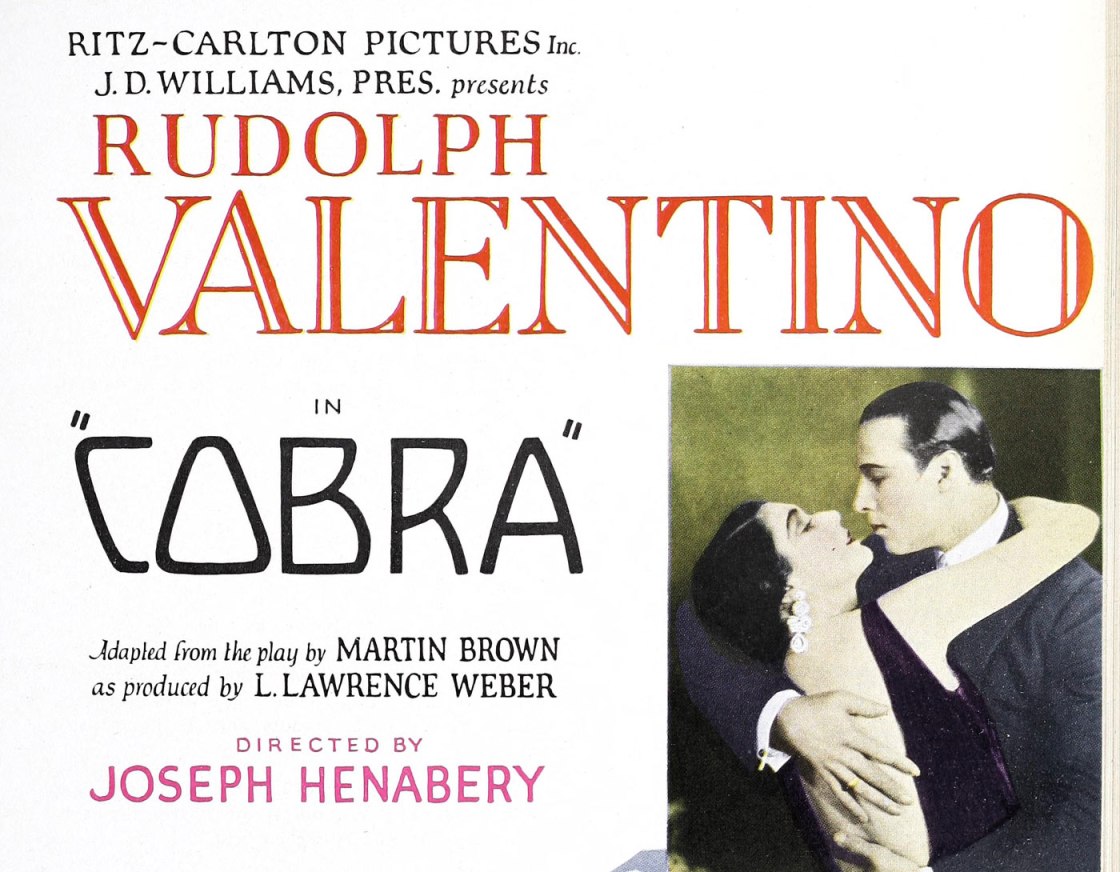
Rudolph Valentino has a problem: women find him attractive and he can’t resist them either. This leads to payoffs and blackmail in abundance, so he jumps at the opportunity to leave Italy for America. Problem solved!
Home Media Availability: Released on DVD.
He’s just a boy who can’t say no
Cobra was made near the end of Rudolph Valentino’s association with Paramount. He had been unhappy with the quality and budgets of the vehicles they had crafted for him, and they were indeed a mixed bag with frequently dopey screenplays and inconsistent production values.
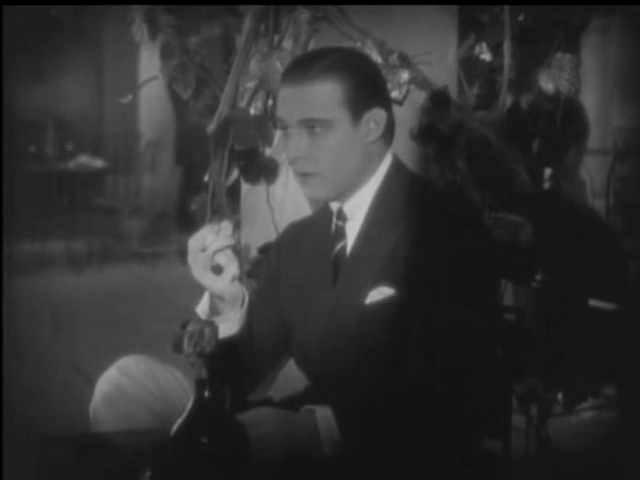
On paper, Cobra should have been a good fit: a rollicking a sexy tale of an Italian count who just can’t lay off the ladies and finds himself getting into worse trouble as the story progresses. Further, it reunited Valentino with his opposite number, Nita Naldi, a combination that had been dynamite in Blood and Sand.
Valentino plays Count Rodrigo Torriani, an Italian nobleman who just can’t stay away from the ladies. He meets American Jack Dorning (Casson Ferguson) when the latter is mistaken for him by a father demanding satisfaction. Rodrigo bemoans the fact that his money woes stem from his inability to resist women. Jack offers him a job at his art and antiques firm in New York and to support him at his own apartment.
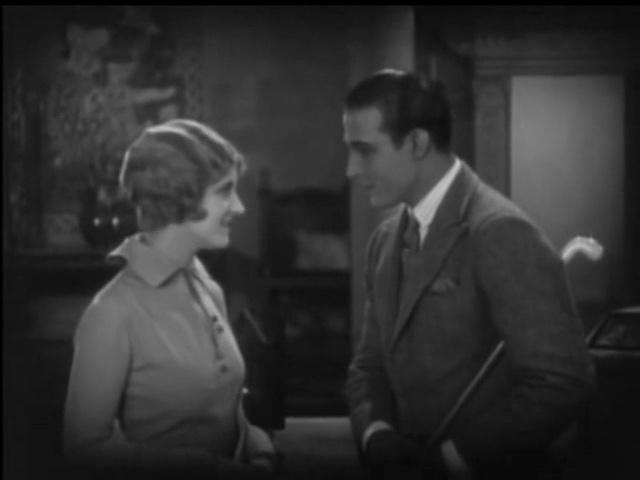
Rodrigo is good at his job and quickly turns his eyes to Mary Drake (Gertrude Olmstead), Jack’s assistant. She wants nothing to do with a playboy and play he does. He quickly becomes involved with a woman who just needs a cool thousand to buy her silence. Jack overhears and indulgently pays off the woman for his roommate. (Are we getting the picture about these two yet?)
The central problem with this film can be summed up by one of Jack’s dialogue cards at this point. He tells Rodrigo: “You’re a puzzle to me. You’re one of the best fellows I’ve ever known, but—” And the audience is left asking, “But is he?” Rodrigo is hospitable to Jack in the beginning of the story and skilled at evaluating antiques but the film goes no deeper than wanting us to believe he is a good fellow because he is played by the actor with the biggest salary.
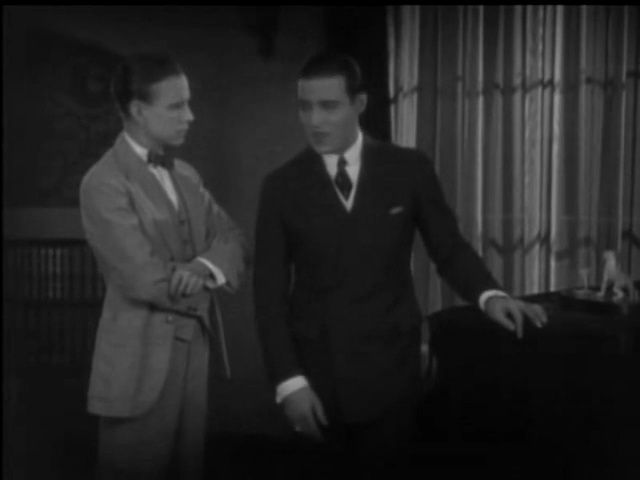
The film is supposed to hinge on the greatness of male platonic friendship (you may put “platonic” in scare quotes, if you wish) but in practice, Jack acts more like the silent film wife who quietly gets her ne’er do well husband out of scrapes in the hope that he will eventually turn into a better man.
I don’t want to give the picture too much credit or make it seem more daring than it is. I am all for a seductive silent era rogue and hidden meanings but, for all its pretentions, Cobra is strangely sexless. We are shown the aftermath of Rodrigo’s romances but very little actual romancing and I doubt this picture could have offended even the strictest censor, which is the meanest thing I can say about a red hot romantic melodrama. Valentino clearly did not want to be making this picture either and that comes through, which is just not want you want in an eye-glinting serial seducer.
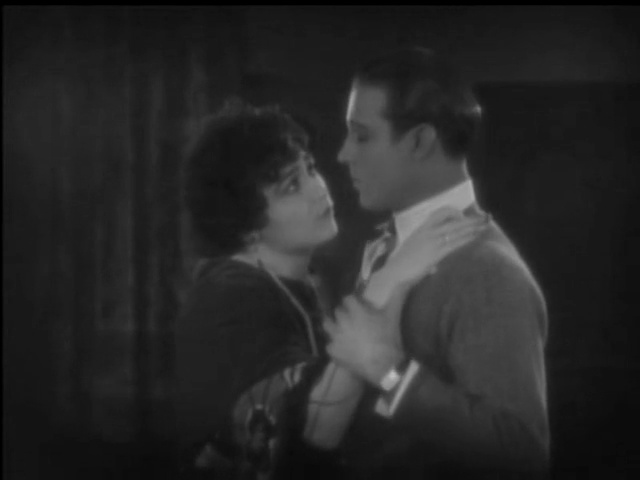
However, even if Valentino had been entirely on board with the film, there were still major issues. You see, the central plot relies on Rodrigo being an idiot. He’s a boy who can’t say no but he goes about it in such a ridiculous manner, lacking any sophistication or caution. Harpo Marx and Animal of the Muppets had more self-control around movie women. Yet Rodrigo is not played for laughs. He is also not played for villainy; we are meant to sympathize with his plight… of writing when he should have telephoned.
This would have been okay if the movie had addressed the issue. He is a prolific seducer but also a sloppy, silly and ridiculous one. But, no, this is portrayed as a problem with the women. Rodrigo bemoans his fate to Jack: women hold power of him, he cannot resist his fascination, they are like cobras hypnotizing their victims.
However, Rodrigo is embarrassed that Jack has paid off his ex, so he decides to turn over a new leaf. Elise Van Zile (Nita Naldi) has spotted Rodrigo and is attracted to both his title and his apparent wealth. Rodrigo sets the record straight and explains that Jack is the one with the money and then steps back as Elise immediately turns her sights to him. Some pal.
Jack and Elise marry and Rodrigo is trying to get Mary to look his way. She is beginning to soften but Elise is also on the hunt. She has been pursuing Rodrigo offscreen but he has rebuffed her out of respect for Jack. She isn’t giving up, though, and when Rodrigo foolishly reveals that he will be working at the office late, she strikes.
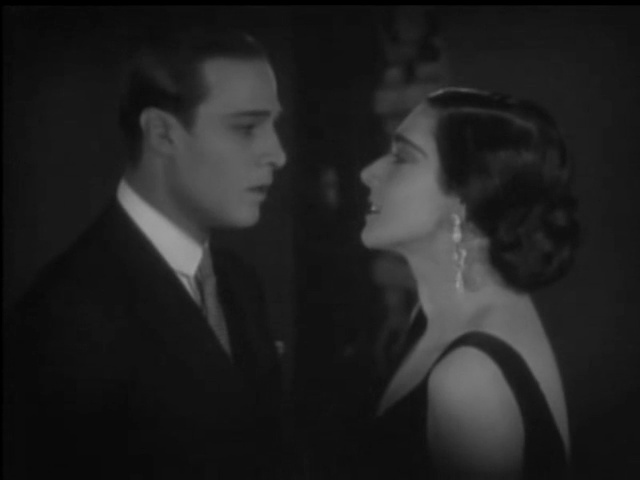
Elise’s stalking of Rodrigo should have been a push and pull of temptation against friendship but in practice, they are onscreen alone together exactly once after his initial rejection and then she merely has to use the schoolyard taunt, “I dare you to kiss me, neener, neener, neener” to make him forget Jack. Rodrigo gets all the way to her hotel room before changing his mind and leaving. Elise is a bit upset but, after an brief burst of temper, calls up another friend to play with her.
Will Rodrigo confess to Jack? Will true love conquer all? And, if so, whose?
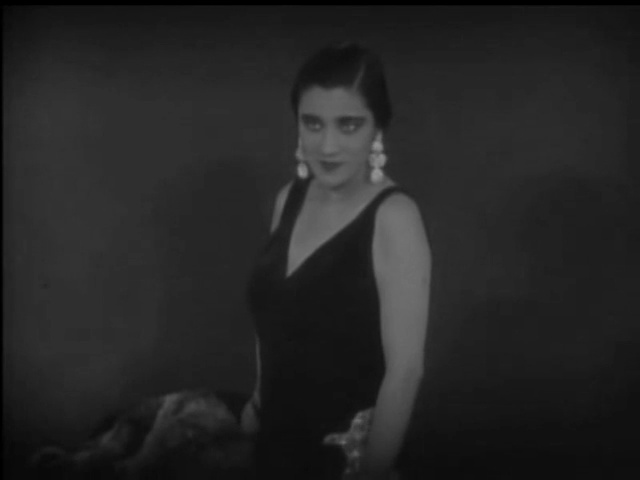
Ultimately, Cobra suffers from meandering too much and not focusing on the power struggle between Rodrigo and Elise. Valentino’s screen image was as an aggressive seducer and the idea of the hunter becoming prey is always going to have zip. (And was pulled off successfully in The Eagle.) However, as mentioned, Elise isn’t given enough screentime for that. A few scenes of her with the trophies of her past conquests, a shot or two of her dancing the night away, and more scenes of her tempting Valentino would have gone far. The majority of her efforts occur offscreen, with other characters merely describing what happened.
Rodrigo’s love for Mary is described as pure and clean via title card but, again, is it? We know Mary is a straight shooter but Rodrigo was ready to jump at Elise despite her status as his best friend’s wife and his alleged devotion to Mary. And, as is the case with Naldi, Valentino is simply not given enough solo scenes with Olmstead to allow us to believe in his devoted love.
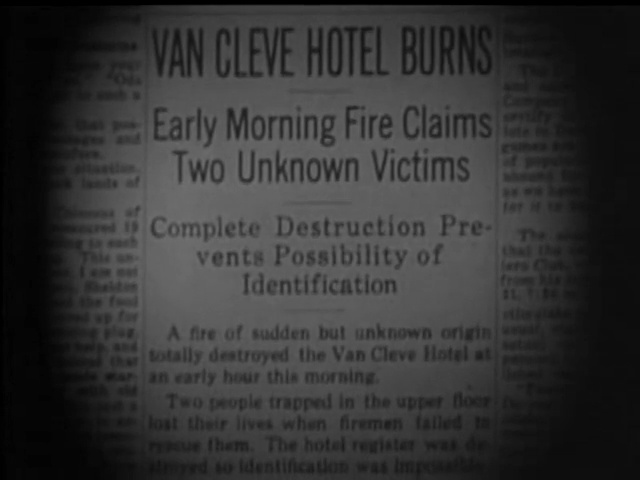
Worse, the picture is well-designed but there are some telltale cost cutting measures that mar it. The film’s final reels are particularly silly: Elise dies in a hotel fire with her lover and her body is burned beyond recognition. This inferno is not shown, Rodrigo merely reads about it in the newspaper. They didn’t even budget a few smoldering timbers for Rodrigo to stare at dramatically.
Jack just thinks Elise is missing and, as days pass and she is not located, teeters on the edge of a breakdown. Rodrigo knows that the unidentified body must be Elise but doesn’t want to hurt Jack. The friendship angle teased in the opening titles doesn’t work because Rodrigo just kind of stands around and looks concerned as Jack is sick with worry over the missing Elise. The film could have shown Rodrigo trying to find a way to identify the unknown bodies in the hotel fire or at least go into detail about how he is caring for his friend. We are also just given shots of Valentino looking perturbed but no clear portrayal of his inner turmoil.
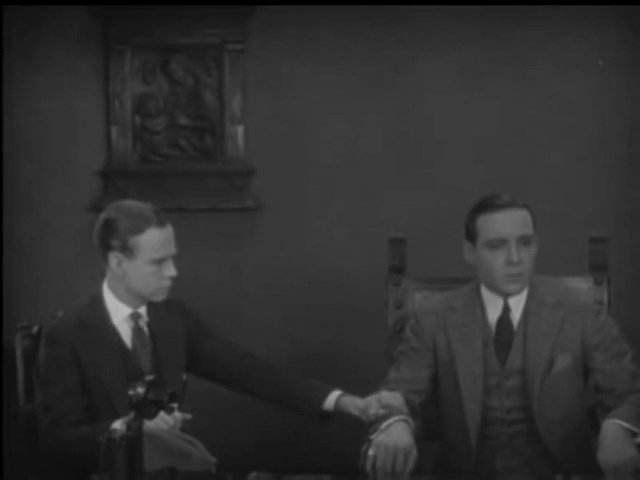
The muddled story also dulls the impact of Rodrigo’s final sacrifice. At the end of the picture, Jack knows all but still thinks Rodrigo is swell. Rodrigo pretends to still be a philanderer so that Mary will go with Jack. He then sails away from America so that his spouse, er, best friend will be free to find happiness.
I have not read the original play upon which the film was based but the novelization is available. It isn’t great (Elise’s sexual aggression is credited to her having a Spanish mother) but it does a better job of conveying the motives of the characters, which are melodramatic and silly but at least there is some story support for their behavior. Oh, and it has a happy ending with Mary wedded to Rodrigo, which I am not entirely sure is satisfying to either audience or censor.
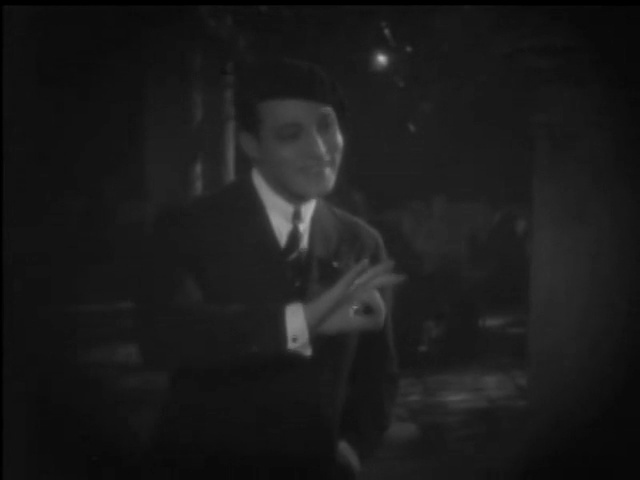
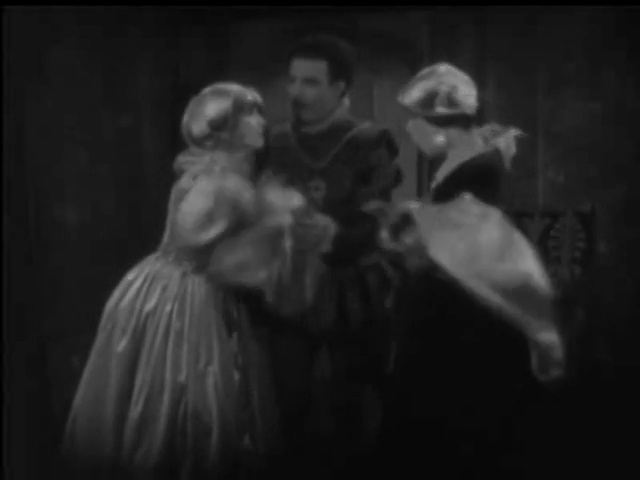
The only things that work in the picture are small details contributed by Valentino or throwaway bits that seem to have sneaked in from another, better movie. I rather enjoyed Valentino switching to talking with his hands every time his character speaks Italian in the early confrontation scene. The historical flashback, put in to give Valentino fans a glimpse of their favorite in fancy togs, is genuinely funny as the Torriani ancestor’s philandering accidentally saves the day.
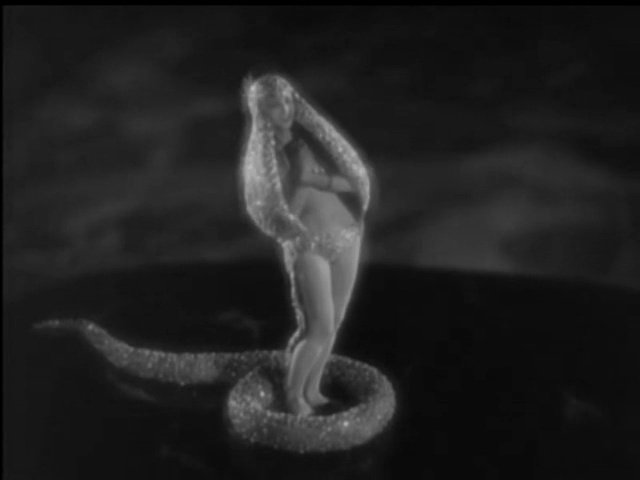
Unfortunately, the more bonkers elements of the story are quickly glossed over. We get just one brief historical flashback and a single scene of a cobra statuette turning into a costumed dancer. If ever a movie needed to lean into decadence, it was this one. It would never be a great movie but it could have been a memorable one.
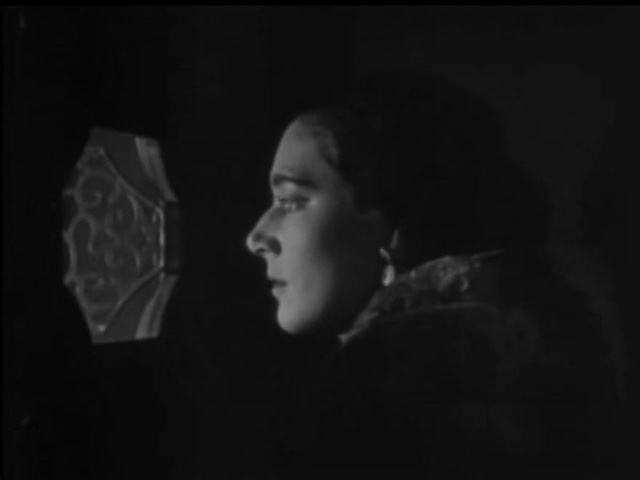
The gowns by Adrian and sets by William Cameron Menzies are likewise a draw for the picture and there is one nice shot of the Dorning antique office that makes use of an elaborate peephole but you know I am stretching to say nice things with I compliment one peephole shot in an entire feature film.
There have been claims that this film was hijacked by Valentino’s wife, talented designer Natacha Rambova. (You can see her work in Camille, in which Valentino supported Nazimova.) There are claims that Rambova meddled with Cobra and the production problems were due to her takeover but, as Donna Hill points out in Rudolph Valentino the Silent Idol, Rambova was occupied with the ultimately unproduced film The Hooded Falcon and was not interested in Cobra. (Natacha and I are in agreement there.)
How much you enjoy Cobra is ultimately going to depend on how much you like Rudolph Valentino and even for his fans, it can be a bit of a slog. He looks beautiful but his character is so ridiculous yet is treated as a dignified figure. Valentino had a flair for comedy and could be quite funny when the story allowed for it.
Regrettably, that didn’t happen and instead we end up with a muddled story with incongruous title cards trying to steer the narrative in a direction that is not supported by anything that happened previously. It’s as if the scenario writer and title card writer were in some kind of duel while production was going on. (Which would have made a better picture than Cobra.)
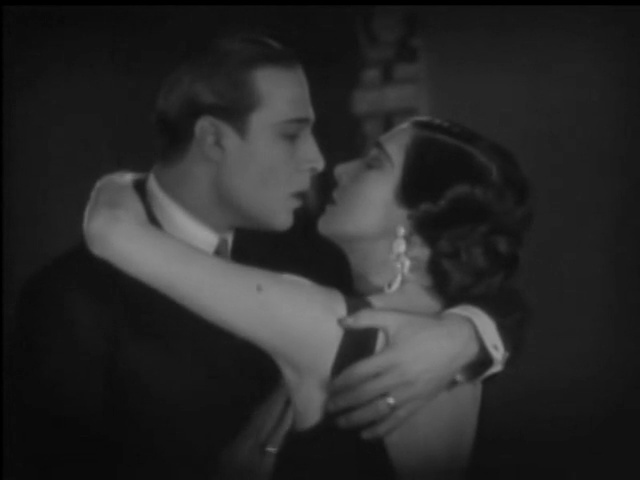
Valentino completists will want to see this and he does have some good moments but it’s otherwise pretty much the essence of the soulless studio production that had annoyed Valentino and Rambova so much while he was alive.
Where can I see it?
The David Shepard-produced version with a Mont Alto Motion Picture Orchestra score is available as an MOD from Flicker Alley.
☙❦❧
Like what you’re reading? Please consider sponsoring me on Patreon. All patrons will get early previews of upcoming features, exclusive polls and other goodies.
Disclosure: Some links included in this post may be affiliate links to products sold by Amazon and as an Amazon Associate I earn from qualifying purchases.
 Movies Silently