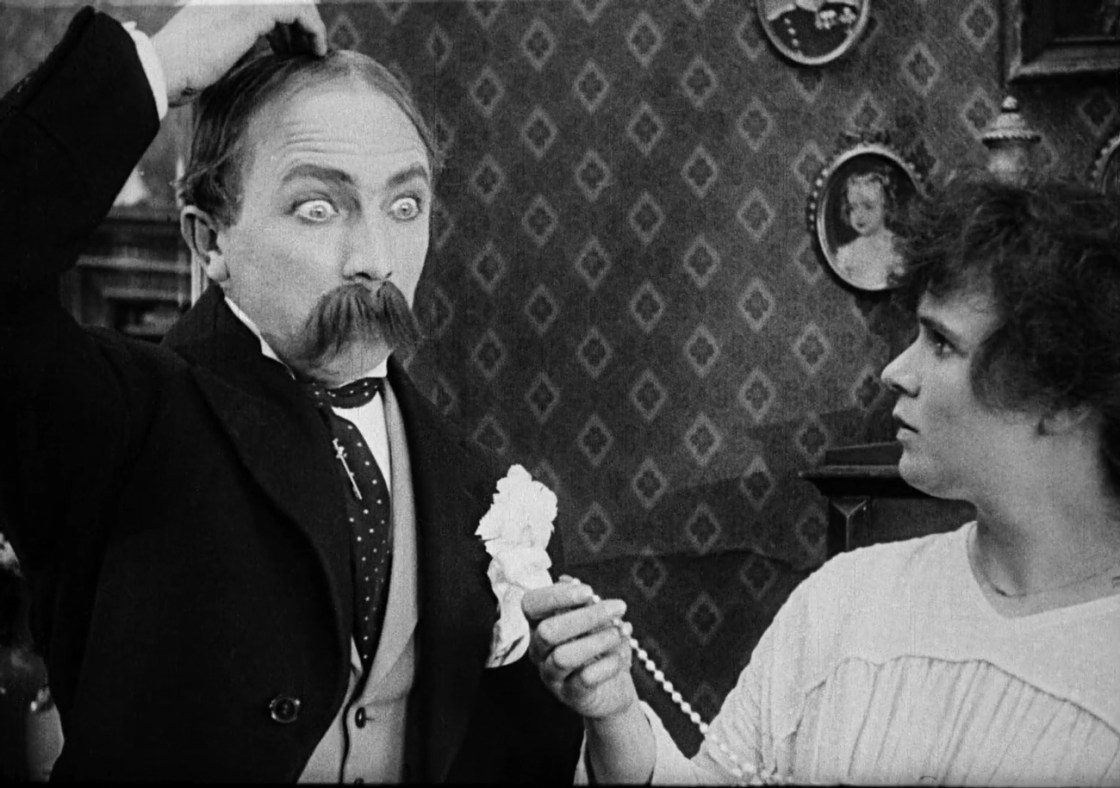
Two Danish couples are hoping for a windfall of expensive gifts when their wealthy uncle from America comes to visit. His cheap presents enrage them and they spend the film destroying and “losing” the tacky items. But one gift, a cheap necklace, can’t seem to stay lost…
Home Media Availability: Stream courtesy of the Danish Film Institute.
Gift horses…
This Danish comedy is an interesting one because it combines two types of humor that I enjoy very much: “every character is an awful person” and “wildly unlikely and almost uncanny luck moves the plot.” And, as you have probably noticed from my glowing reviews of Danish comedies, Danish humor appeals to me. I blame Victor Borge.
In short, spoiler alert, I liked this little 15-minute short quite a lot and I am going to tell you why.
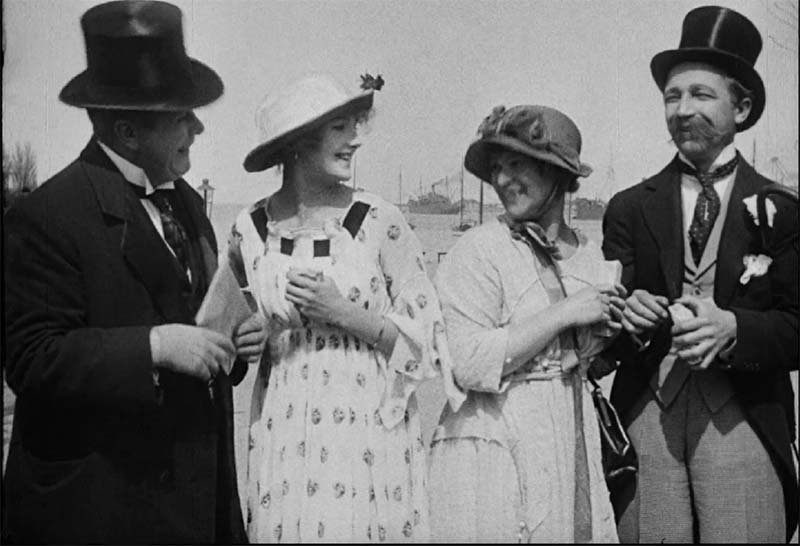
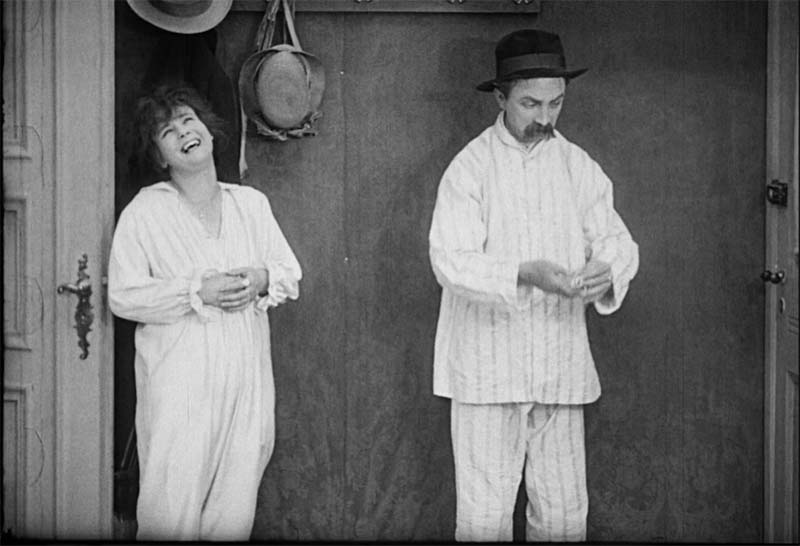
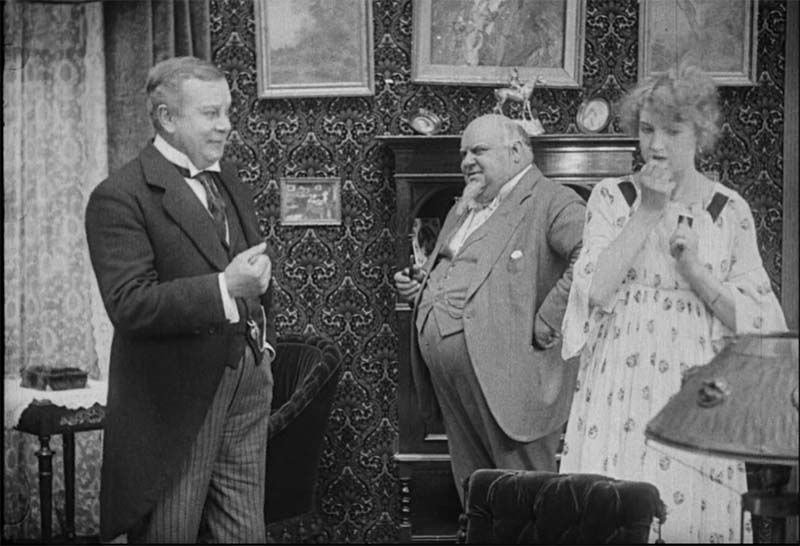
The picture concerns two couples, the Sørensens (Lauritz Olsen and Karen Winther) and the Madsens (Rasmus Christiansen and Jacoba Jensen). They are well-to-do but the wives’ Uncle Bims (Oskar Stribolt) has made a fortune in America and he is coming to visit. Both couples go to meet his ship when it sails into port—and exchange hypocritical greetings with one another as they wait.
Uncle Bims wants to rest at his hotel but he presents all four of his relatives with presents. They can barely wait for his taxi to turn the corner before they tear them open. The Sørensens receive a travel brochure and a paste brooch. The Madsens receive a book and a faux pearl necklace. Hardly the sort of gifts they were expecting from their dear uncle with Roaring Twenties America money. It’s the thought that counts? Bah! They’ve already calculated the prices and no amount of sentiment can make them happy with such terrible, chintzy tat!

The Sørensens tear up the brochure and pelt Uncle Bim’s portrait with cream puffs. How dare he? Mr. Madsen is equally enraged but his wife kind of thinks they should keep the necklace to be polite. He will have none of it and throws it out the window.
And it is returned by the street sweeper.

Later, the Madsen’s maid steals the necklace to impress her boyfriend but he grabs it and runs away to fence it. The maid tearfully confesses but Madsens are delighted.
And it is returned by a policeman.
His wife feels all of this is a sign that they should keep Uncle Bims’ gift but Mr. Madsen won’t hear of it. He finally throws the necklace into the harbor, good riddance, and returns to his flat to await a visit from Uncle Bims. Meanwhile, the maid has purchased a fresh fish for dinner and you will never guess what is inside its stomach…
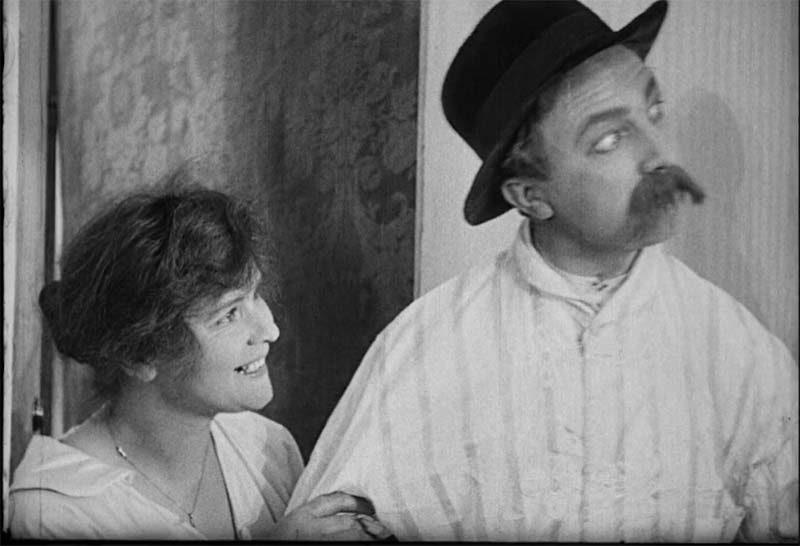
Well, let’s start with my favorite thing about this picture: the cast. This is a farce comedy and it calls for a bit of exaggerated characterization. All four of the lead actors do a wonderful job of balancing between broad humor and sly little flourishes. For example, I just loved the horror on the faces of Christiansen and Jensen turning to amused joy when they realize why their maid is weeping. The wordless communication: free at last!
Or the scene where the Sørensens and the Madsens meet on the dock and the characters shift between hypocritical friendliness and barely-disguised contempt. Is there anything more universal than a relative we dislike but must put up with?
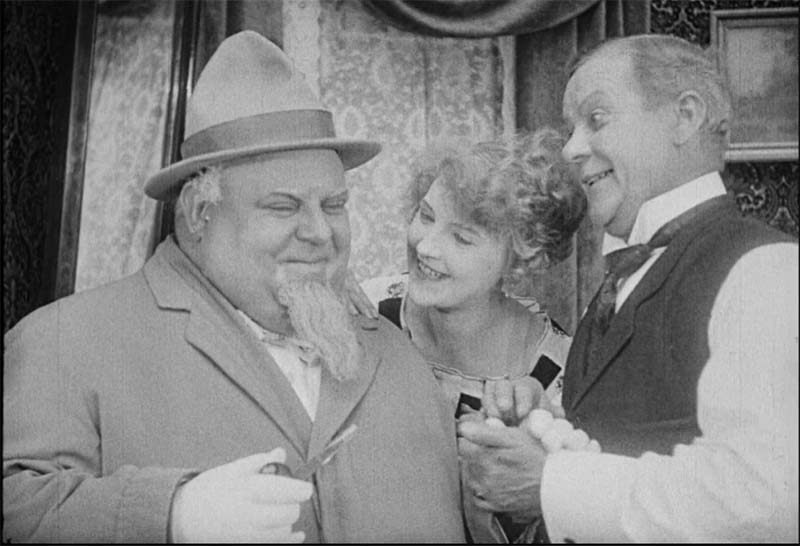
This is the first film I have seen directed by Lau Lauritzen, Sr., whose namesake son remains one of the most awarded Danish directors. The senior Lauritzen displays an admirable sense of comedic timing, which is well-displayed in the scene during which Uncle Bims visits the Sørensens. They have forgotten to clean the pastry cream from his portrait and the vandalized portrait is above its subject just waiting to be discovered. Lauritzen teases the scene a bit before the discovery is made and the Sørensens scramble for an explanation. (“Impromptu dessert fight?”)
While Mrs. Madsen is the most sympathetic of the Danish relatives—she at least hesitates to destroy her uncle’s present and is amused by its consistent resurfacing—nobody in the picture is particularly pleasant. They are all petty, selfish and greedy, “deliciously low,” as a line in My Fair Lady had it. A lot of American comedies of this period had likeable main characters with noble motivations. They are funny, of course, but there is a kind of humor that can only be achieved with a despicable cast. Laughing as the characters earn or escape their comeuppance is quite amusing.
And, of course, the cursed necklace is almost a character in its own right. It should be a simple thing to get rid of it but it stubbornly returns under increasingly unlikely circumstances. Luck-based comedy was also popular and this is a bit of a variation in that the extreme unluckiness of the necklace finally turns out to be a blessing in disguise. It’s not entirely unexpected but the twist is playful and droll. Kudos to screenwriter Aage Brodersen.
Oh! Uncle! plays a bit with the “foreign relative” comedy trope, an international humor staple. In most films of this type, the comedy is derived from the foreigner misunderstanding the local culture. For example, in East and West, wild and secular American Molly Picon violates the religious fast of her devout Jewish relatives while visiting Poland.
In the case of Oh! Uncle! the uncle appears at the beginning and the end of the picture but the majority of the action is taken up by the Madsens and Sørensens reacting to what they perceive as a mortal insult. The jokes aren’t about an American in Denmark, they revolve around the Danes reacting to an American in Denmark.
I am partial to a good farce and Oh! Uncle! fits the bill nicely. Between the charismatic cast and the humorous central concept, I was amused the entire time. I will certainly be keeping my eyes open for other films featuring the same actors (some of them appeared in the excellent silent Danish Dickens adaptations) and will be seeking out more comedies from Lauritzen. This was fun!
Where can I see it?
Stream courtesy of the Danish Film Institute. The titles are not yet translated into English but the story is not difficult to follow. Enjoy!
☙❦❧
Like what you’re reading? Please consider sponsoring me on Patreon. All patrons will get early previews of upcoming features, exclusive polls and other goodies.
Disclosure: Some links included in this post may be affiliate links to products sold by Amazon and as an Amazon Associate I earn from qualifying purchases.
 Movies Silently
Hi, I quite enjoyed this film too! It’s a great job that the Danish Film Institute are doing making all their films available, in such high quality too!
One question I want to ask you is about the year of release. It’s down as 1921 but the style and story seems to be from an earlier time. Have you any thoughts on this?
Comedy shorts pretty frequently reflected their 1910s roots, so I would call it pretty normal.