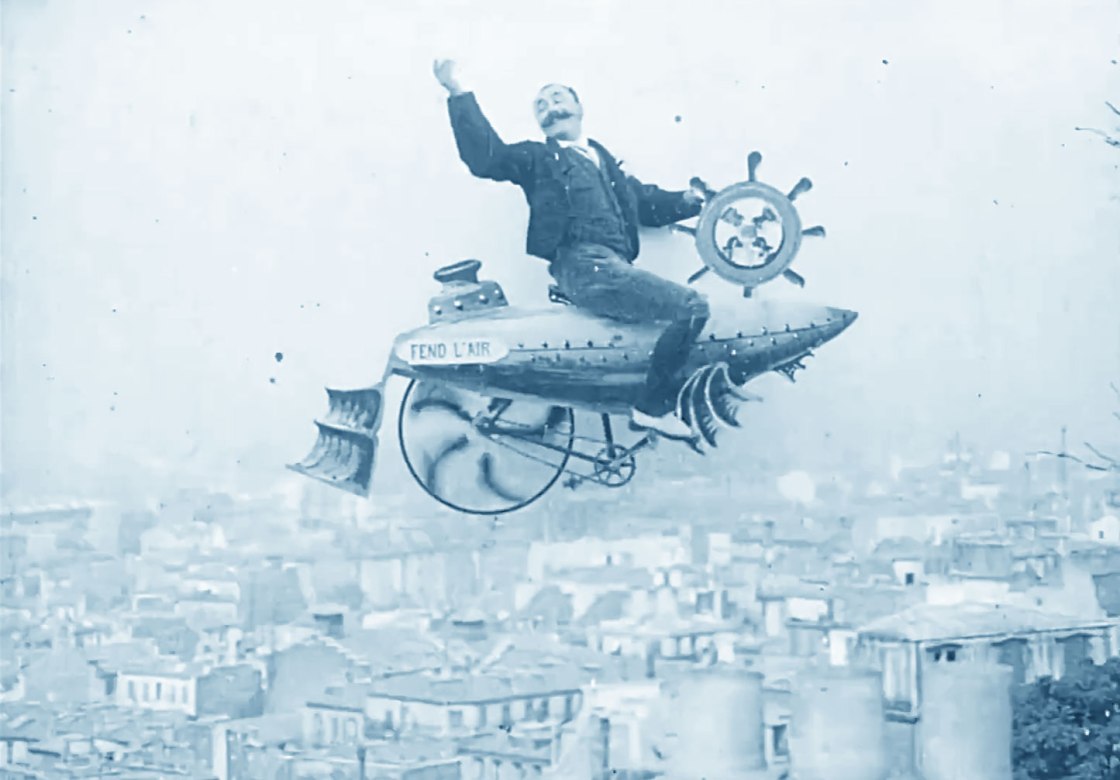
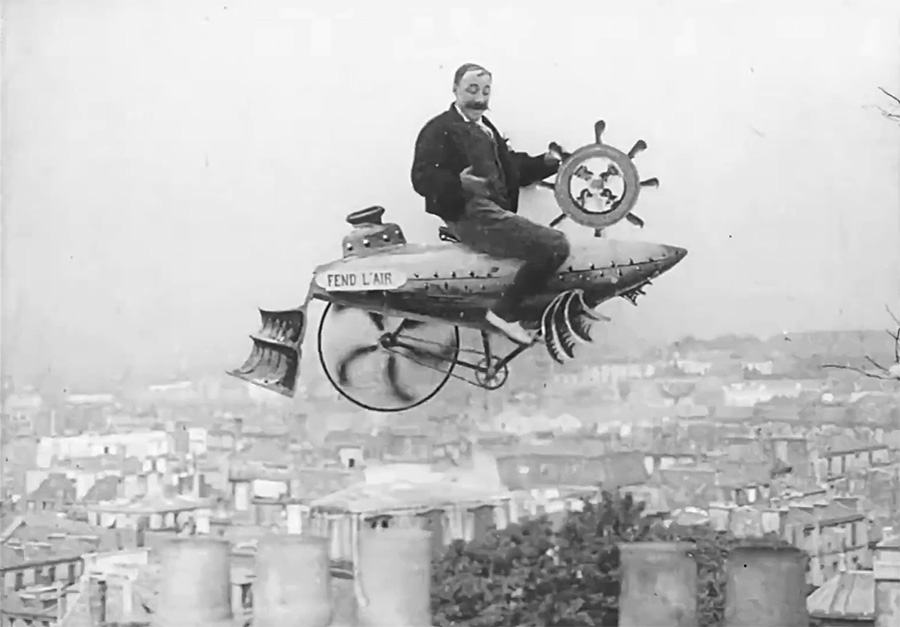
Ferdinand Zecca’s humorously imagined air motorcycle is one of the earliest science fiction films and portrayals of heavier-than-air flight, still years away at the time.
Home Media Availability: Widely available online.
Those Magnificent Men in Their Flying Machines
Declaring firsts is always risky but especially so with early film. So much has been lost that it is nearly impossible to definitively name the first anything. However, Ferdinand Zecca’s Conquering the Air certainly has a claim to being one of the earliest science fiction films and is sometimes also cited as the first aircraft film in general.
Zecca was a musician who had been engaged by the Pathé company to, among other things, help them dominate the film market with synchronized sound. In 1899. Obviously, that didn’t pan out, technology simply was not where it needed to be for talkies and musicals to take over cinema, but Zecca soon shifted over to directing general releases for Pathé, eventually transitioning to a more executive role. 1901 was the very start of his directing career and it proved to be a fruitful year.
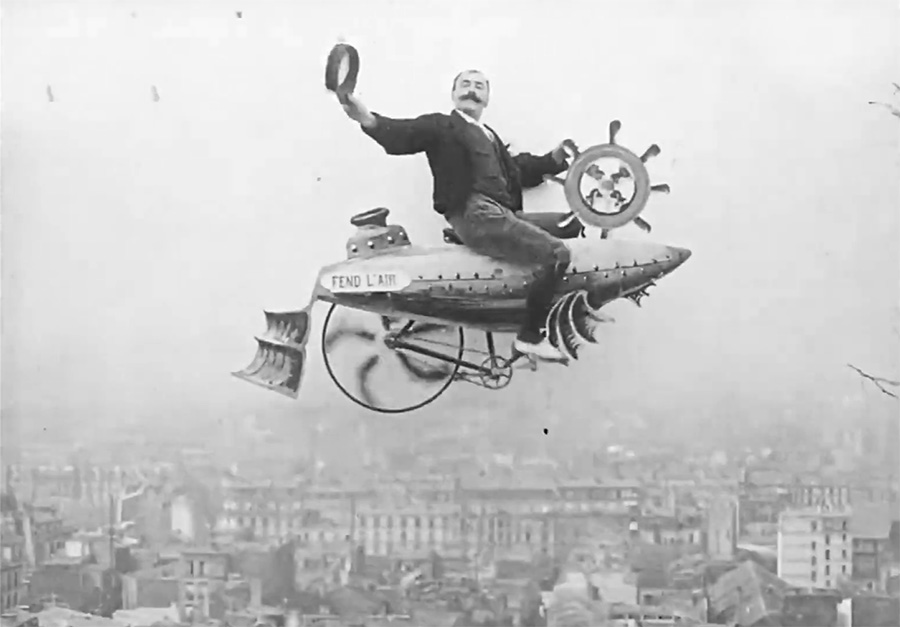
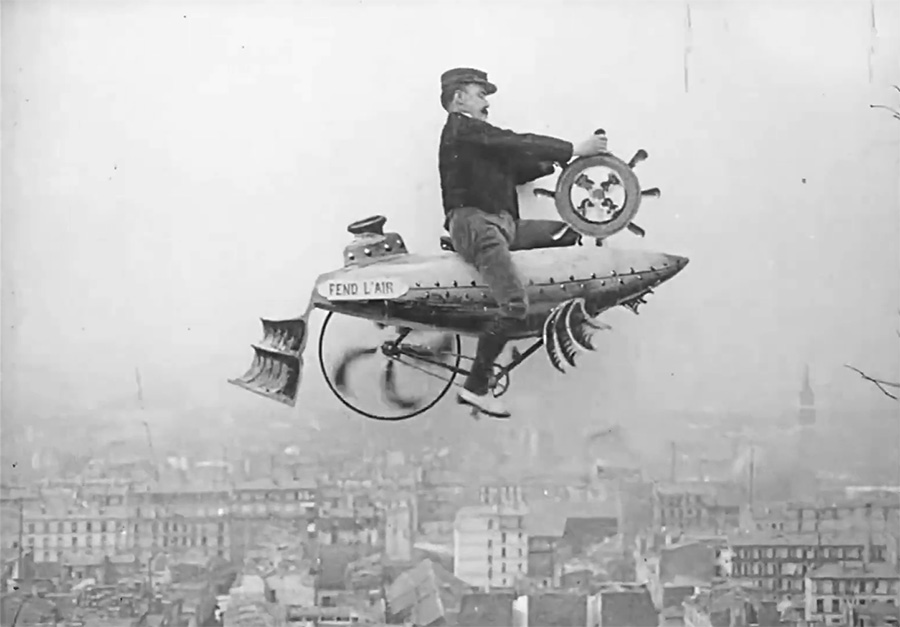
The film’s concept is simple: a dapper gentleman rides across the screen in a pedal-powered airship with a ship’s wheel and rudder for steering. He doffs his cap to the audience a couple of times in celebration of his achievement and then returns to his task of steering his craft. Oh dear, he has lost his hat! Oh well, it’s still a lovely day, isn’t it? There is a misty scene below him as he passes over the rooftops of Paris.
Of course, heavier-than-air flight was still years away but Zecca was able to create the illusion of flight with double exposure. (This film is also credited as the first movie with double exposure. I am not touching that claim with a ten foot barge pole except to say that so many early films are lost that it is a fool’s mission to declare any movie to be the first anything.)
Zecca first filmed the performer (possibly Zecca himself) on the flying machine while it was suspended at a reasonable height. The flying contraption was a flat painted piece, which the actor had to ride slightly sidesaddle in order to keep his balance. (Note that he only engages one peddle.) The lower part of the frame was blacked out but, significantly, Zecca used a soft gradient carefully shaped around the aircraft. The film was then re-exposed to capture a panning shot of the city at a suitably high angle. Since the studio backdrop was light, this created an illusion of smoke and mist over the rooftops, which disguised any imperfections in the illusion. To audiences of 1901, it looked very much like a man could fly, which, even without the gloriously bonkers design, was still sci-fi for heavier-than-air craft in 1901.
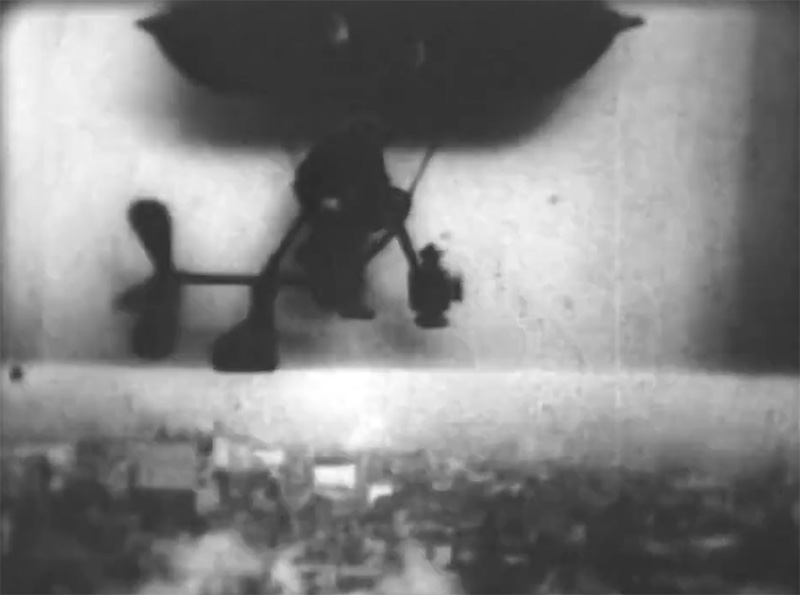
And everyday film audiences weren’t the only ones to notice. Movies could cross the Atlantic in a week via ocean liner, which led to furious ping-ponging of remakes between the countries with active film studios. Whenever something new or interesting showed up in one, every other studio would soon have their own version. (Film copyright laws would not be ironed out in the United States for another decade.) And so, Conquering the Air had an unauthorized American remake a year later: A Twentieth Century Tramp; or, Happy Hooligan and His Airship, also based on the comic character of the same name. This film has confidently been named as the first American science-fiction film but there’s just one issue: it’s not sci-fi.
How can an original be science-fiction but the near-identical remake not be considered so? I go into more details in my review of the picture but briefly, while Conquering the Air portrays a heavier-than-air craft with no buoyancy from gas or hot air, A Twentieth Century Tramp portrays a mini pedal-powered blimp and those things were real at the time. In fact, one was hired by a major New York City newspaper to provide weather reports and could be seen in the skies of the city at the time the film was made. It was also a staple of state fairs and air expositions. In short, it was a known, existing invention. It’s not science-fiction if the central gimcrack and/or doohicky is existing and in use at that moment.
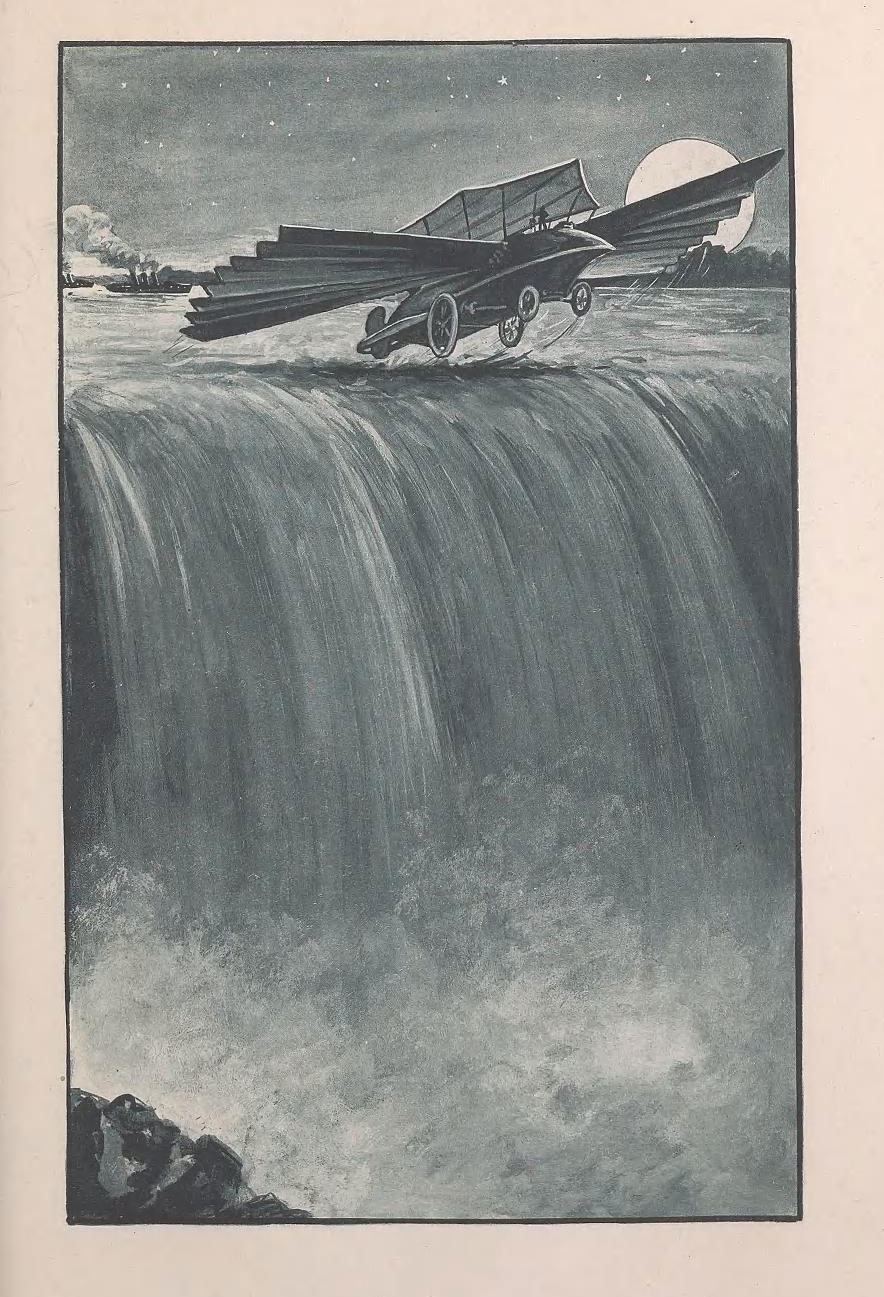
Would this have made a difference to audiences of the time? Well, yes, if they liked Jules Verne. Verne made real and present lighter-than-air vs the theoretical heavier-than-air the central conflict of his 1886 novel Robur the Conqueror, in which an obsessive inventor zips around kidnapping other scientists to prove his heavier-than-air craft is the future of aviation. It was popular enough for Verne to publish a sequel, Master of the World, in 1904, after the Wright Brothers completed their historic 1903 heavier-than-air flight. Having been proved right about blimps vs airplanes, Verne instead had Robur return with a combination airplane/speedboat/automobile/submarine. The jury is still out on that one.
While Conquering the Air makes no reference to Robur the Conqueror and really has no plot to speak of, it is still likely that Verne’s vision of flight would have influence on a French director of the time. In any case, Zecca’s charming mini flying machine would be wholly unsuitable for Robur-style theatrics. Its inventor is a friendly fellow who just wants to say hello!
The aspect of Conquering the Air that really impressed filmmakers and audience of 1901 was the soft and sophisticated double exposure that made it appear as though the inventor was high up in the air. A Twentieth Century Tramp’s use of a double exposure skyline is considerably less sophisticated than Zecca’s film but that seems to have been the central goal of the remake, not the science-fiction vehicle. The trick was used to much greater success in the United States with Dream of a Rarebit Fiend, made five years later. The seams are still obvious but the dream logic of cheese sauce-induced nightmares make it fit.
Conquering the Air may or may not be the first this or that but it was certainly influential and its central special effect has held up well. We know intellectually that Jules Verne’s life overlapped the silent era but it is still a bit thrilling to see Vernian contraptions appear on the screen at this early date. Zecca’s playful approach suits the material perfectly. First or not, it’s a fun bit of entertainment.
Where can I see it?
Released as part of various out of print collections and documentaries but generally all over the internet now with no official version.
☙❦❧
Like what you’re reading? Please consider sponsoring me on Patreon. All patrons will get early previews of upcoming features, exclusive polls and other goodies.
Disclosure: Some links included in this post may be affiliate links and I earn from qualifying purchases.

