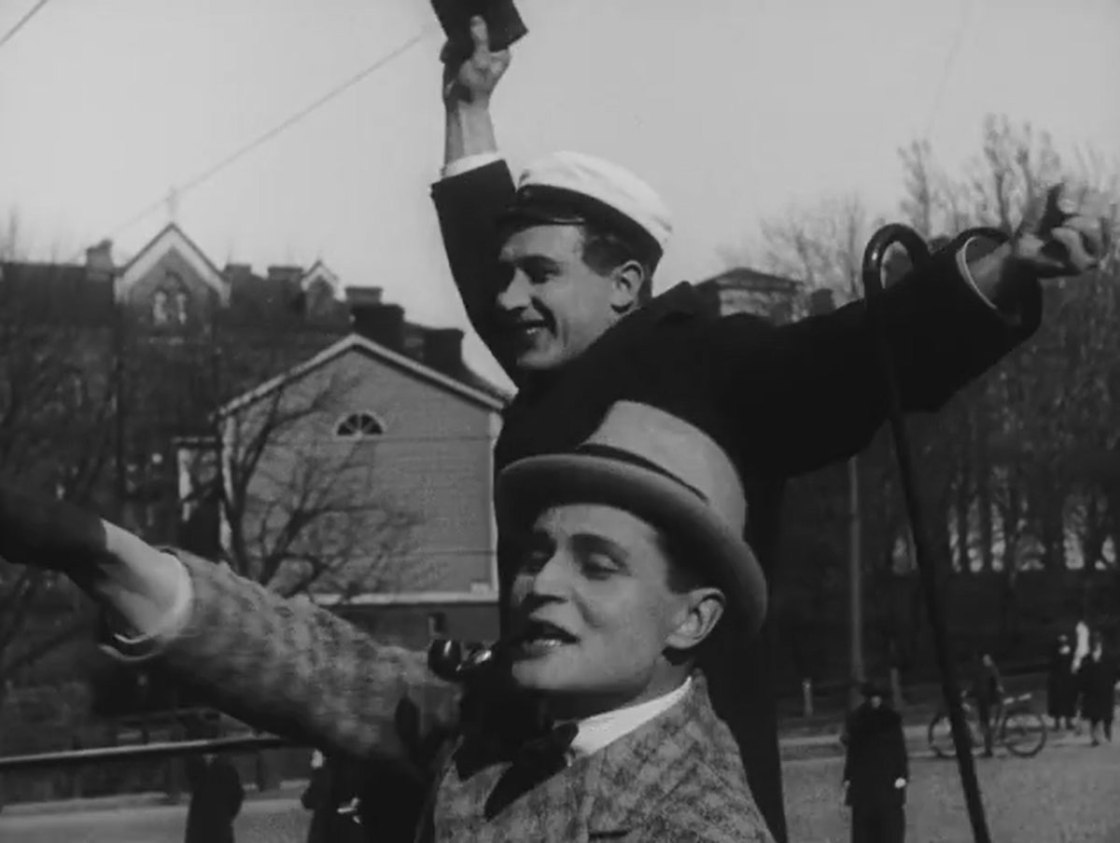
A student is living high in Helsinki, thanks to money from his wealthy, ailing uncle. When his partying exceeds his resources, our hero decides to invent a wife to support in order to get more cash. It’s not like his uncle will ever come to visit, right? Right?
Home Media Availability: Stream on Elonet.
Party Like It’s 1921
The wealthy relative holding the family purse strings was an internationally popular seed for stories, both serious and silly. Alive, they would make eccentric demands. Dead, they would include bizarre clauses in their wills. The one rule: keep them happy, at least until the check clears. Sometimes the poorer relatives are righteous, other times they are wastrels but they all want and need that family fortune.
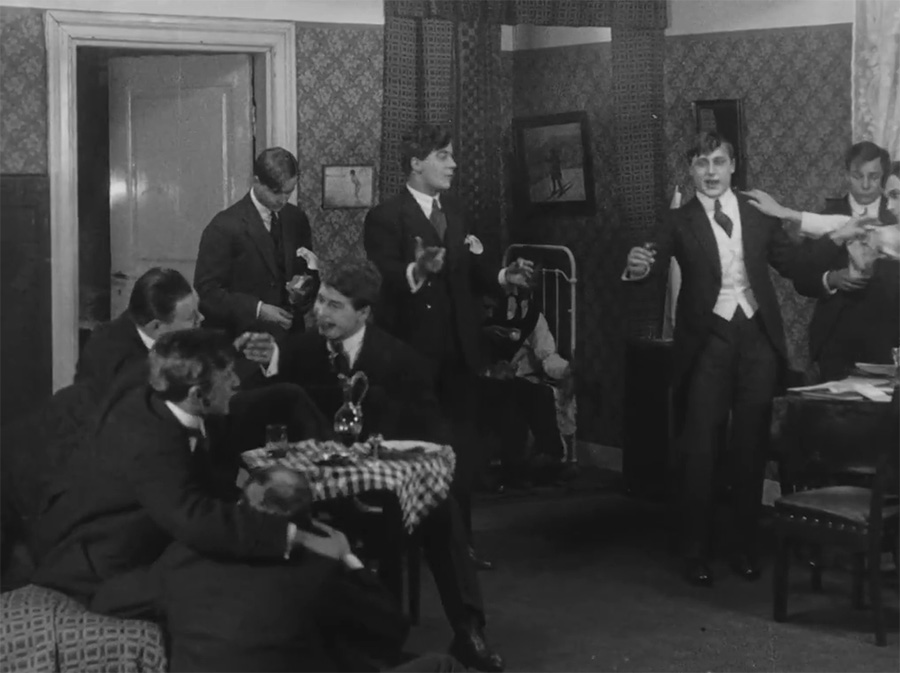
He Who Laughs Last Laughs Best is the story of Martti (Emil Autere), a student who has embraced the college life in Helsinki and spends his money buying rounds of drinks for his friends. (You can spot a very young Joel Rinne as one of his college pals in the opening scene.) His wealthy uncle Kustaa Penttilä (Hemmo Kallio) owns a sawmill, lumber being a major industry in Finland at the time, but has fallen dangerously ill.
Egged on by his artist friend Jussi (Jussi Snellman), Martti writes to his uncle to let him know that he has taken a wife and will need more money. (The waiter in the restaurant scene is Jalmari Rinne, giving this film a 2 out of 3 Rinne brothers score.) What Martti and Jussi do not know is that Penttilä’s doctor (director cameo by Teuvo Puro) has assigned a capable nurse to care for him and his health is rapidly improving.

Jussi has married the well-heeled Impi (Hilja Jorma), who understandably finds it tiresome to be married to half of a frat boy duo, especially since she has just given birth to their son. Impi’s sister, Laura (Ruth Snellman) laughs at their antics because, well, she’s not married to them.
Martti decides to add another layer of gilding to his deception and writes to his uncle that his wife has had a baby. And little Kustaa, sweet Kustaa, named for his great-uncle, he surely needs things! So, if dear uncle could see his way clear to…

Martti has overplayed his hand because Penttilä is now healthy, energetic and eager to rush to Helsinki to meet his niece-in-law and bouncing baby great-nephew. Martti receives word that his uncle is coming and flees to Jussi and Impi’s villa. Quick! He needs to borrow Jussi’s house and his wife as well!
Impi draws the line. He can pretend the house is his but she will not pretend to marry him. Laura, amused as ever, volunteers for the job and so Martti becomes the householder while Jussi and Impi claim they are staying as house guests due to the housing shortage.

Penttilä arrives and takes an immediate dislike to Impi, whom he perceives as a freeloader, entirely too bossy about what happens in the house when she is only a lodger. However, he takes quite a shine to Laura, declaring that he wishes he had met her when she was still single.
Tensions rise in the house as Impi continues to be disrespected in her own home. Martti tries to defend her but this makes Penttilä suspect that he is having an affair with her. Why else would he want to keep her so close? Why else would she act like she is mistress of the house and not Laura?
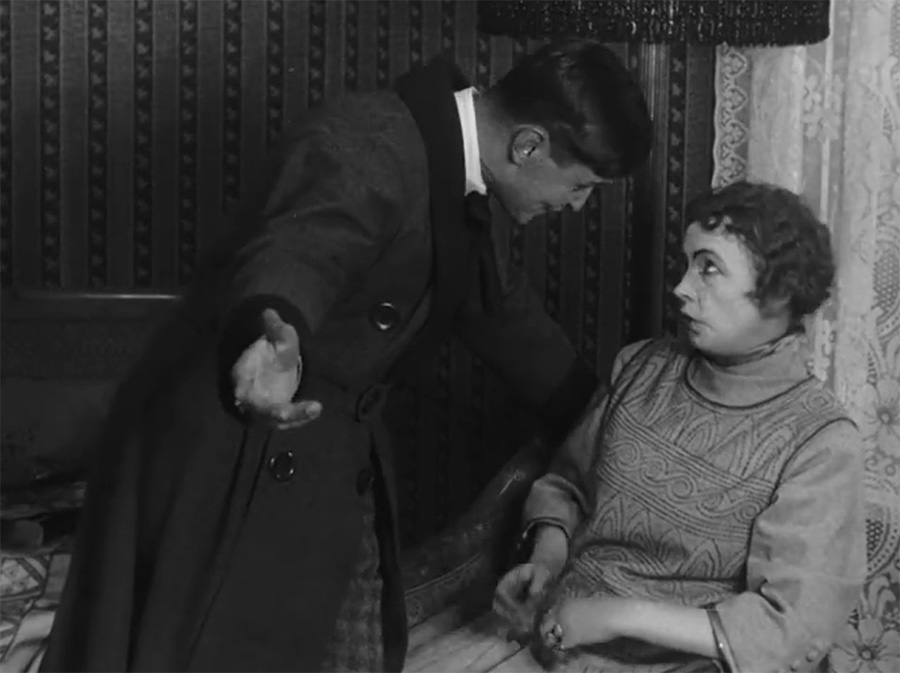
With Penttilä declaring he will extend his visit to the entire summer and Impi threatening to divorce Jussi if he doesn’t throw all the unwelcome guests out, all the pieces are set up for a big explosion and explode they do.
He Who Laughs Last Laughs Best is one of those films that takes familiar comedy situations and puts a new spin on them. The idea of an immature young man taking the dubious advice to fake a wife from his married friend was what kicked off the 1912 American comedy Wanted: A Wife in a Hurry but He Who Laughs Last Laughs Best takes it in a different direction by centering the relatable irritation of poor Impi. She is just trying to mind her own business, do her needlework and deal with her immature husband but now inherits all the problems he has caused with his equally childish friend.
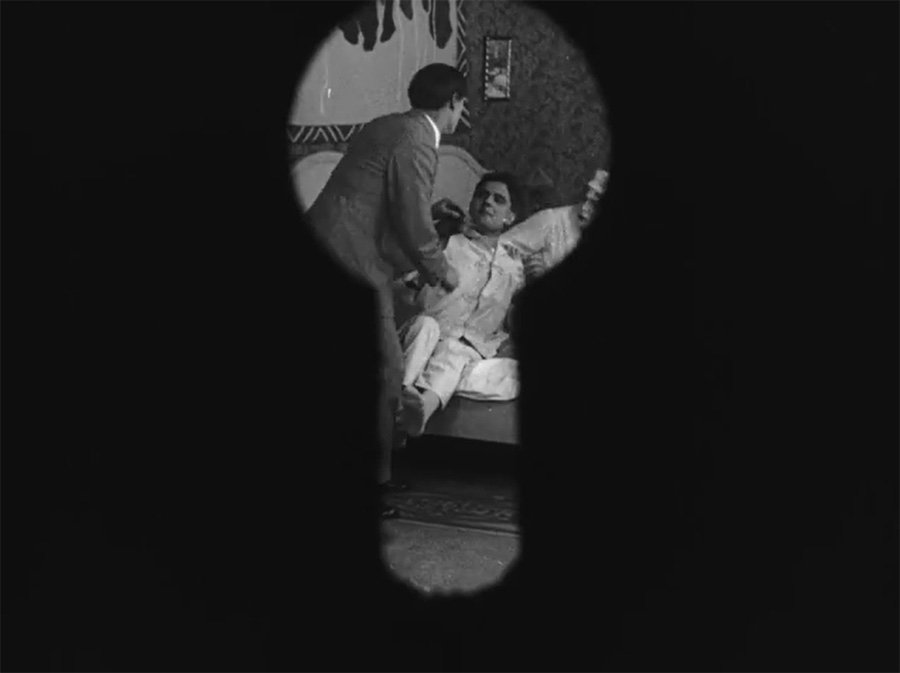
Likewise, the film’s conclusion revolves around the uncle forcefully shoving his nephew and “wife” into the master bedroom. The trope of a nosy relative forcing a not-really-married (or married only on paper) couple together for the night has been used for decades in dramas and comedies alike. All Night (1918) wove an entire feature-length film around Rudolph Valenino and Carmel Myers trying their hardest to avoid being locked in the bedroom together by a baby mad Texan.
However, He Who Laughs Last Laughs Best finds a new twist on the plot: the bedroom is already occupied by Jussi and Impi and when Penttilä hears shouting, he peeps through the keyhole. Four people sharing the bedroom! How shocking! What in the world is going on with young people these days?

I enjoyed Emil Autere’s performance as the irresponsible Martti. He mugs a bit but this is a rather broad comedy. I think Hilja Jorma deserves kudos for her understated performance as Impi, who is really trying to be patient but who can blame her for drawing the line now and again? Hemmo Kallio is clearly enjoying himself as the bombastic Penttilä, who bowls his way through life acting like everyone is an employee at his sawmill.
A great deal of the film’s runtime is taken up with a tour of Helsinki, to the point that this film actually seems like a tourism brochure, but I would say it is quite effective. The people who want to sit down and watch a comparatively obscure silent comedy are also the people who would enjoy seeing a showcase of Helsinki’s beautiful art nouveau architecture. I can imagine it would be fun to seek out the filming locations, I certainly started dreaming of returning for a walking tour.
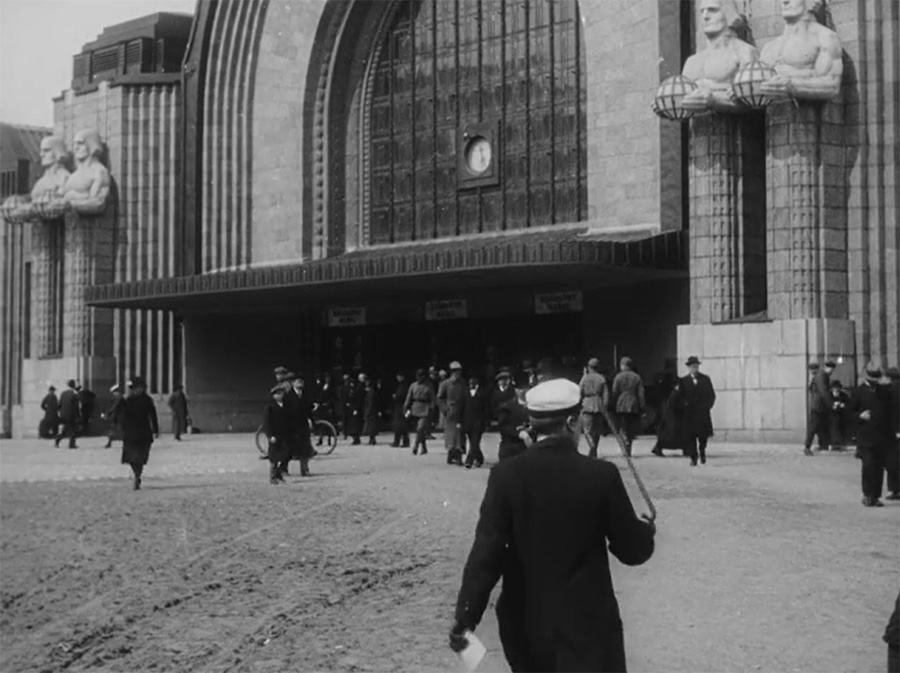
Director Teuvo Puro, whose career pre-dated Finnish independence, is probably best known today for his work in the gothic and horror genres (Before the Face of the Sea is a moody delight) but I think his biggest strength as a director is his ability to convey mood. He Who Laughs Last Laughs Best is a tale of wacky Helsinki college boy antics rather than dark and supernatural deeds but Puro is just as adept at conveying the city’s unique boozy merriment and opulent architecture.
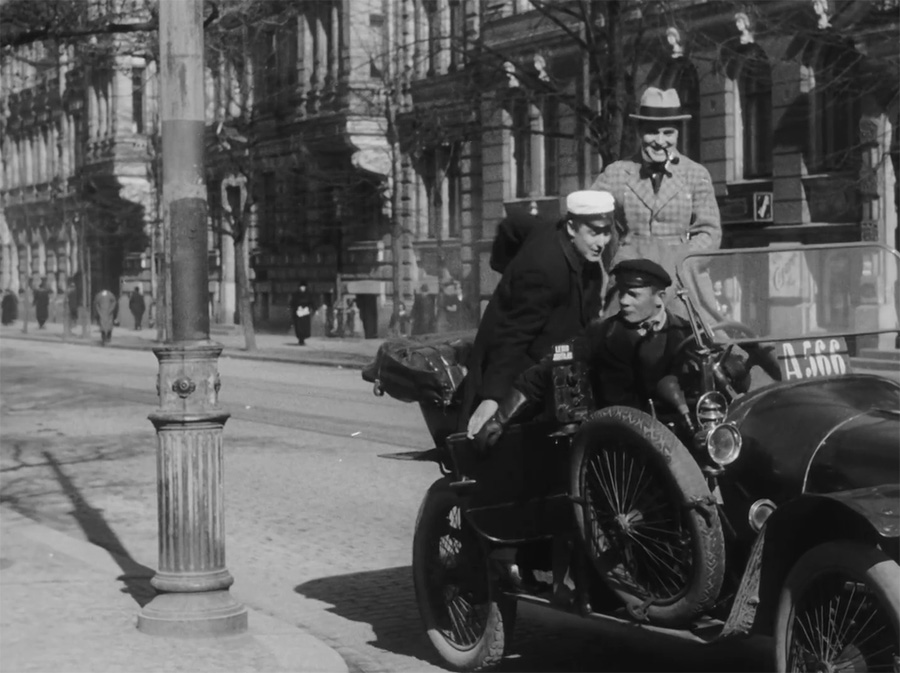
This is a cute short feature, less than an hour, that plays around with familiar tropes and puts its own spin on familiar situations. The cast is game and likable but the real star of the show is Helsinki and its environs with plenty of street scenes, as well as interiors and longer than usual dining and cooking scenes. This is a treasure trove of early twentieth century everyday life (sans the fake marriage, of course).
Where can I see it?
Available to stream on Elonet with Finnish and Swedish intertitles. Swedish speakers should be aware that several long and key title cards are only in Finnish. There are no English subtitles at this time.
☙❦❧
Like what you’re reading? Please consider sponsoring me on Patreon. All patrons will get early previews of upcoming features, exclusive polls and other goodies.
Disclosure: Some links included in this post may be affiliate links to products sold by Amazon and as an Amazon Associate I earn from qualifying purchases.
 Movies Silently