
A mining magnate’s son keeps getting into trouble with women and breach of promise suits follow. To keep him out of trouble, his father sends him on a mineral-finding mission to Basque country, where there are surely no women. But, let’s face it, you’re all here for Harpo Marx in a rare solo (and “speaking”) role.
Home Media Availability: Released on Bluray.
Harpo Speaks
“Harpo Marx made a silent movie” feels like a made-up factoid but it’s quite true and, after being thought lost for decades, a copy of Too Many Kisses was rediscovered but was unavailable on home media in high quality until the Film Preservation Society released a Bluray of a beautiful restoration.

To get the elephant in the room out of the way first, Harpo is both recognizable and displays his characteristic pantomime that he had perfected onstage. However, Harpo’s role is minor, with perhaps two or three minutes of total screentime in a six-reel feature, a decent share of that in the background. Fortunately for fans of the talkies, the villain of the picture is played by William Powell and he has considerable screentime, so you get two sound era superstars for the price of one.
The star of the picture is yet another sound era favorite, Richard Dix. His roles got heavier in the talkies but in the silents, he was frequently cast in breezy adventure pictures that either focused on comedy or romance. As its title indicates, Too Many Kisses goes primarily for the former with some dabs of the latter.

Richard Gaylord, Jr. (Dix) is the son of mining magnate Richard Gaylord, Sr. (Frank Currier) and the father is growing just a bit tired of his son’s antics. You see, Jr. will court women, promise them the world but not marry them, leaving Sr. on the hook for breach of promise money. It’s costing him tens of thousands at a clip.
A solution presents itself when the efficient Mr. Simmons (Joseph Burke) arrives to obtain final approval for his trip to the Basque country, the Pyrenees Mountains between Spain and France, to negotiate mining rights with a local landowner. Simmons informs his boss that the Basque never marry outsiders, so Gaylord, Sr. declares that Jr. will go along and if he stays away from women for the next six months, he will be made a junior partner.
Naturally, nothing goes to plan. Simmons and Gaylord Jr. arrive at the Basque village of Potigny during siesta time (this is where we get our first glimpse of Harpo as the Village Peter Pan) and, after a few attempts to rouse the citizens, nap themselves. When they awaken, the rest of the main characters conveniently arrive.
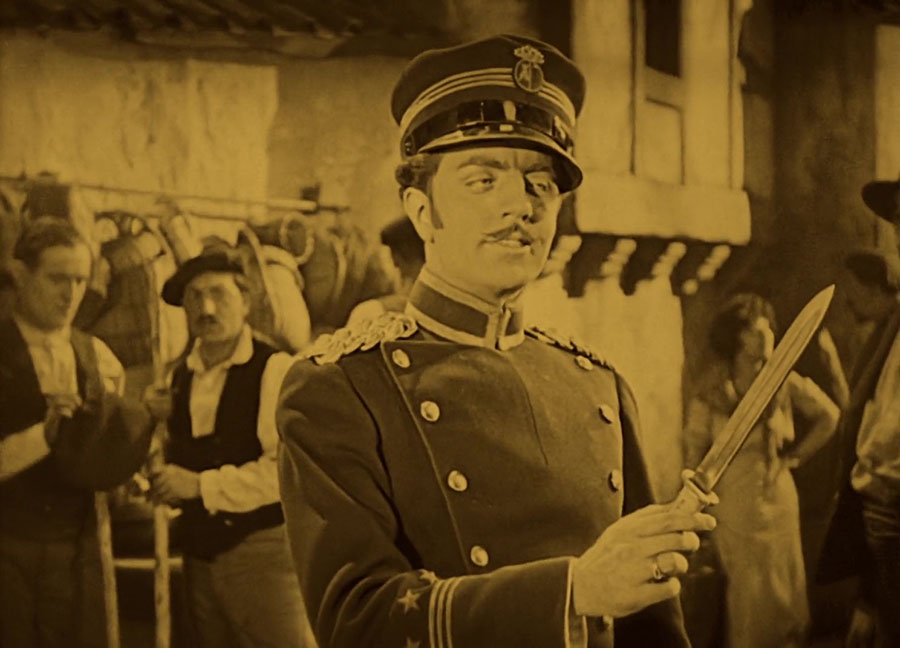
There is Manuel Hurja (Albert Tavernier), with whom Simmons is negotiating the mining rights, and his daughter Yvonne (Frances Howard). Military officer Julio (William Powell) is in love with Yvonne but she will have none of him but her refusal is dangerous because Julio is influential and violent when he does not get his way.
And, yes, everything plays out precisely as you imagine.

Gaylord falls for Yvonne, Yvonne falls for Gaylord. Turns out the “never marry foreigners” thing was much exaggerated. Gaylord tries to woo Yvonne on the balconey and accidentally flirts with Julio, who is trying to serenade from below. Gaylord finds it hilarious, Julio finds it infuriating and the mortal insult can only be wiped out with blood. Not that Julio’s will be at risk, you understand, that’s what henchmen are for.
Julio has Gaylord kidnapped to get him out of the way while he makes his final public move on Yvonne during the local fiesta but he didn’t bet on two complications: first, Gaylord is pretty handy with knives and fists and, second, one of his own henchmen is Harpo Marx.

So, there you have your situation. It’s not bad, as light adventure-romances go, but it’s nothing new and it likely never had any ambitions to reinvent the wheel. I dare say that it would never have seen nearly as nice a release if it weren’t for a certain curly-headed pantomime artist in the cast.
Early Harpo! This sort of movie marketing always has the potential for disappointment. Rudolph Valentino fans will never forgive Alla Nazimova for not making him the main focus of Camille (she played Camille) and latter day marketing teams don’t help matters by selling it as a Valentino picture. The Monster is a solid little horror-comedy but since the audience has been promised Lon Chaney and he only appears near the end, they are disappointed.

In the case of Too Many Kisses, and William Powell notwithstanding, we are here for Harpo. He is briefly shown in the Basque village and then wistfully plays a ladder (no doubt dreaming of harps while miming guitars) before handing it to Powell. So far, so little Harpo. As modern viewers, we are paying a lot more attention to Harpo than any silent era viewer not named Marx would have. Harpo simply not that famous yet. The review in the trade magazine Wid’s had to explain that he was “a comedian from the theater” and adds that he provided good laughs, a sentiment reflected in other reviews that named him as a bright spot in the picture. Meanwhile, the fan magazine Picture-Play named Harpo’s latest stage credit for the benefit of its readers and later name checked him as a draw for Too Many Kisses. So, a good and growing career but not yet a national household name.
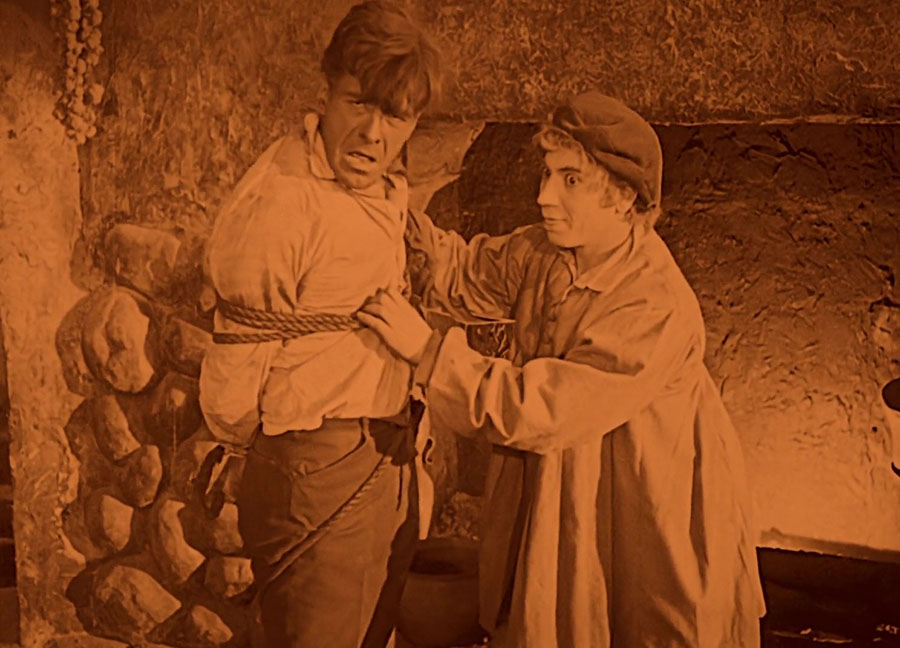
This creates some tension as the viewer waits to see more Harpo in a film that was decidedly not about Harpo. Fortunately, it actually pays off this time because Harpo plays an important part in the finale. He wants to give the captured Dix a drink but the meanest guard bullies him away. Later, Dix escapes (offscreen, boo!) and Harpo finds the guard tied up. Rather than untying him and potentially allowing Dix to be recaptured, Harpo takes the opportunity to punch his tormenter. (After “speaking” a line of dialogue via intertitle.)
With the Harpo question out of the way (the condensed answer being: be prepared for comparatively little screentime but Harpo is recognizably Harpo and his fans should be pleased), let’s dig into the rest of the picture. First of all, the unusual setting needs a bit of discussion. It seems that the plot of Too Many Kisses was sparked by the belief that the Basque would not marry outsiders. (The film is loosely based on a short story but more on that in a minute.)
At the time, Basque nationalism and identity, which had been popularly spearheaded by Sabino Arana, were powerful forces in the region. Arana did indeed condemn marriage to non-Basques but Nick Hutcheon points out in Intra-State Immigrants as Sub-State Nationalists: Lived Experiences in the Basque Country, many of the Basque interview subjects had indeed married outsiders. So, in some ways, Too Many Kisses is accidentally authentic with its main characters not really caring about their different backgrounds that much after all.

Other than the intermarriage plot element and some jaunty berets, the movie’s story proceeds just like any other Hollywood movie set in any location of once and future Spanish rule. Whether Spain, Mexico, Cuba, Argentina or Basque territory, we get siestas, serenades and balconies.
Director Paul Sloane specialized in light entertainment and directed Eve’s Leaves and Corporal Kate for the DeMille company, both of which I enjoyed. And if you want to see Dix in a better vehicle, The Lucky Devil was released earlier in 1925 and it’s the platonic ideal of a fun program picture.
I bring this up because, as Richard Dix films goes, this isn’t his best. The European setting doesn’t seem to do much for him, Dix was at his best in all-American pictures. Wid’s and the Daily Telegraph compare Too Many Kisses to the types of films Wallace Reid used to make for Paramount before his death and it does indeed seem that Paramount was attempting to mold Dix into the new Reid with racing comedies and Yank in Europe romances. That said, I don’t actually like the latter genre for Reid either!

The major issue of the picture, not including William Powell’s nefarious machinations, is that all of Dix’s troubles are self-inflicted but he displays no internal change needed to resolve them. His life would be gravy if he would just stop chasing the skirts. He is sent overseas to cool his ardor, continues to chase skirts and there is no guarantee that he will stop once another attractive dish crosses his path.
Not that it’s a complete wash for Dix, he has some funny scenes. For example, he is shown sniffing the envelopes in his stack of correspondence, only opening the perfumed ones. Later, he is trapped on the phone with a chatterbox lover and, after attempting to get a word in edgewise to excuse himself, ends up passing the phone in order to escape. And, of course, the balcony scene with Powell is a highlight.
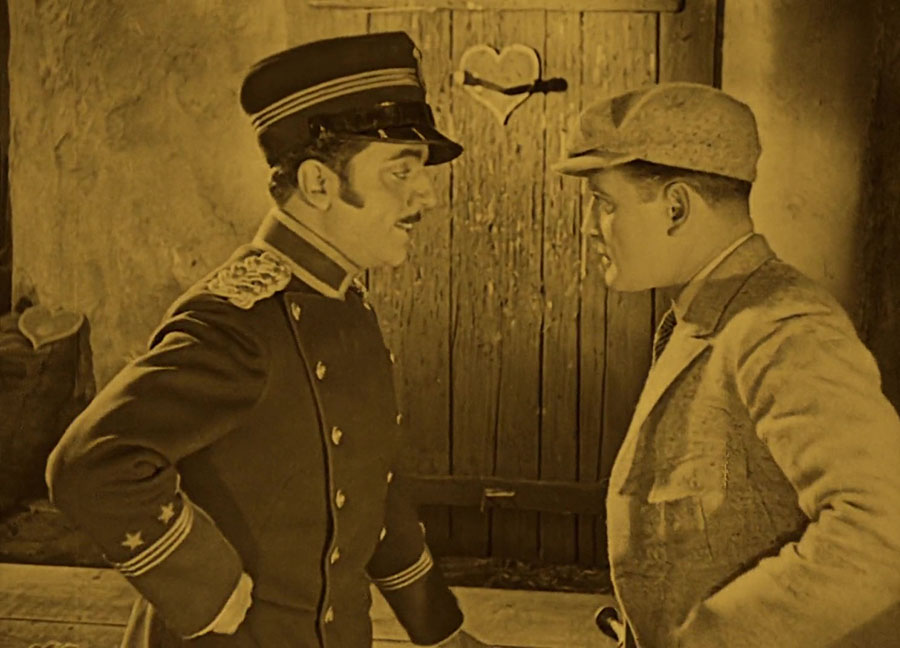
Powell’s character is a real mustache-twirler of a baddie, cowardly in a fight and relying on his henchmen to enforce his will. The film also seems confused about his position as an officer and a bandit. That said, Powell does what he can with the material and the goofier scenes with Dix are quite funny and could have boueyed the picture if there had been more of them.
The movie may be a harmless and silly bit of fluff but it is a masterpiece compared to the short story upon which it is based. A Maker of Gestures by John Monk Saunders was published in Cosmopolitan magazine in 1923 and was breathlessly subtitled with “A Romance of the Pyrenees, where women carry daggers.” If the name Saunders sounds familiar, he was a pilot-turned author who, among many other things in the sound era, penned the source material for Wings and contributed to She Goes to War. I don’t think much of the writing in Wings or She Goes to War.

Trench Gaylord, a name I still cannot believe was published, is not a skirt-chaser in the story, he is a would-be author suffering from ennui, so his mentor tells him to head off to Basque country and soak up the atmosphere. Julio is not an officer, just the local loverboy whom everyone figures will marry Yvonne. The conflict for Gaylord is not only the jealous Julio but also the locals just kind of don’t like him. Not that I’m surprised as he comes off as a kind of boorish alpha male wish fulfillment, attacking the Basque citizenry for daring to tsk tsk at him. “He lowered his head and catapulted into them, a driving force of one hundred and eighty pounds of compact bone and muscle.”
Yvonne is, of course, fiery and I kept waiting for her to wield that famous dagger. She finally does– on Gaylord. She tries to break up the fight between he and Julio, you see, and Gaylord decides she must not love him and leaves in a huff. She doesn’t want him to leave, so she stabs him in the leg, six-inch blade to the hilt, as one does, and Gaylord is head over heels with this Nietzschean ideal of womanhood.

Yes, literally.
“What courage, to hurt the man she loved! Nietszche had said something about that—takes greater courage to cause suffering than to endure suffering.”
I need a drink.
And then Saunders, I mean Gaylord’s book becomes a critical darling and he ends up with Yvonne. No wonder Hollywood (Hollywood!) jettisoned just about everything except some character names, one or two events and the Basque setting. All praise to screenwriter Gerald Duffy for making, if not a silk purse at least one of decent rayon, out of this sow’s ear.

The Gaylord of the story also comes off as more xenohobic than the film, rebuffing Yvonne’s attempts to teach him the Basque language and, unprompted, insulting both Hungarian and Finnish while he is at it for good measure. “Magyar,” he said, “is an atrocity. Finnish is a barbarity. Any relation between those two languages is an absurdity.” Alrighty then. This actually ties into popular race “science” of the era since Basque is not generally reckoned to be in the Indo-European language family, while the Uralic origins of Finnish and Hungarian meant the people were classified as Asian in pro-eugenics circles, which were terrifyingly mainstream at the time. I am not certain why Estonian, the closest relative to Finnish, was left out of Saunders-Gaylord’s rant. Perhaps he was a devotee of Estonian linguist Johannes Aavik but I doubt it.
Quotes Nietzsche, spontaneous xenophobic rants a la Roderick Spode, very strange views on women… check check check… Yeah, not getting a thumbs up from me.
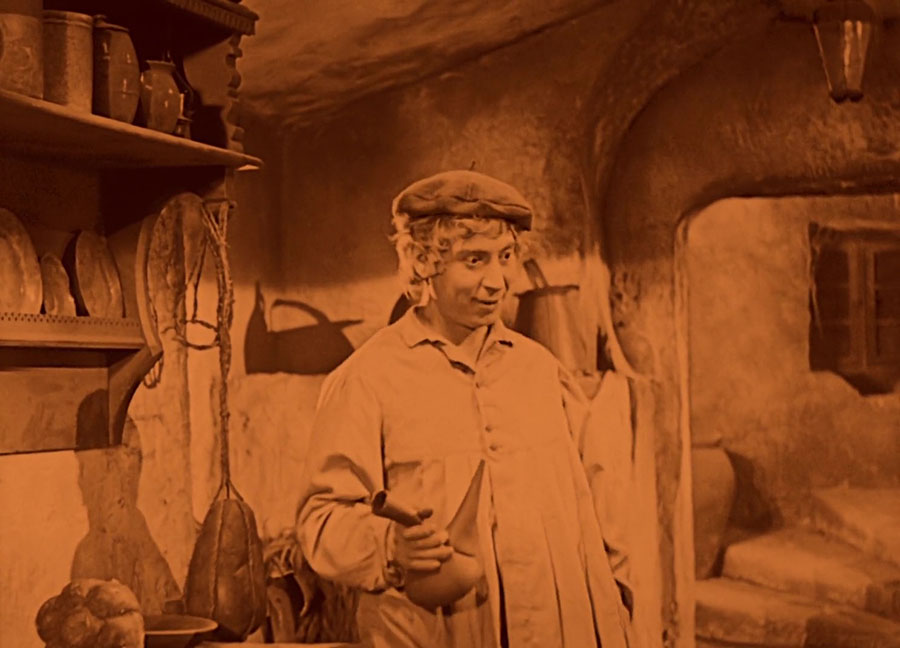
You know what? After reading the short story, I revised my score for this film. Dix is fine, Howard is okay, Powell does his best glowering and Harpo is fun, while Sloane keeps it light as director. Considering what they had to work with, they did a darn fine job.
If you like Dix, Powell or Harpo, you’re going to find something to like about this picture. It’s no masterpiece but it’s entertaining in a silly kind of way and I am glad that it was rediscovered. Now, if anyone can track down Moe Howard’s childhood Vitagraph performances…
Where can I see it?
Released on Bluray by the Film Preservation Society with a score by Bill Marx, son of Harpo.
☙❦❧
Like what you’re reading? Please consider sponsoring me on Patreon. All patrons will get early previews of upcoming features, exclusive polls and other goodies.
Disclosure: Some links included in this post may be affiliate links to products sold by Amazon and as an Amazon Associate I earn from qualifying purchases.
 Movies Silently