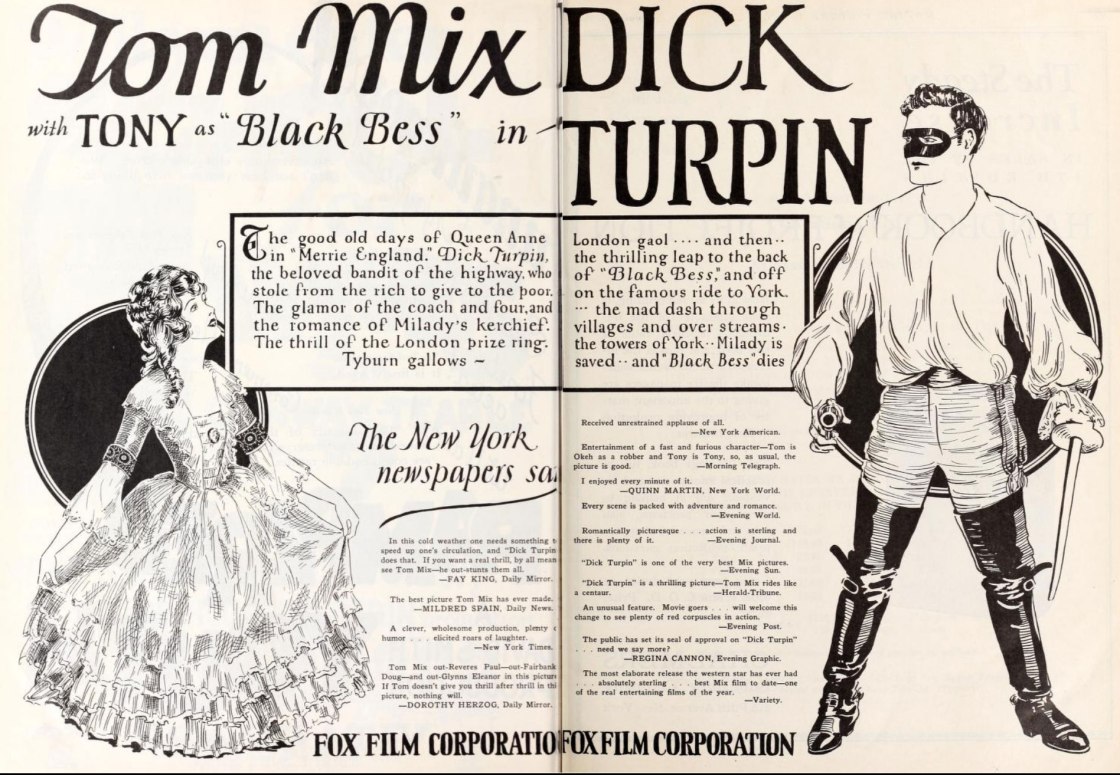
Western superstar Tom Mix, top cowboy of the Roaring Twenties, attempted to expand his success into costume romance with this tale of the famous English highwayman. Lavish sets and costumes, plus the stalwart Alan Hale, support this endeavor.
Home Media Availability: Stream online.
Note: I will also be covering the 1974 Dick Turpin comedy Carry On Dick. Click here to jump to the talkie.
Stand and Deliver
Conventional film history often tells us that the first “adult” western was Stagecoach (1939) but it wasn’t even director John Ford’s first adult western. Conventional silent film history often tells us that westerns started out dusty and gritty (at least from William S. Hart’s debut on) and then Tom Mix and his spangled britches sent them in a far more glamorous and unrealistic direction.

Fact is, Tom Mix started out as dusty and gritty as the rest. In the Days of the Thundering Herd (1914) is as grim as anything Hart made. By the end of the decade, Mix’s films were instead being advertised as full of laughs, thrills and pep. However, Hart was still a going concern and there were still dusty westerns to be had alongside the glitzier Mix films. Rhinestone cowboys and dusty gunslingers have always existed side-by-side in Hollywood.
Mix was at the height of his popularity in the 1920s, audiences loved his glamorous take on the west but, like many western stars before and since, he wanted to expand his selection of roles. Hart had tried something similar by playing a Canadian fur trapper and a Mayan monarch. Other western stars simply swapped their Stetsons and flannel shirts for Mountie uniforms. In Mix’s case, he wanted a role that would still show off his riding skills, he was a cavalry veteran and a genuine rodeo rider, after all.
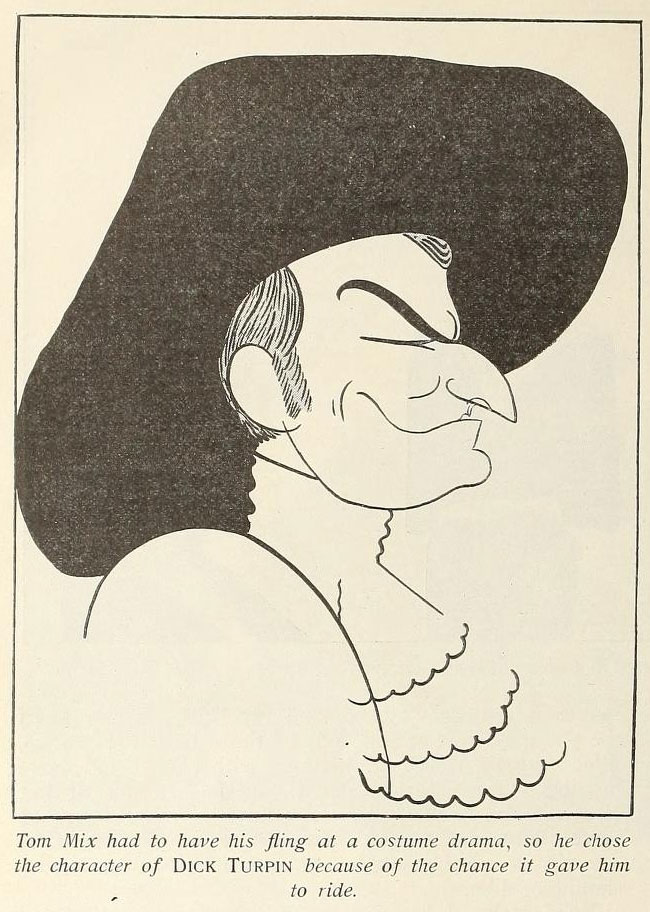
This is where Dick Turpin comes in. Like Bonnie and Clyde, Turpin’s reality was a queasy mixture of cruelty, violence and incompetence that had been rebranded as righteous criminality and, well, print the legend. So what if he was more of a home invasion burglar who tortured innocent homeowners for the location of their valuables (possibly accidentally shooting one of his own accomplices at one point)? The image of Turpin glamorously holding up carriages and lavishing the loot onto the deserving poor was irresistable. Further, Douglas Fairbanks had successfully parlayed his skills as a modern stunt comedian into the king of swashbucklers, so why not try the same trick with a cowboy?
And so, Mix traded his ten-gallon cowboy hat in for a ten-gallon cavalier number with lace cuffs and cravat to match. The picture gets right down to business, admitting in the opening titles that they were going with the romantic legend and immediately showing Turpin at work with a classic “Stand and deliver!” Except this is a reverse robbery and Turpin is actually delivering money to a clergyman to give to the poor.

Turpin rides to his next mark, a nobleman on horseback, only to discover that he is really Tom King (Alan Hale, who seemed to be an essential fixture in these sorts of films as the once and future Little John in the 1922 and 1938 Robin Hoods). King thought he would rob Turpin but they recognize one another as old friends and agree to meet later.
Turpin rides off to rob again, this time targeting Lord Churlton (Philo McCullough), a snotty nobleman. Later, Churlton’s fiancée, Lady Alice Brookfield (Kathleen Myers) and her uncle Squire Crabstone (James Marcus) are robbed by less glamorous highwaymen. Crabstone bravely flees to get help—he promises he’ll be right back—leaving Alice to fend for herself. Fortunately, Turpin arrives to save the day and Alice confesses that she does not love her fiancé and was planning to run away. (With villains named Churlton and Crabstone, you may correctly surmise that subtle this ain’t.)

With four holdups in the first reel, one wonders why carriages were not escorted by the military but the Bow Street Runners, precursor to the modern police force, are on the case and eager to capture this Turpin character. And by “eager to capture” I mean they ride by once and then don’t show up again until the finale.
Anyway, Turpin has a cunning plan, a theme that will repeat itself throughout the picture despite its absolutely dire success rate. Alice will dress as a boy and leave with Turpin. Alice’s maid, Sally (Lucille Hutton), will dress as the bride to buy Alice time to escape. How this is supposed to work, I have no idea. Indeed, Sally is unmasked in minutes and Churlton and Crabstone race off to capture Turpin and Alice.
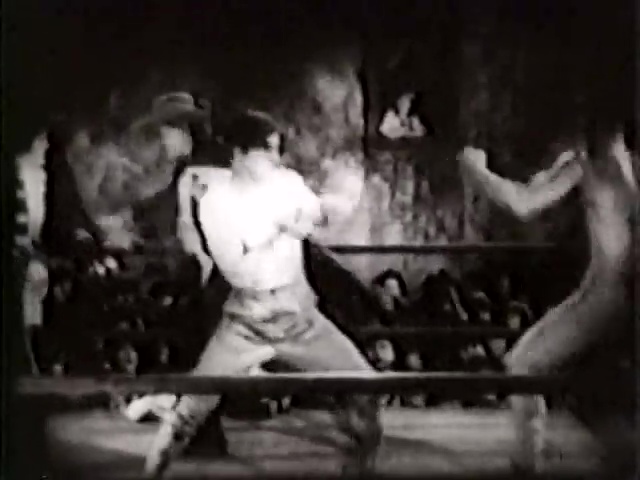
Turpin meets with Tom, who is preparing Bully Boy (Bull Montana), the boxer he is managing, for his debut in the ring. The villains show up (along with Sally) and begin to search for the fugitives. Sally slips away to warn Alice, Tom convinces the villains that Bully Boy is Turpin, Turpin decides to hide out by pretending to be Bully Boy. Got all that?
Again, I have no idea how this is supposed to work because Churlton soon realizes Bully Boy is not Turpin and since the fight is still going forward, surmises that the boxer in the ring is his man. Turpin, Alice, Sally and Tom all escape again but Turpin is lured into a trap and Alice is recaptured.
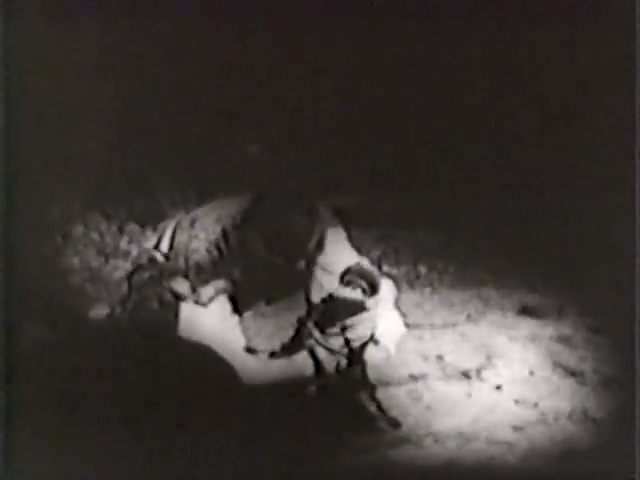
Oh yes, and throughout all this, Turpin’s legendary steed Black Bess (Mix’s regular horse Tony in drag) is following along, kind of hoping to get into a few shots.
Will Turpin hang, as he historically did? Or will yet another cunning plan (with disguises!) spare him from the hangman’s noose? See Dick Turpin to find out!
Well, then.
So, to be clear, I don’t dislike Tom Mix or Tom Mix movies. I wouldn’t walk out of a festival that screened them but I also wouldn’t necessarily make them my first choice either. Mix was an excellent rider and charming onscreen but he just didn’t have the acting chops needed to stand out amongst the sets and costumes of a historical swashbuckler and the screenplay by Donald W. Lee, who had worked with Mix before, didn’t help him.

You see, the film had another structural problem: Tom Mix. Not the man himself, you understand, but what the audience already knew about Tom Mix. Take Black Bess. There are no “a man and his horse” scenes in the picture but (spoiler) when Bess is shot and dies in Turpin’s arms, director John G. Blystone (a regular mix collaborator) was clearly going for pathos but even if Mix had been a Barrymore, the scene still wouldn’t have worked.
I believe the production team was intimately familiar with Tom Mix’s massive filmography and the well-known tropes that his audience loved. Mix fans knew and loved Tony and they knew Mix loved him too. The problem is that Dick Turpin was made to expand Mix’s appeal to people who didn’t necessarily watch westerns (or at least his westerns). Indeed, the film was loudly advertised as “A Woman’s Picture!” A regular Mix western didn’t have to have man-horse bromance scenes every time because their relationship was well-established with regular viewers but Dick Turpin should have and didn’t.

Similarly, the sort of crowd-pleasing westerns that were Mix’s stock in trade tended to not waste too much time on mush, lest they alienate the adventure seekers and tween boys. In Dick Turpin, there is romance but no slow beats to allow it to develop. Mix sees lady, saves lady, falls in love and that’s that. Even in romances where the pair is willing from the word go, a bit of a slow dance is needed to establish an emotional connection so the audience is invested.
Costume pictures were seen as a risk for stars at the time. There was a divide between the tastes of larger city moviegoers and those of the small town houses that had made Mix a superstar. Dick Turpin received strong positive reviews with critics lavishing accolades on the film’s design and Mix’s new direction as a performer. It did good business in New York but New York was not America. We get a hint into the fan response with Agnes Smith’s roundup for the fan periodical Picture-Play Magazine.
“Tom Mix has gone and made himself a costume picture if you can believe such a thing. He simply couldn’t go all through his screen career with a reputation for making nothing but those Westerns, and any way, all the other boys have had their fling, so why not Tom?… Tom proves there were he-men even in England, although many of Tom’s fans believe that Englishmen are saps who drink tea and wear their handkerchiefs up their sleeves.”

Smith’s overall assessment of the picture was positive but her quip about Mix’s fans not accepting him as a foreign fellow in fancy duds proved accurate. We can get some insight into the everyday fans living outside major cities (Tom’s bread and butter) via the feedback small theater owners wrote into industry publications. Their response was exactly what Fox and Mix did not want to hear: they liked the picture but the usual Mix fans just didn’t show up in the quantity they had hoped for. They saw advertisements with Mix in lace and stayed home in droves.
“The poorest Mix we ever ran from a box office angle. The man or woman doesn’t live that can get away with costume stuff in this town… Had several walkouts on this one. Mix really is ludicrous in this.” -Gilman City, Missouri
“Great stuff, but the costumes scare the fans away.” -Mason, Michigan
“Business off a third from other Mix pictures, but you’ll pay the same price. A good production but a disappointment to fans and box office.” -Ada, Oklahoma
“Good, Tom fine and well liked. Some of his fans would not come in to see him, though, as it had costume stuff in it. Our patrons do not like anything with a foreign atmosphere in it.” Genesco, Illinois
“This is perhaps Tom’s most pretentious picture and pleased the majority of those who came to see it. However, I did the poorest business on this of any Mix picture I ever ran. This was probably due to the fact that the paper showed Tom in laces and other frills. They will not bite at this costume bunk, no matter who is in it.” -Neillsville, Wisconsin
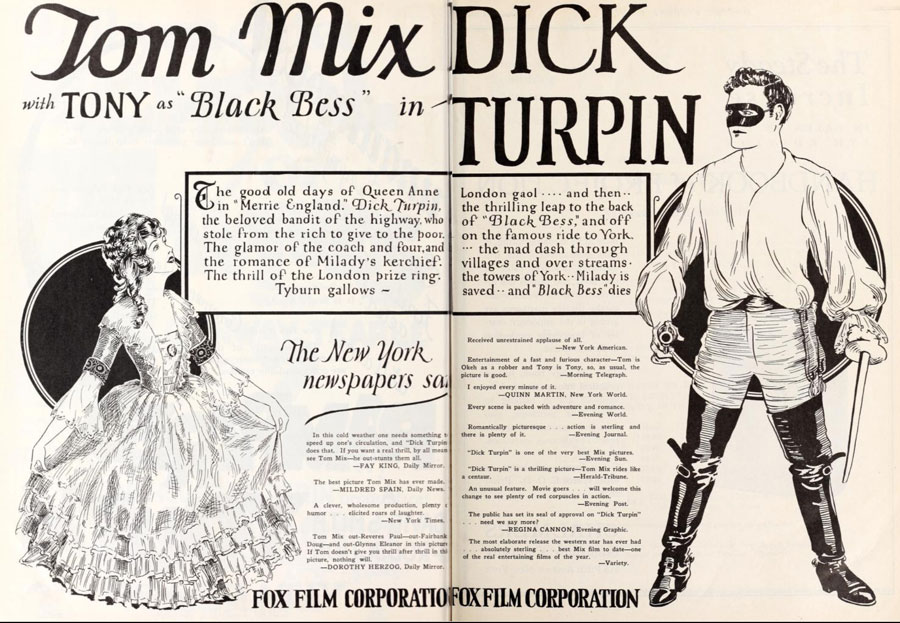
I don’t have box office numbers for Dick Turpin but Mix did not return to the costume picture well, heading back west and staying there (with a foray into the circus) for the remainder of his time at Fox, so take that as you will. And, just as Douglas Fairbanks had one of his popular modern crowdpleasers ready to go after the experiment that was The Mark of Zorro, Mix had Riders of the Purple Sage pre-loaded to follow Dick Turpin, which proved to be a savvy move.
And for all this talk of foreign atmosphere, Dick Turpin doesn’t give the American audience much of a sense of geography for the grand finale and Turpin and Bess’s fatal overnight ride from London to York, some 200 miles. The real Dick Turpin did no such thing and apparently the feat had been attributed to various highwaymen before attaching itself to Turpin. The 1834 novel Rookwood by William Harrison Ainsworth is considered to be the major grounding point for all Turpin lore and features him riding Bess to death in the attempt:
“Bess tottered—fell. There was a dreadful gasp—a parting moan—a snort; her eye gazed, for an instant, upon her master, with a dying glare; then grew glassy, rayless, fixed. A shiver ran through her frame. Her heart had burst.”

That was clearly a bridge too far for Mix and Fox. Killing Tony onscreen was risky enough but to have Mix be the one to ride him to death would have been unendurable. Instead, Bess is shot from behind. As is Tom King in a separate scene, I should point out. I told you this movie has issues with repetitive plot points. Even softened as it was, I cannot imagine the death of Tony pleased Mix’s young fans and word of mouth on the subject (the fate of Black Bess being well known at the time and actually part of the film’s ad campaign) may have also contributed to the film’s disappointing performance. By the way, Tony was billed as “Black Bess” in the credits, which caused some amount of confusion.
Now, I have discussed the film’s flaws at length but it’s not a bad picture by any means. Unfortunately, none of the home media editions are particularly high quality and that kills the big appeal that I have seen repeated over and over in contemporary reviews: the sets and costumes are lovely. And they absolutely seem to be but the details are lost of decay, poor transfers and blowout. I’d be willing to reassess if and when I see this in higher definition.
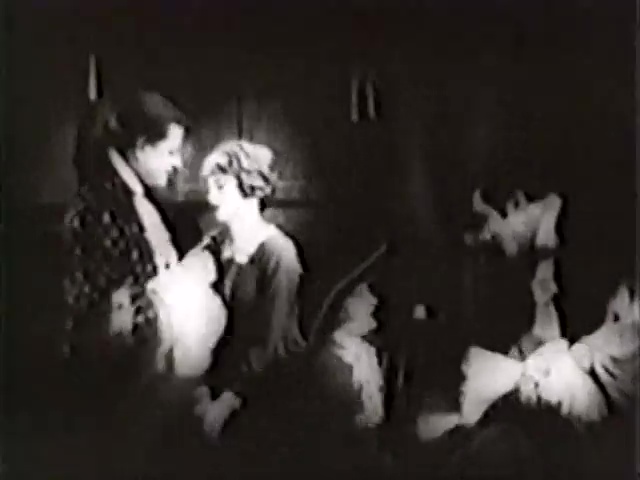
But the film’s strengths that I can see include the performances of Alan Hale and Lucille Hutton, who manage to bring great chemistry and emotion to their romance despite their comparatively brief screentime. And Mix and Tony ride together like a dream, it’s a beautiful thing to see. But again, there’s not enough of it. I actually think there was a much better Turpin picture but it was left on the Fox cutting room floor.
Speaking of cuts, the version available on home media seems to be slightly truncated by five or ten minutes. I wonder what was cut out and shame on them if they were the kinds of slower, quiet, character-building moments that I have been wishing for.

So, once again, is Dick Turpin a bad movie? No. But was and is it enough to turn Mix into a multi-genre star? Again, no. It’s a well-made picture, if ineptly plotted, and I have no complaints about the cast, the costumes or the action sequences. (Except perhaps the pandering-to-the-teens bare-knuckle boxing match.) That said, I am not really sure there is much memorable about it beyond the novelty of Mix in lace cuffs. This puts it in strong C+ territory: you won’t regret spending some time with it but I am not sure it can be called any kind of triumph.
Where can I see it?
There are assorted public domain versions available, none with particularly good transfers. Here is a link to a theater screening with a live accompanist, Bill Rowland on organ. I always sit as close to the musicians as I can when I attend live silent screenings, so I appreciate the keyboard camera on the organist.
Silents vs Talkies
Dick Turpin (1925) vs Carry On Dick (1974)
Ladies and gentlemen! It’s the battle of the Turpins. In this corner, we have the pricey American epic and in that corner, we have the notoriously cheap British farce! Which highwayman will ride away with the victory?

Carry On Dick (1974)
Carry On films tend to be a regional preference and so a bit of an introduction to this spoofy farce series is in order. The original franchise ran from 1958 to 1978 with thirty films in all, plus a 1992 attempt at a revival tying in with the seemed-like-a-good-idea-at-the-time Columbus picture stampede to celebrate the 500th anniversary of, well, you know.
There was no attempt at serialization with each picture set in a different place in time, often spoofing popular genres, hit films or historical figures. The tone was bawdy, the productions were cheap and the whole thing lived or died on the shoulders of the underpaid regulars. While there was no continuity as such, the regular actors tended to play archetypes rooted in British music hall tradition.
(Writing this, I realize that I like Carry On films because of their similarity to the broad, wild, cheap, music-hall-infused and off-the-cuff wildcat producers of the early silent film days.)
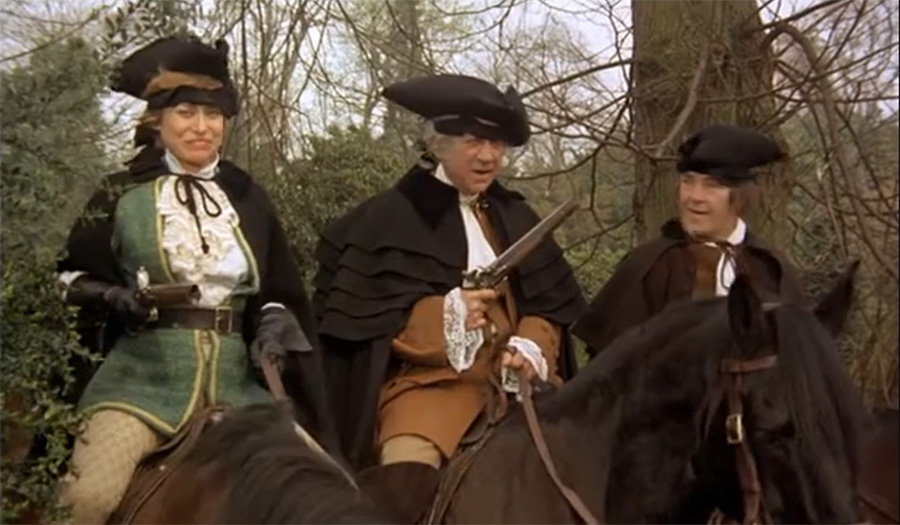
The films were assertively lowbrow and reveled in it, making no attempt to spiff things up. There was never a danger of a royal command Carry On performance and, like Tom Mix pictures, the films were never going to get within spitting distance of the Academy or any other kind of award. And that was the secret of their appeal, really. (And, of course, the decidedly unfancy tone of Carry On is a humorous contrast to silent era Americans proclaiming Brits fancy and stuffy.)
Carry On Dick was released near the end of the original run, with old regulars dropping away from the films and a more overt tone creeping (bursting? Carry On was never subtle) into the gags. The series was most at home in the swinging sixties and struggled to maintain its audience as the 1970s wore on. This picture was the swan song for several more of the regulars (most notably Sid James) and the last time Carry On would do a full costume production until the attempted revival (unless you count a war picture).
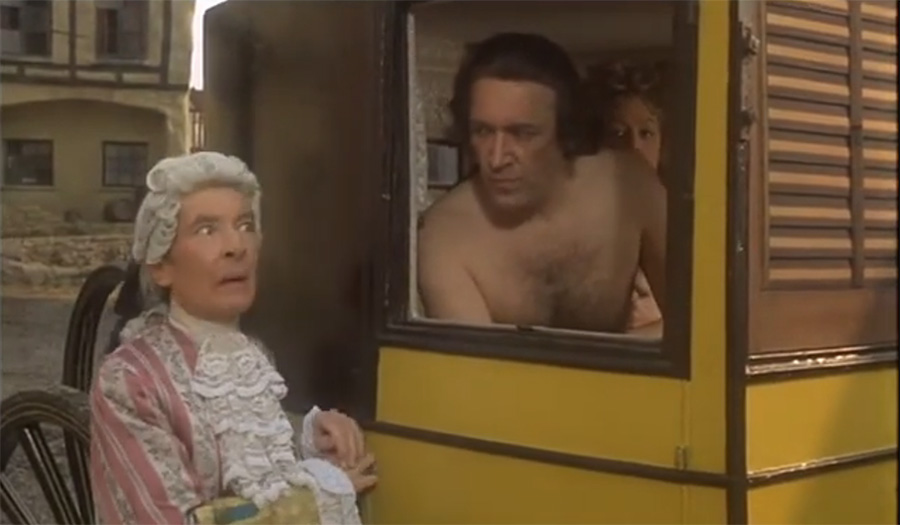
As is typical for the series, Carry On Dick makes no effort to portray either the reality or legend of Dick Turpin. In fact, he seems to have been chosen as a subject entirely for the double entendre. The film follows Captain Fancey (Kenneth Williams) and Sargeant Jock Strapp (Jack Douglas) as they hunt Big Dick Turpin (Sid James) and his gang (Barbara Windsor and Peter Butterworth).
Turpin robs and strips Madame Desiree’s (Joan Sims) mobile burlesque show, as well as Sir Roger and Lady Daley (Bernard Bresslaw and Margaret Nolan), which sets the law, in the form of the Bow Street Runners, onto his heels. However, Turpin is apparently invisible in his secret identity as the kindly Reverand Flasher, who always seems to be selling valuables to help the poor. (As you can see, the names in this Dick Turpin are about as subtle as the ones in the silent film and very much par for the Carry On course.)

Carry On Dick is in reliable territory for the series but the picture feels… empty, I suppose is the best way to put it. At its best, Carry On films are absolute chaos with mad caricatures racing about. I am not sure if there were limitations on the availability of the actors (a distinct possibility) but all the different actors are paired off and then sort of boxed away and kept from the main plot until needed, making the whole picture mechanical and disjointed.
The main thread of the story is Fancey trying to capture Turpin and being outfoxed but the match is so uneven that it’s not particularly amusing to see Turpin-as-Flasher get away again and again and again. This sort of thing worked in Don’t Lose Your Head (1968, a sendup of The Scarlet Pimpernel) simply because there was more of everything else to compensate, including some genuinely funny guillotine escape scenes.
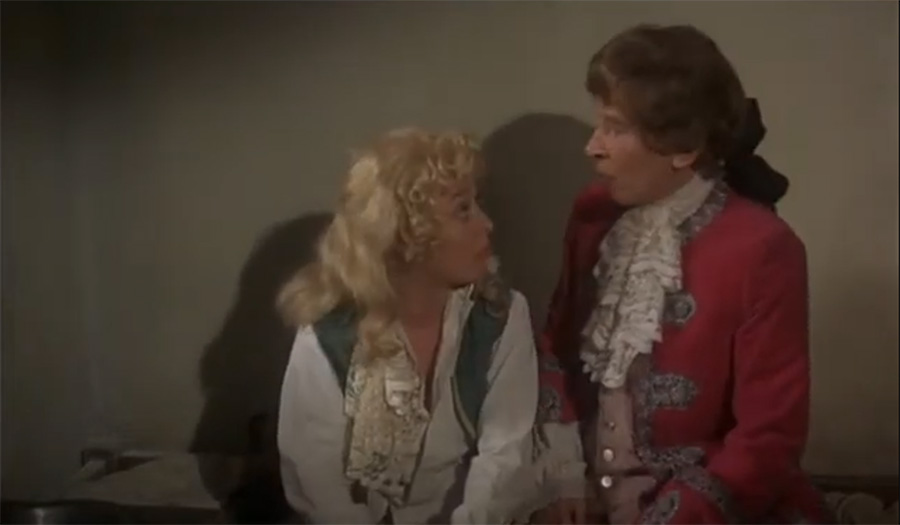
In comparison, Carry on Up the Khyber’s plot is kicked off when Charles Hawtrey’s hapless private is discovered to be wearing underpants under his kilt, destroying the regiment’s tough reputation, making them the underdogs. Carry On Cleo, probably the most popular entry, has all the royalty and generals and senators one would expect but the protagonists are Jim Dale and Kenneth Connor as enslaved and baffled Brits just trying to escape and maybe get a bit of romance on the side, know what I mean? (nudge nudge)
Entries like this really make me miss Dale, who managed to bring a gentle naivete that contrasted well with Sid James’ unabashed raunchiness and Kenneth Williams’ affectedly posh double entendre. Dale, unsurprisingly, was subsequently snapped up by Disney for their live-action fare, which was where I first encountered him. I don’t blame him wanting to be paid, in money even, but his loss is felt. Charles Hawtrey and his specialty for playing weird little men is also sorely missed, we could have done with a bit more of that, especially since series regulars Joan Sims and Kenneth Connor were underused, as was newcomer Sam Kelly.

While Carry On films were famous for their naughty sense of humor, there was usually something more to giggle at. For example, Carry On Cleo contains some fun wordplay. Caesar (Kenneth Williams, of course) shouting “Infamy! Infamy! They’ve all got it in for me.” is hilarious, as are the legionaires chanting “sinister-dexter-sinister-dexter” as they march.
Carry On Dick, well, just doesn’t. Farce comedy exists on just this side of plausible deniability. Characters smirk as they declare that the new servant has a promising future in front of her, a double blessing, in fact. A character bursting in to shout “Yeah, and she has huge knockers!” thus ruining the carefully constructed inuendo, was a popular gag in such comedies and a variation is used in this film.
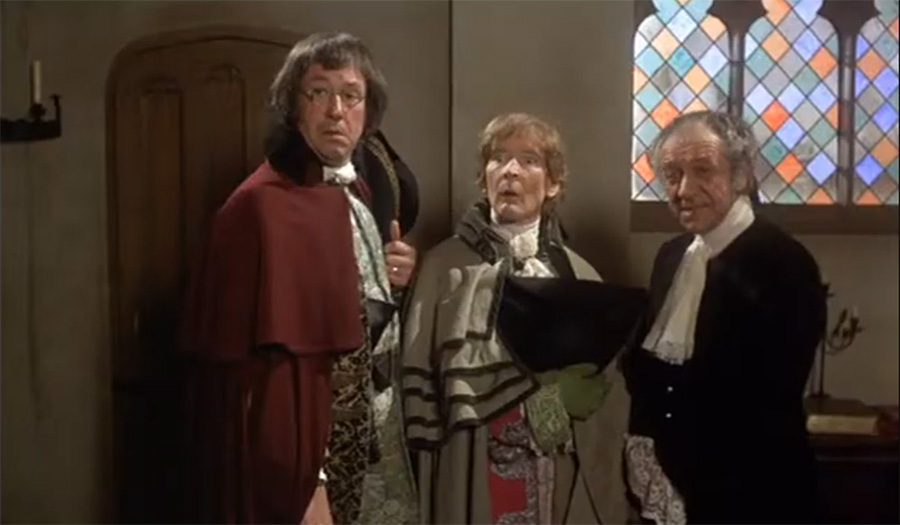
However, the problem with the Carry On series at this point was that it was about 90% knockers and vanishingly little nudge nudge when the best entries were about 50-50. Jeremy Lloyd and David Croft had picked up the nudging slack and their nudges were being broadcast right into the audience’s homes. (Carry On also attempted to jump to the small screen with many regulars and a return to costume settings. Carry On Laughing lasted for two series.)
Worse, with so few characters to watch and so few interactions between the different groups, the film is also inconsistent in its motivations and behavior. Again, I am aware with whom I have the pleasure, I am not expecting a one-man Winston Churchill show or something equally actory but this is ridiculous.
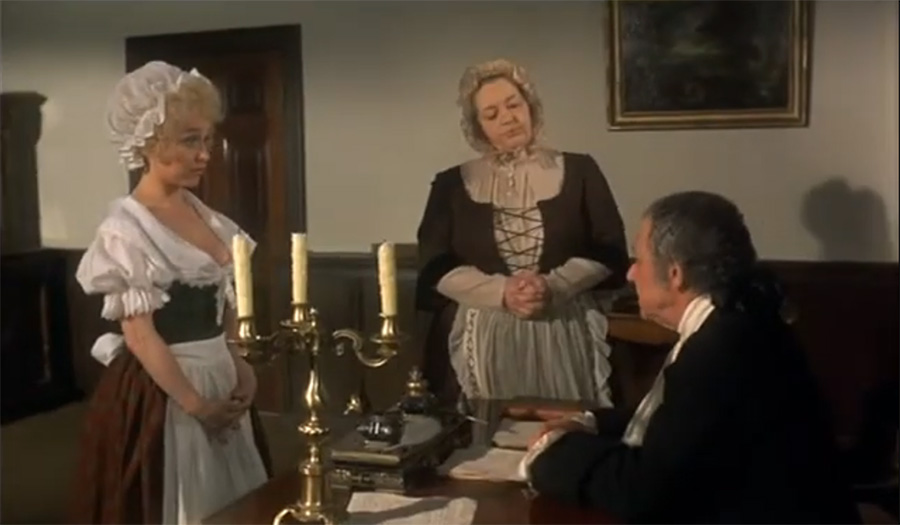
For example, Sims’ Madame Desiree is one minute screaming that her girls are not common tarts and the next gleefully shrieking for them to disrobe Fancey. Her French-to-cockney code switch is never capitalized on. Bernard Bresslaw has a roaring good time as Sir Roger Daley but the screenplay can’t quite decide whether to make him a prude or a pervert. The plot device of a birthmark on Turpin’s “difference” has no real payoff. The abilities of the characters are also inconsistent, with the Bow Street Runners established as dangerously efficient in the prologue, only to transform into the Keystone Cops for the remainder of the picture.
Barbara Windsor and Hattie Jacques are the only members of the cast given something really interesting to do (and Jacques only in the third act, again with no payoff) as the highwayman-servant and the housekeeper, organist and would-be wife to Reverand Flasher. Sid James seems a bit bored with his signature roaring bawdiness and his turn as the “devout” rector is far more interesting.

All in all, the series was on its last legs and it was obvious on the screen, not a very happy state of affairs even if some of the old charm peeped through. (Know what I mean? Nudge nudge!)
And the winner is…
Carry On Dick

This one was close. I mean, close close. In fact, I didn’t really know which I would pick until right before this review published. I probably would have called a tie if it weren’t for my longstanding “no ties” policy for these things. What struck me was how many similarities there were between these films despite their very different approaches to the material.
Both pictures suffer from relying too heavily on the past popularity of their stars and stock characters, using fond audience memories where character and plot development should be. Both contrive an unearned happy ending that feels abrupt and unsatisfying. Both get caught up with inn-bound set pieces that are not nearly as amusing as their screenwriters seemed to have thought they would be. Both feel curiously empty with a small small world that never expands outward at any point. Both unsuccessfully pander to their target audience in a way that feels inauthentic.

With all these similarities, I had to start looking for differences outside of genre and I finally hit on one that matters to my perception of the films: budget. I am always a harsher critic toward big budget films than cheaper fare simply because the former have the resources to fix most of their problems. Carry On’s producers were notoriously stingy and the films had enough money for a pretty good puppet show but they managed anyway. Dick Turpin, on the other hand, had the entire might of the Fox company behind it and as Tom Mix was their biggest star, they had every incentive to make the picture succeed.
Also, Carry On doesn’t kill any horses onscreen here, so another point to them.
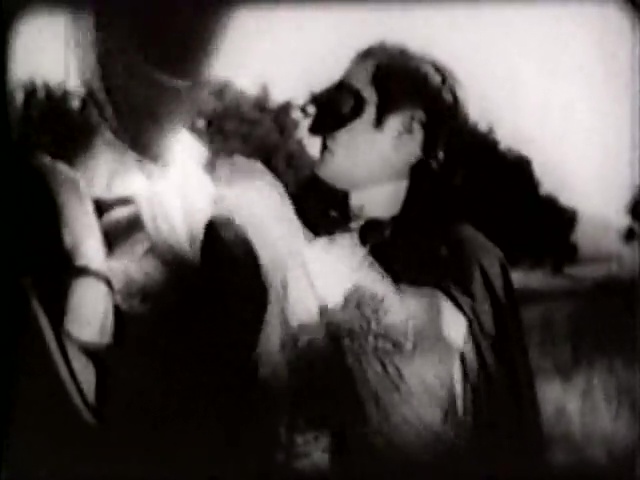
Again, Dick Turpin is not a bad movie but it is very easy to see why it was not a success with audiences of its day. Carry On Dick made a bit of money and the series lived to fight another day, even if those days were numbered.
I have to admit that I am a much bigger fan of Tom Mix from his earlier, scruffier days and if you want to see him at his best, check out Saved by the Pony Express (1911), which dispenses with all fluff and excuses and just gets right down to the business of Mix riding hell for leather to deliver evidence that will clear an innocent man.
As for Carry On, if you want to see the series when it was firing on all cylinders, Carry on Cleo and Carry On Screaming are far better choices and will give you an idea of why these pictures were so beloved for such a long time.
☙❦❧
Like what you’re reading? Please consider sponsoring me on Patreon. All patrons will get early previews of upcoming features, exclusive polls and other goodies.
Disclosure: Some links included in this post may be affiliate links to products sold by Amazon and as an Amazon Associate I earn from qualifying purchases.
 Movies Silently
Well I never thought I’d see a Carry On film on this site – or that it would be a winner in a comparison test (with anything other than another Carry On film) – but then the BFI includes Carry on Up the Kyber as one of the 100 best British films of the 20th century….
Ha! Yes, if we keep going, maybe a Carry On movie will be remembered as the pinnacle of cinema in a century of so.