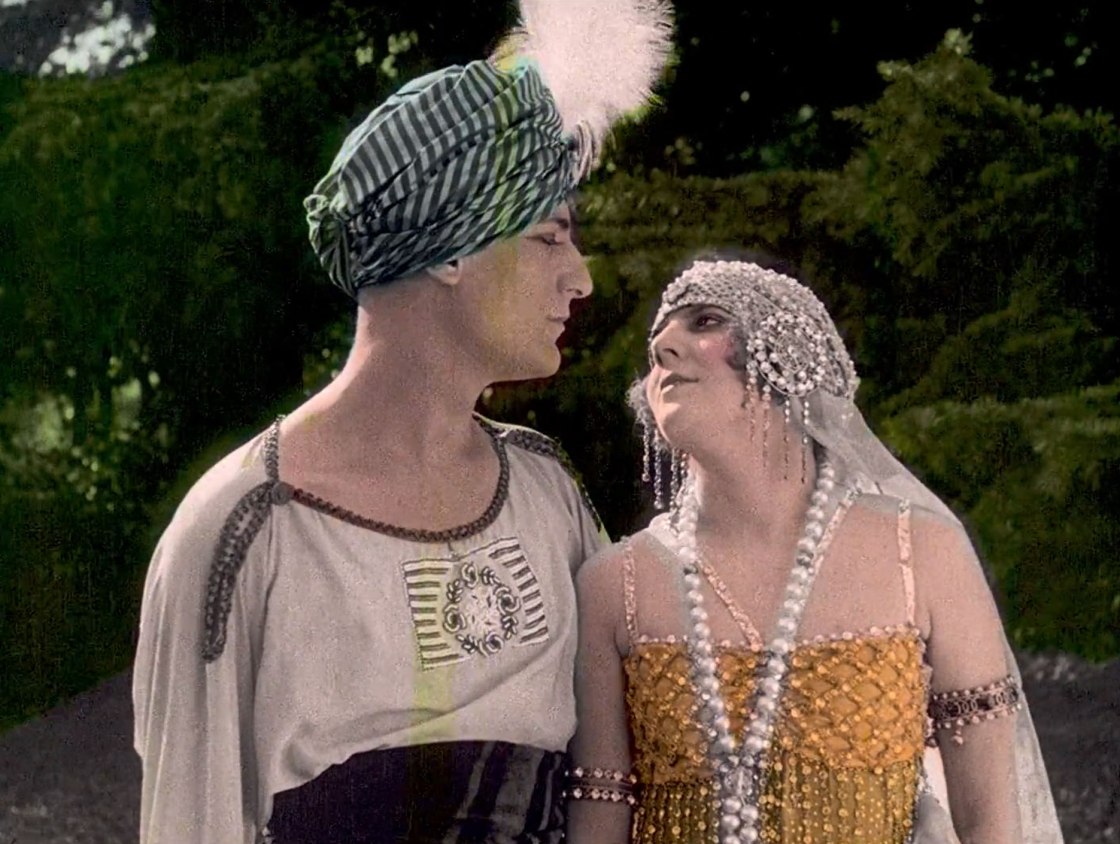
A wicked ruler wants to cure his boredom with the wonders of the world and the one he wants most is the princess of a nearby kingdom. Stencil color enhances this Arabian Nights Fantasy.
Home Media Availability: Stream on Henri.
The color of romance
In the aftermath of the First World War, France was ready to reassert its position as a global cinema powerhouse and productions of the late-1910s through the 1920s grew bigger, grander, more elaborate… and more colorful. The Sultana of Love has an official release date of 1919 but the 1923 release is the one we will be focusing on because it was a showcase for one of France’s most famous movie crafts: applied color.
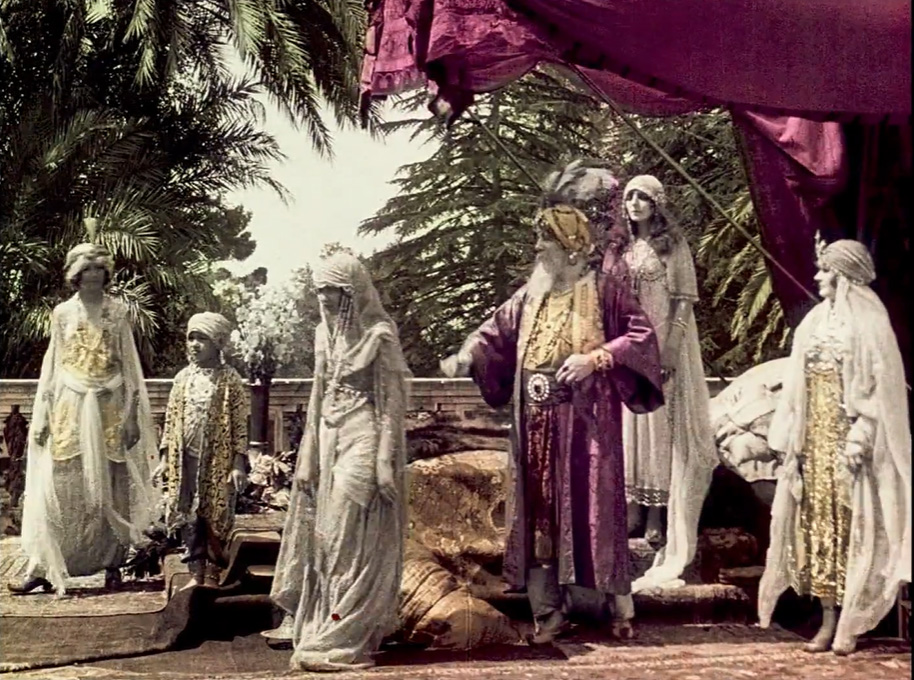
Producer Louis Nalpas secured an estate in Nice to serve as a backdrop for his Arabian Nights tale of romance, adventure and Orientalism. The Sultan Malik (Paul Vermoyal) is bored and when he gets bored, he gets violent and when he gets violent, members of his court lose their heads. He has sent out his personal bandits to find him wonders to amuse him. Kadjar (Gaston Modot) is the nastiest of the lot and he rides into a neighboring kingdom, scaling the palace walls.
There he discovers Princess Daoulah (France Dhélia), the most beautiful woman in the world. Her father is in a tizzy because she refuses to marry and will not tell anyone why. Satisfied, Kadjar rushes off to tell Malik about Daoulah.

The princess confides in her eunuch nursemaid the true reason for her refusal to marry: she is already in love. While disguised as a commoner, she met a fisherman who saved her life. He gave her an emerald ring and she has worn it in an amulet ever since.
But how could a fisherman afford such a ring? Well, in another neighboring kingdom, Prince Mourad (Sylvio De Pedrelli) is pining and refuses his royal duties. You see, while disguised as a commoner, he met a dancer and saved her life. He gave her an emerald ring and then they parted and he can’t find her, so he is frequenting every cabaret and hiring every dancer he can find. It’s a sacrifice but he’s ready to do anything for love.

This may be a good thing or a bad thing, depending on your perspective, but once you strip away the lavish trappings, beating at the heart of The Sultana of Love is a P.G. Wodehouse story. Two rich ditzes traveling incognito, fall in love and forget to tell one another who they really are or even where they are from? Only Jeeves could untangle this mess!
Unfortunately, there is no Jeeves and our romantic leads, while quite attractive, are about as sharp as a sack of wet mice. There’s no hope they’ll ever find each other… until Mourad flirts with a dancer Kadjar fancies and he ends up getting his royal ribs stabbed by the bandit. While recovering, his adviser tells him of a wondrous telescope that can see one’s heart’s desire.

Meanwhile, Malik flirts with executing some Greek slaves for funsies but is finally distracted when his bandits return. One brings a magic telescope, Kadjar brings news of Daoulah. Malik doesn’t believe him but the magic telescope doesn’t lie. Malik declares that he will win Daoulah for himself.
Will the villain succeed or will true love conquer all? I have a feeling you have already guessed which way The Sultana of Love goes but you will have to watch the movie to see how!

So much of this picture can be classified as “your mileage may vary.” Directors Charles Burguet and René Le Somptier make the most of the beautiful scenery and The Sultana of Love is considerably faster moving than other European films in the genre. Perhaps it’s the three settings that eventually converge but there is comparatively little dramatic staring in this picture.
However, there are oddities. I am not sure why Gaston Modot’s Kadjar is given screen time and closeups equal to that of the main cast for what is, essentially, a henchman, especially since there is no particular payoff in the finale with a mighty duel or something similar. (Think Rupert in The Prisoner of Zenda.) In fact, the film lingers over multiple minor characters who do not really have a major role in the story overall. There’s world building and then there’s just dithering about and this feels like the latter.

The action sequences are quite good, extremely vigorous. The kidnapping scene is particularly interesting because it seems that both Modot and Dhélia are performing their own stunts, which involve being lowered down a steep cliff (and climbing same) into the ocean. There’s also a lot of hell for leather riding, which always looks good no matter the genre. I do wonder at the ease with which everyone is able to invade everyone else’s private gardens, though. Seems like a bit of a security concern.
Again, your mileage may vary. This is not a film that stands up to heavy scrutiny and is meant to be enjoyed as a bit of fluff rather than intensely discussed. The costumes and the scenery are delightful and everyone seems to be into their roles.

However, the main attraction here is the color. Stencil color was introduced in the 1900s and it is exactly what it says on the tin: thousands of tiny stencils were cut, one for each color of each frame, and the color was then stamped onto the movie’s prints. Natural color technology was fussy and did not capture the full spectrum, so stencil color remained popular even after newer technology was introduced, particularly in France, where most of the stencil color laboratories and technicians could be found.
If stencil color sounds laborious, it was. Even the most skilled stencil cutters had to take time and care, so the process was usually limited to short films or set piece sequences within longer films. The 1925 film Cyrano de Bergerac is one of the few all-stencil features and it took years to release because of the meticulous color.
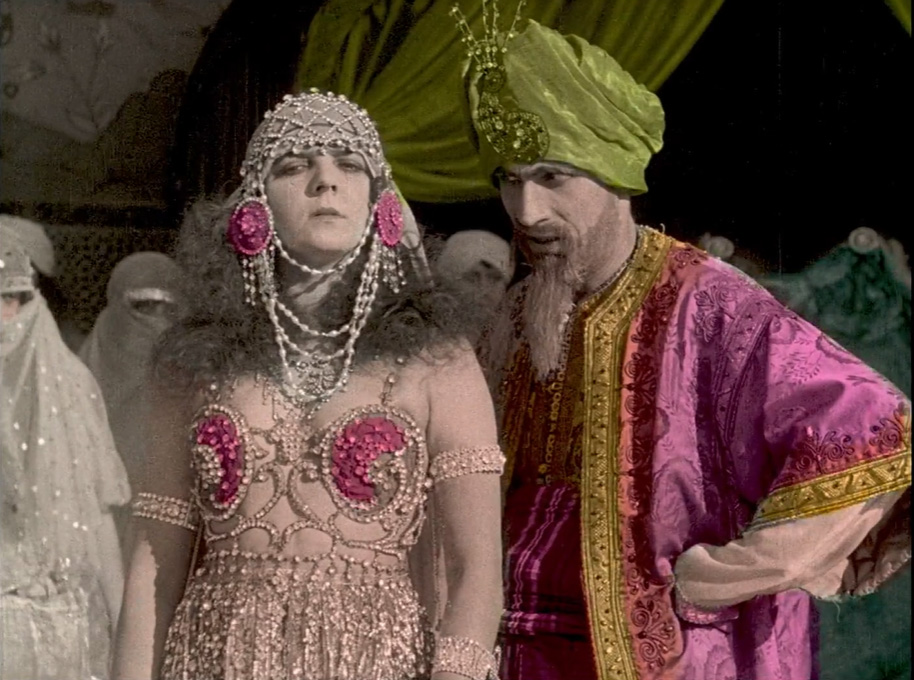
The Sultana of Love was a slightly different situation. While it had been initially planned as a stencil-colored film, it had been released in 1919 without it, presumably to avoid an expensive product moldering on the shelf while the color application was completed. Another assumption I make is that the film would have been tinted upon its original release, something common for films, particularly lavish epics, at the time.
The film was recut, taking it from eight reels to six, and re-released with stencil color at last in 1923. The reviews were generally positive but some critics proclaimed the colors garish and that the pink cheeks of the cast members made them look feverish. One particularly memorable pan declared that it “will soon go to sleep in the common grave of the worst turnips.”

While I enjoyed the color overall, I do think the piecemeal approach to it ended up harming the product to a certain extent. While Cyrano de Bergerac was overseen by Madame Thuillier and had a set palette based on artworks of its period setting, The Sultana of Love’s shades vary wildly, from dainty and natural fruit blossoms to eye-searing yellows and oranges inside the cabaret.
Some scenes are breathtaking in their beauty, especially shots involving sunsets, the sea, trees and mountains. Nature is friendly to stencil color. Less successful are scenes involving large numbers of extras. The color is inconsistent between long shots and closeups, details appear and disappear and recolor. Action sequences also seem to be a problem, with the color sometimes being lost as the characters slug it out and dive to the floor.
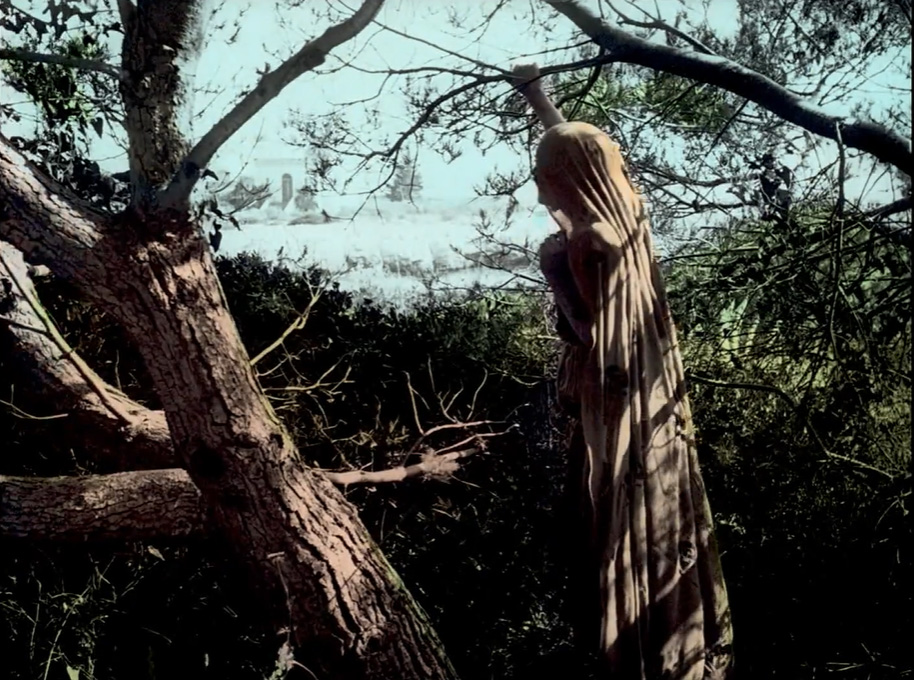
That’s not to say the stencil color is a failure as a whole. The film is extremely impressive and the sheer amount of handcrafted labor that went into the color is staggering. However, I do think the length of the picture led to some corner cutting and you can immediately recognize when one of the some fifty colorists who worked on this picture was having an off day. This was a big risk and it didn’t always work but I am glad they were bold enough to attempt it. Also, the mixed reviews are revealing as to the tastes and preferences of the audience, as varied as they are today. One viewer’s garish is another’s bright and cheerful.

So, is The Sultana of Love worth seeing? Well, it depends on what you want to see. If you’re in the mood for a very fluffy fantasy with beautiful design and groundbreaking color, this will be a winner. But if you get distracted by somewhat sloppy plotting and sad sack characters, it will probably be annoying to you. I’m glad I saw it, it’s a beautiful picture, but I must admit that it is a rather silly one.
Where can I see it?
Stream for free courtesy of Cinémathèque Française. The film does not have English subtitles or a score but the story is easy enough to follow.
☙❦❧
Like what you’re reading? Please consider sponsoring me on Patreon. All patrons will get early previews of upcoming features, exclusive polls and other goodies.
Disclosure: Some links included in this post may be affiliate links to products sold by Amazon and as an Amazon Associate I earn from qualifying purchases.
 Movies Silently
That scene at about 60mins is rather brutal.
Right?
The PG Wodehouse comparison had me cackling. This movie feels more like something that Bertie would recount to Jeeves over a brandy, presumably as justification for why some scheme he’s planning is sure to work.
And then Jeeves will see through Bertie’s muddle and contrive to bring to daffy lovebirds together with an elaborate scheme that will involve poor Bertie being attacked in that cabaret!
I’m a big fan of early color on film. I have a big pet peeve when people think that Technicolor was the sole color process (or always looked like The Wizard of Oz).
Btw: Have you seen Siren of the Tropics? It’s one of those native ingenue-like silent movies but it stars Josephine. It has a somewhat remake called Princess Tam-Tam that has a couple similarities and it’s a sound.
Yes, I love sharing all the early color methods!