
When a Danish nobleman is left bankrupt by the death of his spendthrift father, he travels to America to seek his fortune. A rich and modern young woman hires him as her chauffeur but things turn from professional to personal quickly.
Home Media Availability: Stream courtesy of the Danish Film Institute.
Nice work if you can get it
The movie star system had been building during the late 1900s and became a major force in the film industry in the early 1910s. Denmark’s bustling industry had its share of names with international appeal. Asta Nielsen still has instant name recognition among film buffs but her contemporary superstar, Valdemar Psilander, is not nearly so well-known.

My first Psilander movie was The Aviator’s Generosity and it wasn’t a bad film but I didn’t quite see what the appeal was. When this happens, I like to give the star multiple chances. After all, what if I had judged Ivan Mosjoukine by Surrender or Mary Pickford by Less Than Dust? So, I selected a random Psilander vehicle and gave him another shot.
The Modern Girl is that curious 30-45-minute length that experienced some popularity in the 1910s. Longer than a short, shorter than a feature, they have a similar runtime to modern hour long television dramas. I like films this length personally, they’re kind of the novellas to the short stories and novels. You get a fair helping of plot but the story doesn’t wear out its welcome.
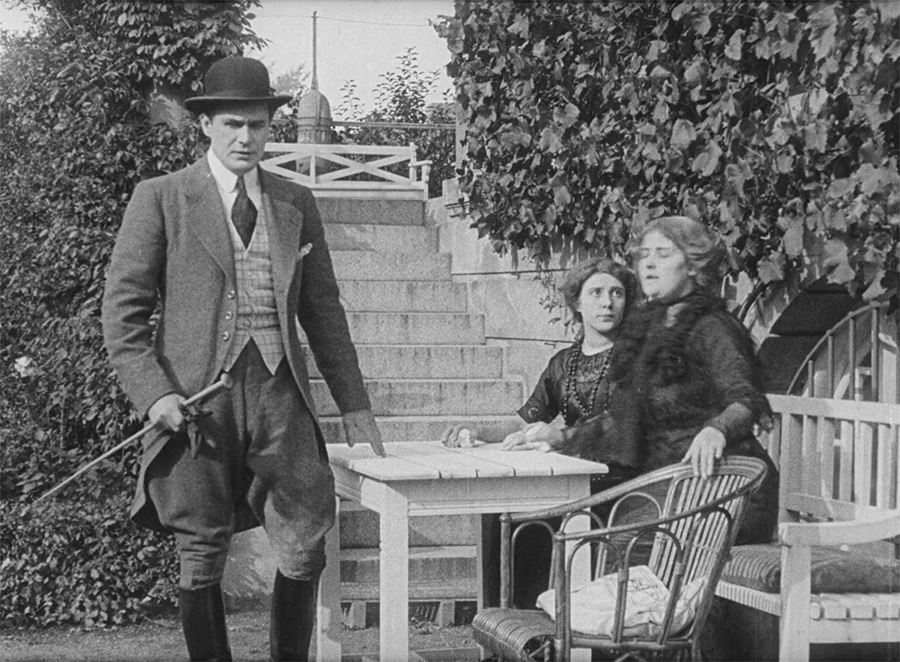
The plot is a classic for melodrama: the patriarch of the family has passed and has left his heirs in sorry financial condition. The original screenplay states that the father, the Count Salzburg, squandered the money but this scene is not present in the film’s print. In any case, Hans von Berner (Psilander) must find some way to support his mother and sister, especially after the latter’s fiance dumps her when he realizes she is poor.
Hans sails for America and seeks employment but nobody wants to hire him. He seizes on an opportunity at a coal plant when the workers dump their foreman into the water via crane (very clearly a real crane and live actor performing the stunt). Hans identifies the culprits and is hired. He then saves a young lady from being harassed by his coworkers, knocking the man down.

A better job is needed, so Hans applies for the position of chauffeur for Anny Stevenson (Clara Wieth). Anny’s father (Viking Ringheim) has the applicants line up and allows her to choose her new toy and she picks Hans.
When Anny’s speedboat is stolen in the harbor, Hans once again goes into vigilante mode, pursues it and jumps aboard, returning it safely to its owner. Now, rich women falling for their chauffeurs was a common trope in silent films and Anny is no exception. Hans is doing the work of an entire police department and he looks good in his uniform, she is open to a bit of flirtation.
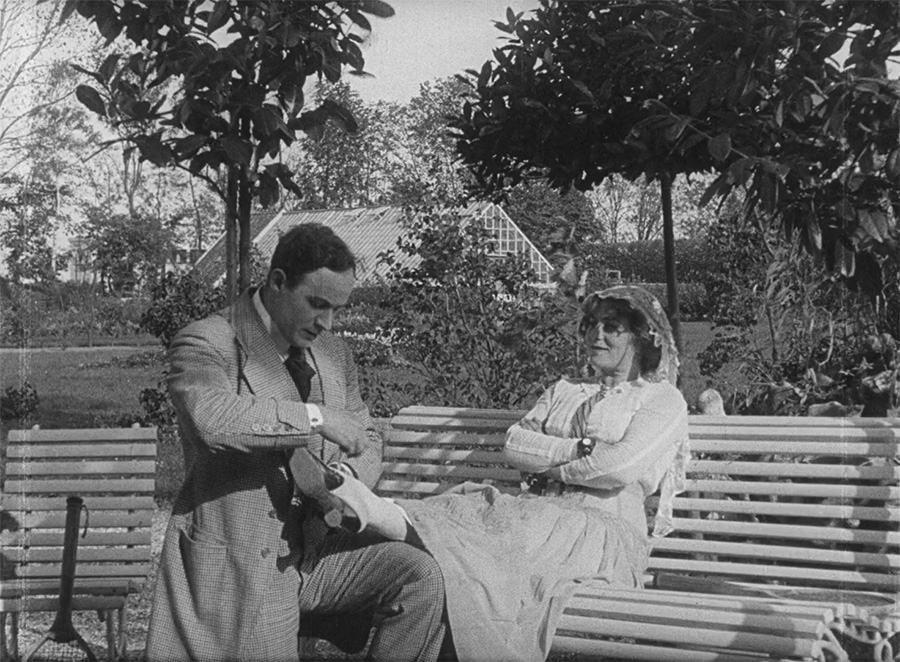
This displeases Anny’s dweeby suitor, Pullman (Lauritz Olsen) and he begins to scheme. Anny, meanwhile, continues to flirt with Hans, who tries to kiss her and his rebuffed. He is still a servant, after all. Pullman sees what is going on and immediately tattles on the pair. Hans is sacked. However, Hans is able to save the Stevensons and Pullman from an angry mob of protesting workers, so he wins his job back but things are a bit cool between he and Anny. The still-jealous Pullman forges a letter from Anny with money to pay off his debts so he will return to Europe and then conspires to get him a job on the proverbial slow boat to China.
Anny sees through Pullman’s schemes, traps him in an empty swimming pool (with built-in doghouses– ultra-spoiled pups were international shorthand for the wealthy in the movies) and pours water on him until he confesses. Once she has the facts, she races off to rescue Hans. Will she get there in time? See The Modern Girl to find out!

Well, then, the first question is, how was Psilander? And the answer is: rather good! This story is the type of light melodrama that audiences around the world enjoyed enormously. It’s not serious or heavy and it was never intended to be. It’s a bit of easy-to-digest entertainment and it succeeds brilliantly on these terms.
Melodrama acting varied wildly during the silent era– in fact, all genre acting varied wildly, especially during the pre-feature era– and you can see everything from arm flailing hams to far more subtle performances and Psilander falls into the latter category. The story could have invited some rather florid moments but Psilander shows discipline and maintains a realistic, made-for-the-camera (as opposed to the cheap seats in the theater) acting style that comes off as fresh and modern.

Likewise, Clara Wieth, who was also excellent in The Girl Behind the Counter, provides as well-metered performance as the vivacious and slightly bratty American heiress who lives up to the title of the film by aggressively pursuing Hans (though she does blow hot and cold), driving her own car and eventually saving the day. She’s more subtle than Ossi Oswalda in The Oyster Princess and Molly Picon in East and West but both those pictures are broad social farces, while The Modern Girl is intended to be somewhat more serious. Lauritz Olsen probably gives the broadest performance in the picture but it suits his petty little machinations and he is not so sweeping as to look out of place next to his more subtle co-stars.

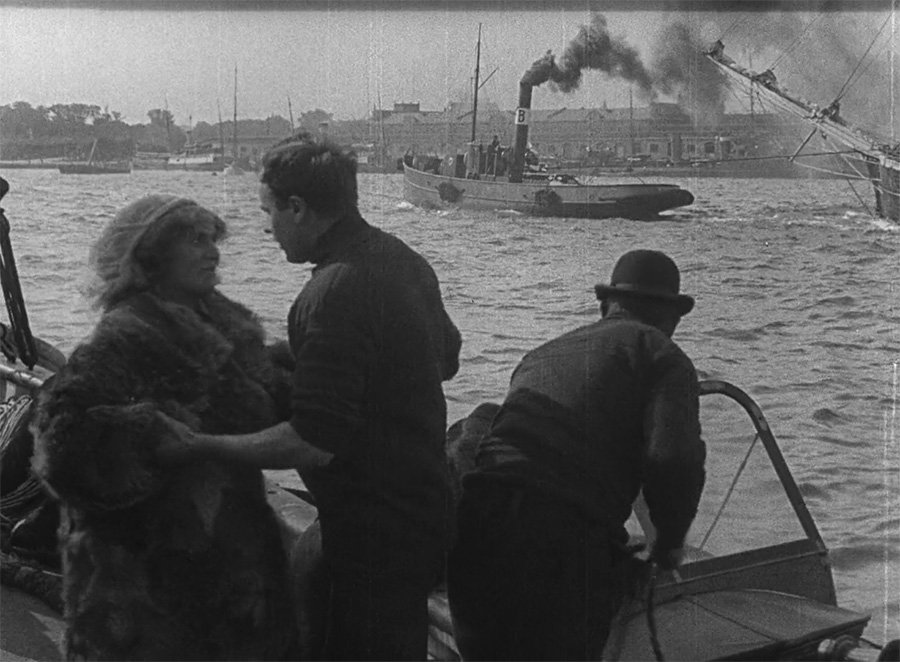
Without a doubt, the set piece of the picture is the race to recover Anny’s stolen speedboat. Director Eduard Schnedler-Sørensen and cinematographer Axel Graatkjær capture the action by mounting a camera to the boat carrying Hans and Anny. Hans manages to climb aboard and his efforts to control the boat are captured in a long tracking shot. It’s remarkably dynamic and even more exciting because Psilander is clearly performing his own stunts, his face is in full view of the camera the entire time. Like French western star Joë Hamman’s death-defying leaps in The Railway of Death, Psilander’s stunts are unpolished compared to those of a stunt performer but this raw quality adds to the realism.
As is always the case with foreign films set in America, it is fun to see how my home country is perceived from abroad. The America in The Modern Girl has cars driving on the left and signs in Danish, but it also portrays Americans as overboard dog fanciers who are willing to overlook anything in order to gain a royal title, which… fair enough. Spot on, I would say. I rate this portrayal as very accurate.
So, all in all, this was an extremely successful random draw. I figured out the appeal of Psilander with his understated approach and willingness to go all in with stunts. As melodramas go, this is a good one but what really sets The Modern Girl apart are its action sequences, which are among the best I have seen from 1912, easily on par with the French and well ahead of the Americans. This is a prime example of the kind of high quality popular entertainment that moviegoers of the era demanded and often received.
Where can I see it?
Stream courtesy of the Danish Film Institute. The titles are in Danish with no English subtitles but the plot is easy enough to follow.
☙❦❧
Like what you’re reading? Please consider sponsoring me on Patreon. All patrons will get early previews of upcoming features, exclusive polls and other goodies.
Disclosure: Some links included in this post may be affiliate links to products sold by Amazon and as an Amazon Associate I earn from qualifying purchases.
 Movies Silently
Liked this film very much. Great action scenes and fine performances by the cast, especially Clara Wieth. I thought she was very good. Many thanks for selecting this film and for your entertaining review.
Thank you!