
You cannot accuse early film of false advertising: a motor car drives along and explodes, body parts comically rain from the sky. Another home run from Cecil Hepworth.
Home Media Availability: Released on DVD.
What’s All This Then?
Cecil Hepworth is most famous for his hit genius dog picture, Rescued by Rover (1905), but his entire surviving body of work is interesting in its innovation and variety. Explosion of a Motor-Car is just over one minute long but what a strange and twisted minute it is!
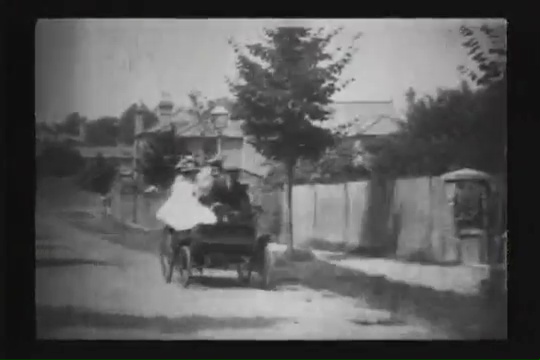
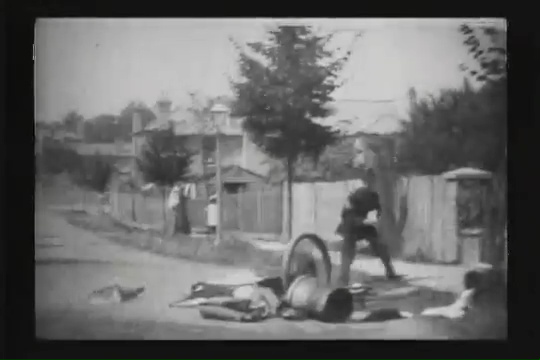
As is the case with many early films, you get exactly what it says on the tin: a car filled with passengers joyously waving handkerchiefs enters the frame. Suddenly… kaboom! The whole thing blows up via editing and a nearby policeman watches in horror as body parts begin to rain from the sky, arms, legs, torsos. The appalled policeman begins to sort through the mayhem, placing body parts in appropriate piles, and then gets out his notebook to scribble out a citation.
(Some synopses of this film speculate that the policeman is documenting the incident and cataloging the body parts, showcasing his unflappability. Given the general lack of respect for the law in early film in general and other examples in early British film, I think my interpretation is quite possible and, in any case, I think it’s funnier too. “Littering, operating motor vehicle without license, obstructing pathway…”)
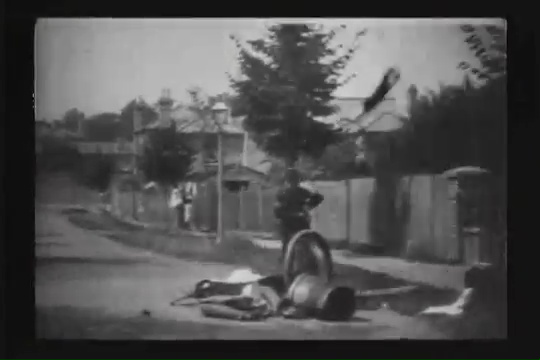
From a historical perspective, the film is of interest because of the comedic delay of the rain of body parts, creating anticipation as the policeman quickly scuttles back to avoid being struck by them. I always hesitate to call something the first because such a large amount of early cinema is lost forever and, in this case, comedic anticipation was used as early as 1895 in the popular hosepipe comedies. (Someone steps on the hose, the person holding the other end looks down the hose to see where the water has gone, the other person steps off the hose… you get the idea.)
However, being the first is not nearly as important as being one of the best and Explosion of a Motor-Car is remarkably droll. The actor playing the policeman makes the most of his solo time, tut-tutting over the body parts and keeping his notebook at the ready. The acting in Hepworth comedy pictures tended to be playful and charming, not overly dramatic and with little mugging (except for any animal performers, who went ham) and we can see that trend in this early production.

Cecil Hepworth published his memoirs Came the Dawn: Memories of a Film Pioneer in 1951 and the book’s contents are just as charmingly ornate as its title. All film memories should be taken with a grain of salt as to accuracy but Hepworth’s writings are an interesting insight into how the man himself viewed his most important films and legacy.
Hepworth made multiple comedies that centered on the dangers of automobiles. Were these films meant as an attack on the popularity of this new form of transportation? Hepworth admits that Explosion of a Motor-Car reflected the popular attitude toward cars as risky (and, really, they had a point and still do) but, in fact, he was an early adopter of the private car, purchasing his own (unfortunately, he did not record the made and model). Hepworth recalled taking his family on jaunts in his “crazy car” and that it had some peculiarities that inspired his film.

Hepworth describes his car thus: “The carriage was of dog-cart design, completely without protection, and so balanced that if the occupants of the front seats got out first the whole thing tipped up and pitched out the others.” Further, the car had to be refilled with water every five miles or so and was so light that it was possible to turn it around by simply lifting the front wheels and flipping its direction. This was fortunate as it had no reverse gear.
We often joke as a way to express legitimate fears and, given the freewheeling and risky world of early motoring, Hepworth’s jokes seem well-placed. The comedic jump from an unbalanced, overheated, thirsty car tipping over to an exploding car that throws its passengers to their doom would have been an easy one, especially considering the Victorian British taste for black comedy. A bit of gallows humor among devotees of a particular risky hobby is a constant.

Hepworth tended to dismiss his own early work but he was proud of Explosion of a Motor-Car, describing it as “something of an epoch in my film life” and “had, for an alleged ‘comic,’ quite a germ of genuine humour in it.”
Hepworth also spoke highly of How if Feels to Be Run Over, another violent car comedy released in 1900, for its “novel effects.” The film is a point of view shot of an approaching motor car with the screen blacking out at the moment of impact and concludes with one of the earliest film with title cards (the sardonic “Oh! Mother will be pleased.). Its exact release date is not known beyond the year but Hepworth places it chronologically after Explosion of a Motor-Car. It displays the same moral-free black comedy and is perhaps even funnier in its sudden impact.
However, it would be possible to frame the pair of films as a “reap what you sow” moral lesson: the group of merry hit and run drivers find themselves blown to kingdom come at a later date, should the theater manager wish to run the films in that order.
Hepworth’s flair for making the most of his resources– he used his own car and his own family pets, not to mention his family in his films– and his dark sense of humor are displayed to excellent advantage in this little comedy. It’s easy to see why it was, per Hepworth, his bestselling film to date. Topical, goofy, subversive, it really does have it all.
Where can I see it?
Released on DVD as part of The Movies Begin box set, which I still highly recommend as a curated entrance to the first decade or so of cinema. Otherwise, it’s public domain and widely available unofficially online.
☙❦❧
Like what you’re reading? Please consider sponsoring me on Patreon. All patrons will get early previews of upcoming features, exclusive polls and other goodies.
Disclosure: Some links included in this post may be affiliate links to products sold by Amazon and as an Amazon Associate I earn from qualifying purchases.
 Movies Silently
Really enjoyed learning about this film, Fritzi, and then checking it out for myself. I didn’t expect to actually laugh out loud — but I did! — and I totally think your interpretation is spot-on. Thank you for the introduction to this one!
Karen
Glad you enjoyed!