
When an Italian dandy finds himself the subject of ridicule, he discovers that his narrow hat is simply not the style. He buys the broadest brim he can find and chaos ensues.
Home Media Availability: Stream courtesy of EYE.
Where did you get that hat?
The silent era Italian film industry is usually associated with elaborate mega epics like Cabiria and Quo Vadis or tour de force acting by grand divas like Francesca Bertini and Lyda Borelli but, like any good filmmaking community, the silent era Italians made comedies too.

And here is where we meet Ernesto Vaser. I had never heard of him before but I stumbled on Wide Brimmed Hats are Fashionable and was completely charmed by his strange, wacky world of slapstick mayhem and haberdashery.
The film opens with Ernesto, clad in a loud checked suit and a matching narrow-brimmed hat, as he swaggers about town. Passersby laugh at his appearance, what a ridiculous hat! Ernesto doesn’t understand what is happening and asks some men to explain what the joke is. They explain that his hat is very… small. Ernesto thanks them and decides he will do something about it then and there.

The action is conveyed entirely by broad gestures, this film has no intertitles. Generally, I am not a fan of this type of storytelling (see my review of the abysmal French Sherlock Holmes flick The Copper Beeches) but you know what? I’ll allow it here. It suits the tone of the picture and, let’s face it, if anyone can pull off an all-gesture comedy, it’s the Italians.
Ernesto goes hat shopping and he doesn’t want just any hat, only the broadest brim in the shop will do. Once he puts on the massive straw hat, Ernesto tries to leave but finds that his hat is too big to fit through the doorway. Undeterred, he smashes his way through the shop window.

Now at large, Ernesto nonchalantly decapitates a workman with his hat brim. When a woman laughs at his hat, he waves it, creating a wind that blows her away and her little dog too. He is then mocked by a group gathered at an outdoor concession, so he blows them away as well.
He shows his more gallant side when he helps two women caught in the rain, sheltering them on either side of his hat. Unfortunately, the storm blows him away and he hurtles through the skies before falling into a lake. He drags himself to the surface and discovers that his hat is full of fish. Well, if life hands you fish, you have a fish bake and he does just that, using his hat as a grill for the fish. Who said fashion couldn’t be practical?

Well, that was gloriously strange and fun! Casual decapitations and dismemberments were a hallmark of early comedy but I was surprised and delighted to see one in a fashion satire. I also enjoyed Vaser’s glee as he discovers all of the powers granted to him by his monstrous hat. This is the kind of light, off-the-cuff comedy that was common in early cinema and faded away with the rise of the studio system and increasing production costs.
Fashion satire comedies were very much their own genre. With new styles being publicized more than ever, motion pictures were a vehicle for fashion showcases. Studios would even advertise that their actors would be modeling the latest modes. But with style, there was sometimes annoyance and pain.

Literal pain in the cases of the 1912 comedy Pumps, in which a man and woman both wear too-small shoes to a ball out of vanity. Max Linder had made a similar comedy in the same vein and also starred in Max Sets the Style, in which he must convince everyone that work boots are the height of haute couture. (He needed only wait a few decades.)
Women’s hats had been growing in diameter since the late-19th century and had reached truly whopping proportions in the 1900s and early 1910s. They would slowly shrink back down through the 1910s and early 1920s before the iconic cloche would take over. (Though picture hats and tams remained popular throughout the 1920s, it wasn’t all tight little skullcaps.)
Naturally, any extreme fashion trend would be met with satire. The giant wigs of late-18th century French fashion were broadly caricatured, for example. The rise of colossal hats coincided with the rise of motion pictures and moviegoers had a special interest in the topic, as evidenced by the iconic “please remove your hats” slides.
Danish director Viggo Larsen tackled the topic, along with hobble skirts, in his comedy A New Hat for the Madam (1906), in which a fashionable woman tries to wear both items and has to be wheeled about in kiddie wagon by her indulgent husband. Trouble follows wherever the massive hat goes, and the humor is directed at both the vain wife and the silly husband who goes along with her.

D.W. Griffith’s film Those Awful Hats (1909) is probably the most famous hat-based comedy with women refusing to remove their hats at a movie theater and subsequently dragged out via crude special effects. As is typical for the director, he jumps straight to violence against women while Mack Sennett’s character keeps his own oversize top hat on for the entire picture without comment or consequence.
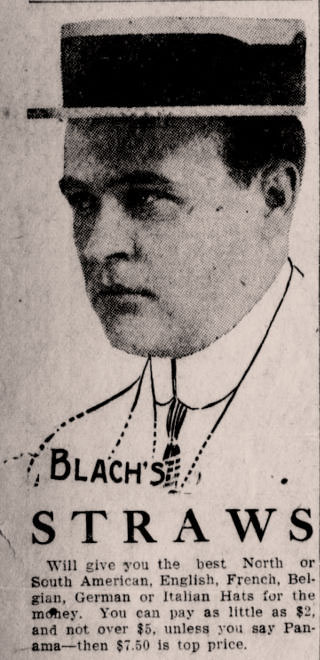
Men had hat trends too, but hats of the era trended to the vertical rather than the horizontal and then mainly for eveningwear and slapstick comedians. A straw boater of the era, though perhaps a touch larger than what would later be fashionable, was still manageable and downright cute.

Wide Brimmed Hats Are Fashionable builds on Larsen’s lead and goes one better: instead of merely being caught up in women’s fashion, our hero gender flips the plot and embraces the enormous hat himself. Given that always-fashionable Italy was an exporter of fine hats for men, Ernesto Vaser’s decision makes perfect sense.
The ridiculous hat conferring equally ridiculous powers—It kills! It flies! It grills fish!—unexpectedly elevates the picture into the surreal. Rather than a vindictive crane coming to carry away women who violate headgear rules, as was the case in Those Awful Hats, Vaser visualizes a bloody and joyous victory for his hero: he has won Fashion and he deserves a snack.
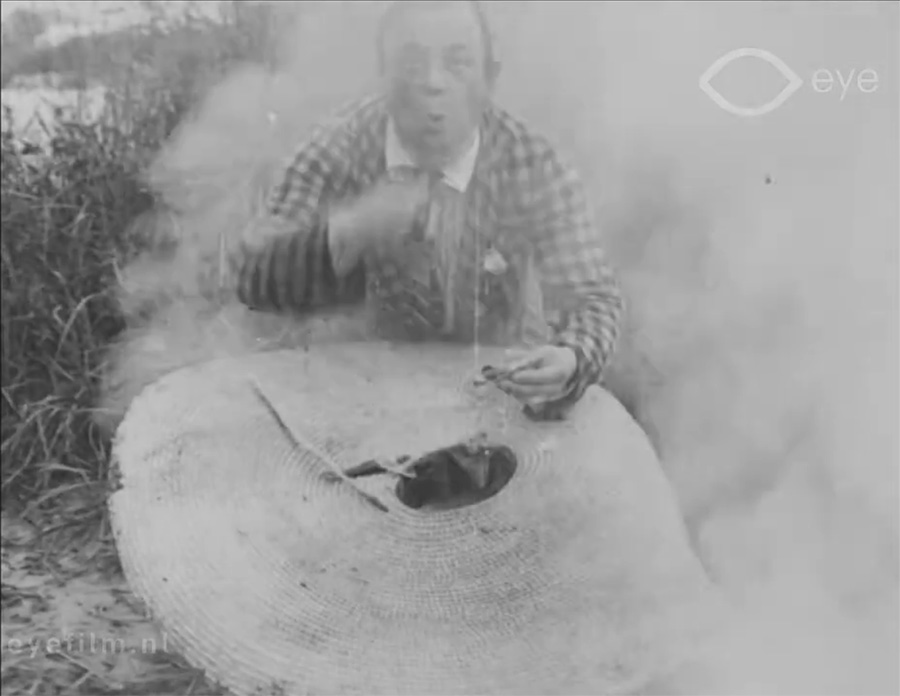
Wide Brimmed Hats are Fashionable was exported to the U.S. market and the trade magazine Moving Picture World described it as “unusually good.” I don’t think I can add to that assessment. This strange little comedy is, indeed, unusually good and well worth seeing.
Where can I see it?
❧
Like what you’re reading? Please consider sponsoring me on Patreon. All patrons will get early previews of upcoming features, exclusive polls and other goodies.
 Movies Silently
As a seller of vintage hats, there’s nothing better than a movie featuring millinery!
What a wild-sounding movie (especially the decapitation)! I will definitely have to check this out. Thanks, Fritzi!
Karen