
A pair of Copenhagen roommates have a falling out over a social snub and one decides to take revenge by sneaking a piece of stinky cheese into his friend’s pocket before the big party. Smelly chaos ensues but revenge is sweet.
Home Media Availability: Stream courtesy of the Danish Film Institute.
The Smell of Success
Obnoxious smells were popular comedic fodder in the movies. There are certain odors that are offensive to everyone but then there are the more controversial, and therefore funnier, scents that are beloved by some and repel others.
American films of the silent era, in keeping with cookery trends of the day, frequently would use the humble, mild green onion as a symbol of noxious eating habits. Charlie Chaplin is assaulted by onion breath in Behind the Screen, Douglas Fairbanks has an anthropomorphic green onion go wild in his stomach in When the Clouds Roll By, and Gloria Swanson divorces Elliott Dexter thanks to his onion preferences in Don’t Change Your Husband.
But even more endearing was the horror of smelly cheese and it was international. Weaponized Limburger was a comedy staple for decades, with comedies like A Limburger Cyclone (1917) revolving around its odor. Europe, home of many a pungent cheese, got in on the act too. Georges Méliès made The Skipping Cheese, a comedy about noxious cheese on a French streetcar in 1907. Smelly cheese humor pre-dated the movies, as proven by coverage of vaudeville and phonograph comedians entertaining audiences with Limburger routines.
And so it is no surprise that cheese would make an appearance in Danish film. Director Lau Lauritzen Sr. tackles the smelly subject as a weapon of war between roommates David (Lauritz Olsen) and Jonathan (Carl Schenstrøm).
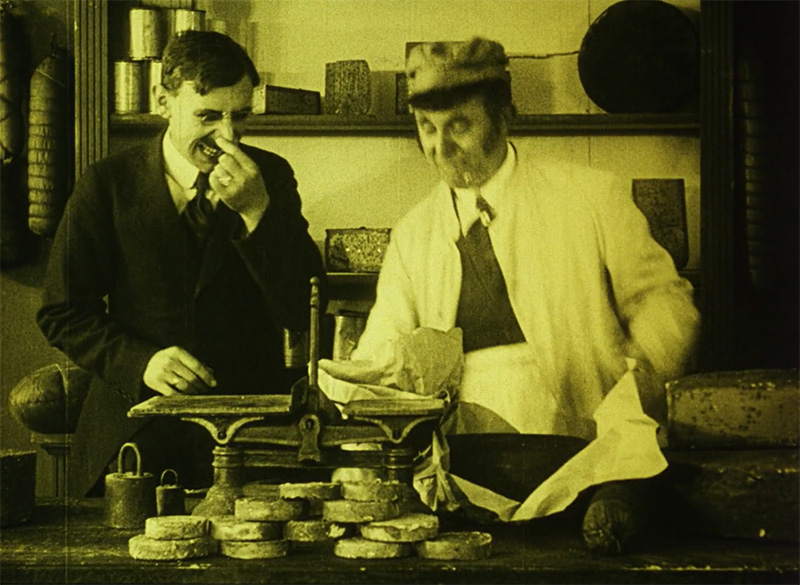
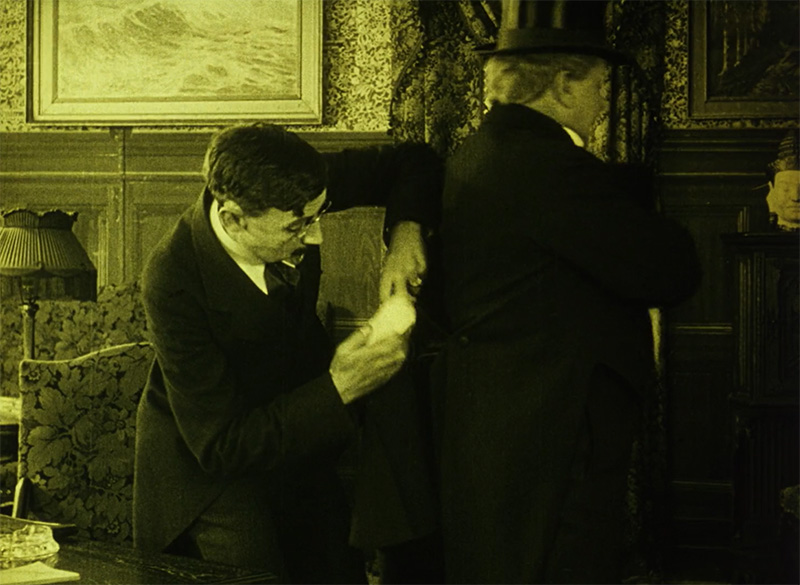
The first few minutes of the picture are lost but per the original scenario, David and his girlfriend are invited to a part and Jonathan is not. Offended, Jonathan heads to the cheese shop. (The footage begins here.) Jonathan asks the cheesemonger for the smelliest cheese he has and returns to his flat with the slice. David is recovering from a cold and cannot smell a thing, so he doesn’t realize that Jonathan has slipped the cheese into his dress suit pocket.
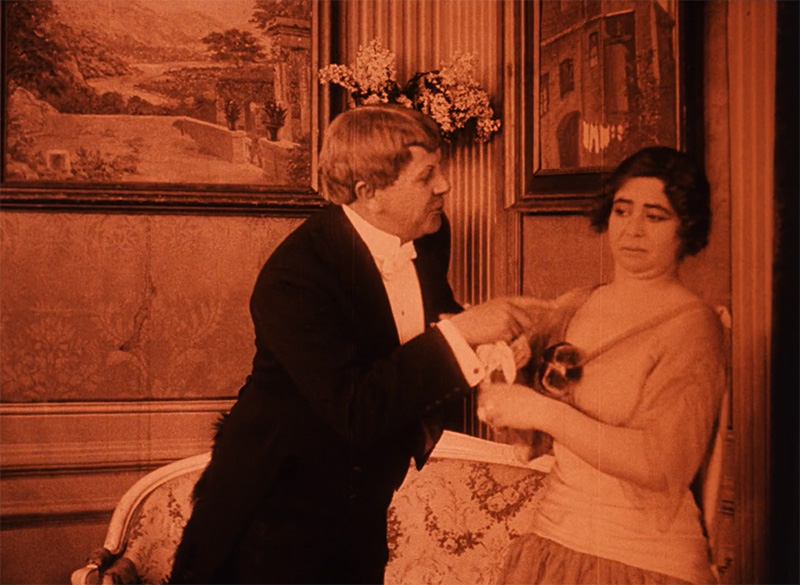
At the party, David is ostracized; partygoers openly scramble to get away from him. Even his girlfriend (Ingeborg Bruhn Bertelsen) cannot bear to finish a dance with him. She disappears into a quiet room and David follows. Finally, she blurts out that he smells and flees. David is horrified and begins to weep, reaching for his handkerchief and discovering the cheese in his pocket. Jonathan! The fiend!
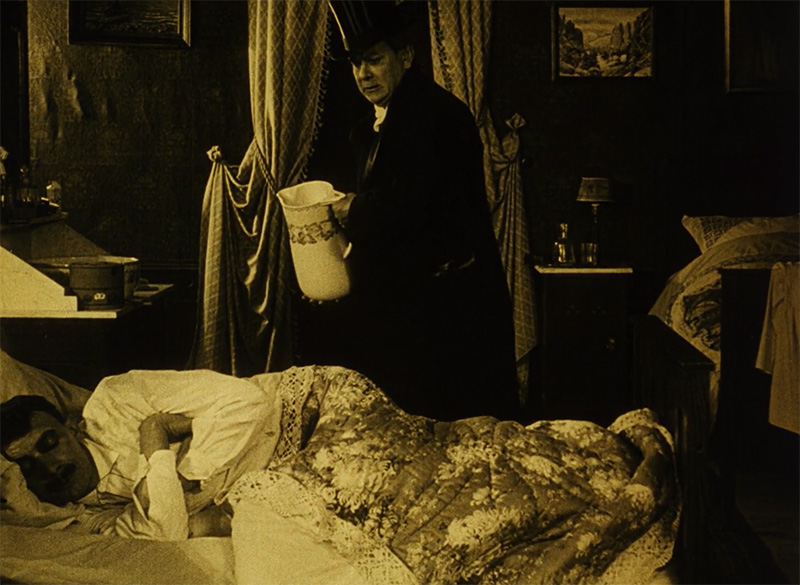
David returns to the flat and contemplates his revenge. Hit Jonathan on the head? Douse his bed with water? No, something more is needed.
With the help of his girlfriend, David sets a trap. He puts an advertisement in the newspaper: a handsome young man seeks marriage to an eligible woman and will meet her at the park. Both parties are to carry a white chrysanthemum for identification.
They also write a little note to Jonathan: a well-to-do young lady has spotted him and is in love. She wants to meet him and asks him to come to the park and to carry a white chrysanthemum for identification.
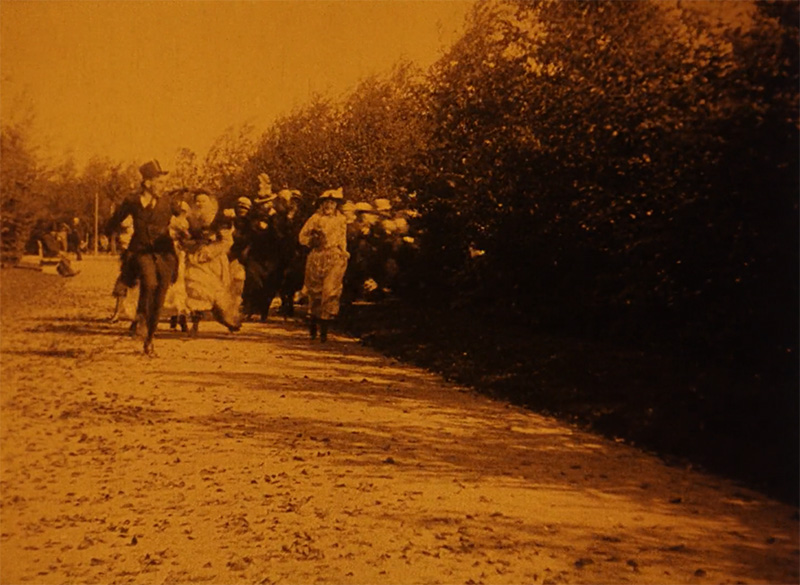
David and his girlfriend follow Jonathan to enjoy the chaos. As planned, dozens of women have shown up in response to the ad and, when they spot the white chrysanthemum, give chase. Jonathan realizes something has gone very wrong and runs for his life. The women are enraged at being duped and pelt him with their flowers before departing. Let that be a lesson to him!
Well, that was fun! The picture isn’t quite a domestic comedy (depending on how you interpret naming the lead characters David and Jonathan) but it very much has a similar mood to the shorts in that genre being released by Vitagraph at the time. Both the Vitagraph and Oh! That Cheese! feature very little slapstick and much of the comedy is derived from social embarrassment, mind games and ruthlessly petty revenge.
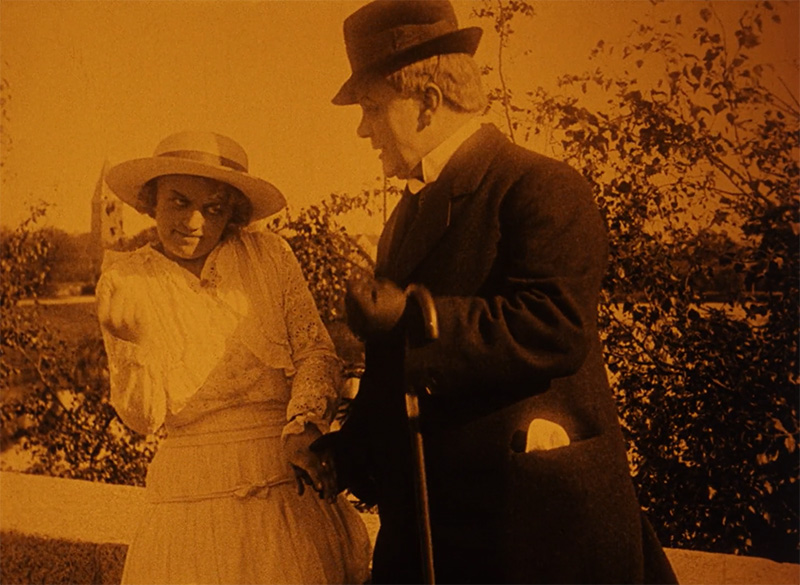
The decision to make smelly cheese the cinematic shorthand for a nasty smell has multiple layers to it. First, strong cheeses do smell like feet and that’s not poetic license, it’s a bacterial connection. You either love this funk (as I do) or you hate it. And it’s a convenient stand-in for more, ahem, bodily scents that would perhaps be a bit too offensive.
But second is the subject of class. Strong-smelling foods were associated with a lower class of person and so garlic, onions and cheese all had snobby detractors. In Elizabeth Gaskell’s novel Wives and Daughters (1864), the new wife discovers her husband’s shocking addiction when speaking with her step-daughter:
“Papa doesn’t care what he has, if it’s only ready. He would take bread-and-cheese, if cook would only send it in instead of dinner.”
“Bread-and-cheese! Does Mr. Gibson eat cheese?”
“Yes; he’s very fond of it,” said Molly, innocently. “I’ve known him eat toasted cheese when he has been too tired to fancy anything else.”
“Oh! but, my dear, we must change all that. I shouldn’t like to think of your father eating cheese; it’s such a strong-smelling, coarse kind of thing. We must get him a cook who can toss him up an omelette, or something elegant. Cheese is only fit for the kitchen.”
“Papa is very fond of it,” persevered Molly.
“Oh! but we will cure him of that. I couldn’t bear the smell of cheese; and I’m sure he would be sorry to annoy me.”
Third, in the case of American films, smelly cheese was associated with the new immigrants from abroad. Comedy routines would tie the scent of Limburger to the scent of German newcomers generally. In recent time, similar mockery has been leveled at the fermented foods of Koreans, and the rich spices of South Asians. (Oddly enough, WWI comedies later deployed Limburger as a chemical weapon against the Germans, which, given the previous stereotypes, would be like assaulting the Italians with pasta.)
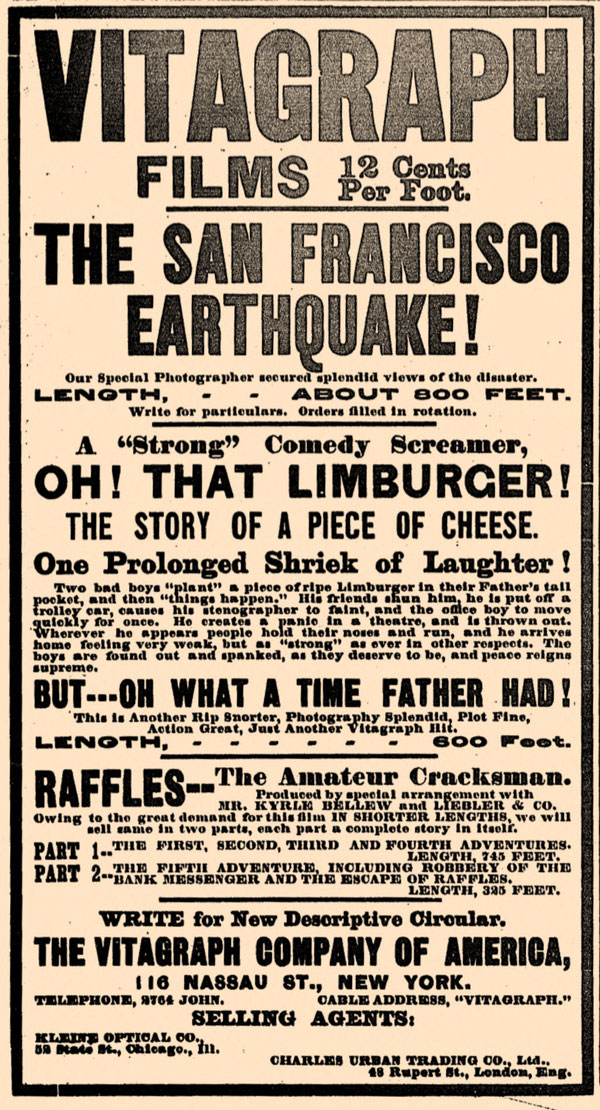
One of the earliest examples of cheese-based humor can be found in Oh! That Limburger! The Story of a Piece of Cheese, a 1906 Vitagraph comedy with a plot rather similar to Oh! That Cheese! A pair of naughty boys slip a piece of Limburger into their father’s pocket and he experiences social ostracism until he realizes what has happened and takes his wayward kids behind the woodshed.
Silent filmmakers were working from a tradition of stock comedy situations and authorship of a gag was not as important as the way a comedian played with the material. So, for example, while Roscoe “Fatty” Arbuckle did a bread roll dance before Chaplin, Chaplin’s dainty bread ballet was distinct and unique to him.

So, Oh! That Cheese! was likely inspired by a comedy of Limburger but it’s quite possible that the production team had no particular cheese in mind when they made the picture. Certainly, what Jonathan buys looks like a not-too-smelly hard variety like parmesan, which would make sense if they had to handle it on-camera for retakes and so forth, the sturdier the better as smelly cheese tends to be gooey. (Or they simply swapped in some soap.)
I put out an inquiry to see if any Nordic people had ideas and varieties suggested included Norway’s infamously stinky Gamalost (which received the most votes), a Rotschmiere (a treatment that produces very smelly cheese like Limburger), and Danish Black Sara (a strong cheese with a black wax coating).
The other big question silent film fans will doubtlessly ask is… Seven Chances? The 1925 Buster Keaton film ends with him being chased by a mob of women vying for his hand and, while the chase in Oh! That Cheese! is smaller and less elaborate, it is remarkably similar.
Well, the film Seven Chances was based on a play of the same name that was released in 1916, the same year as Oh! That Cheese!, so my initial reaction was that the Danish filmmakers may have drawn inspiration from accounts of the play. However, I then looked up the play and after reading it over, that could not be the case. The play systematically parades in the hero’s “seven chances”, that is, seven different women he attempts to woo in order to inherit money. Seven is hardly a mob and the wooing is done on a one-on-one basis.

I don’t know whether Oh! That Cheese! was released in the United States but it was released in the United Kingdom and this was an era of ping-ponging remakes, so it’s entirely possible that the picture was remade by another company or that it was released in the USA under a different title.
However, since one half of Oh! That Cheese! seems to be inspired by an earlier comedy, maybe there is another, earlier example of a mob of brides chasing a bewildered would-be groom as well. Or it may be a case of parallel invention. Heaven knows classified ads were ripe for parody.
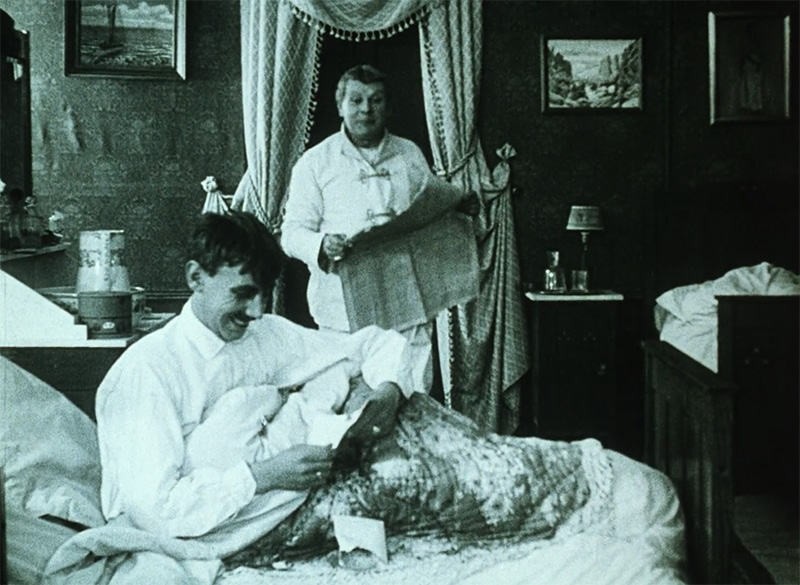
There’s really nothing new about the plot of Oh! That Cheese! and that’s not the point. As has been the case of all the Lau Lauritzen-helmed comedies I have enjoyed so far, what sets the picture apart is the deft touch of the cast and crew.
The gags are broad but the acting is kept to a manageable level of exaggeration. I especially liked the scene in Jonathan’s bedroom when David, realizing his friend’s nefarious scheme, pantomimes various methods of revenge without following through. As Lauritz Olsen blusters, Schenstrøm quakes, trying his best to feign sleep. Schenstrøm has a wonderful, rubbery face that puts across all kind of silly expressions without falling into mugging.

(Schenstrøm would later find fame in the iconic Pat and Patachon comedy series. I have not seen any entries yet but Oh! That Cheese! has whetted my appetite.)
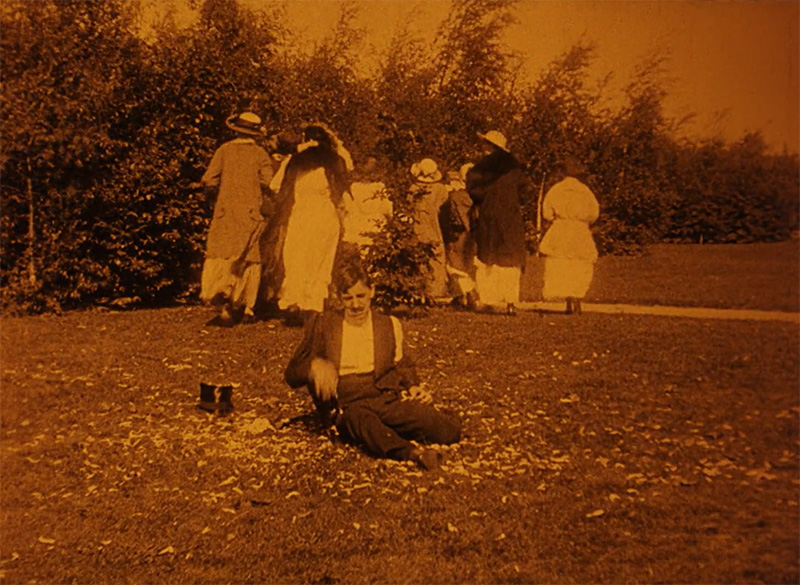
Later, when he is running for his life from a ground of women armed with comically large chrysanthemums, Schenstrøm is cornered and flees into the water, fluttering and blubbering until he is forced to head back to shore for his floral clobbering. Every movement is a scream, no cartoon character could be as elastic-limbed. I also enjoyed the way the women awaiting Jonathan follow every likely man that passes like a school of fish. It’s a small detail but adds to the constant stream of drollness.

Like so many Danish silent comedies, Oh! That Cheese! is fast, fun and enthusiastic. The plot may be well-worn but the cast solo on it like a jazz band riffing on a classic melody. Schenstrøm is particularly good but I enjoyed everyone’s performance. It’s a delightful little comedy bonbon.
Where can I see it?
Stream with Norwegian intertitles courtesy of the Danish Film Institute.
☙❦❧
Like what you’re reading? Please consider sponsoring me on Patreon. All patrons will get early previews of upcoming features, exclusive polls and other goodies.
Disclosure: Some links included in this post may be affiliate links to products sold by Amazon and as an Amazon Associate I earn from qualifying purchases.
 Movies Silently