
A pair of cavaliers get more than they bargained for when they enter you-know-where. This early Méliès film is sometimes described as the first horror movie.
Home Media Availability: Released on DVD.
The Devil You Say!
Georges Méliès entered the motion picture industry in 1896 and as that year drew to a close, he released his longest and most ambitious film to date. His earliest releases had been a mix of actualities, live performances and conjuring but he had begun to pursue the fantastic fiction that would become his trademark.
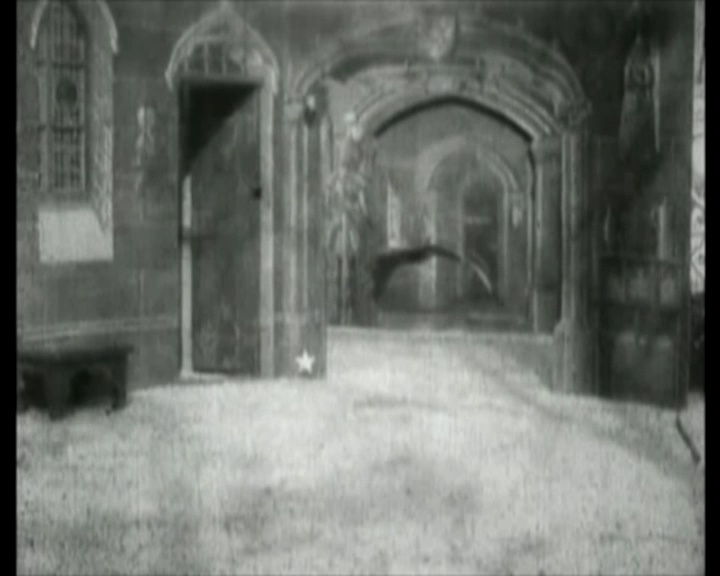
The Haunted Castle ran for three minutes, quite lengthy for the time, and featured a combination of practical effects—puppetry and smoke—and newfangled film effects like substitution splices. This film is sometimes described as the first horror movie. I am always a bit cautious about declaring firsts because so few motion pictures survive from this era that it is nearly impossible to be definitive. (Indeed, this picture was missing and considered lost until the 1980s.)
The story opens with a bat flying into a castle chamber and transforming into Mephistopheles, who summons a cauldron and a minion to produce a beautiful woman from a mysterious brew. His tasks done, Mephistopheles puts on his cloak and vanishes just as two cavaliers enter (the more grandly attired one played by Méliès).
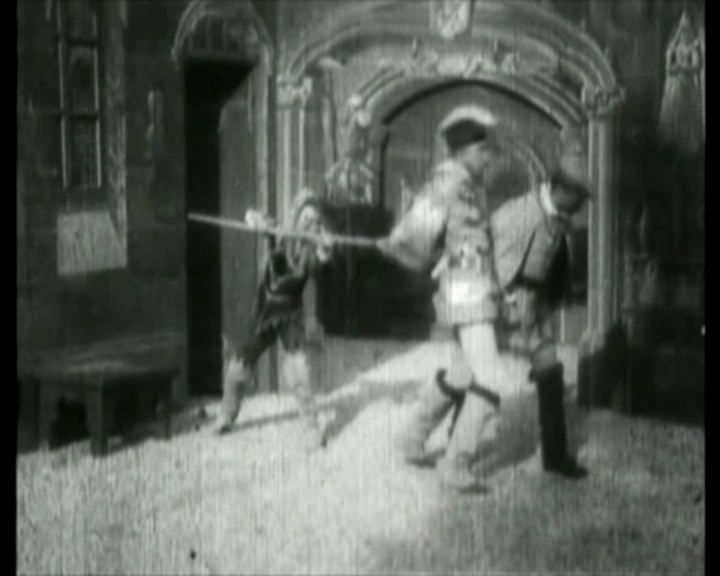
The cavaliers are tormented by disappearing furniture, buttock-spearing imps, a skeleton, and, finally, Mephistopheles himself. More special effects antics ensue, the beautiful woman conjured earlier turns into a coven of witches and the second cavalier throws himself off the balcony. Finally, the first cavalier spots a crucifix on the wall and uses it to drive Mephistopheles away.
On a technical level, some of Méliès’ substitution shots here are smoother than his earlier macabre picture of 1896, The Vanishing Lady, but some are jerkier. This is a more ambitious picture but also faster moving, so the seam between “stop cranking the camera” and “resume cranking after changing one thing” are less obvious.
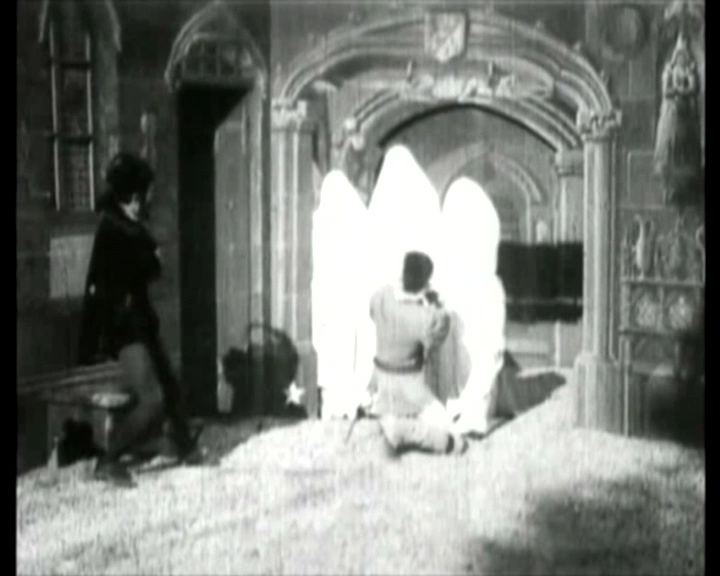
Some pieces discussing The Haunted Castle remark on the film’s light, comedic tone, suggesting that it is at odds with the film’s horror genre. There are a few things to consider here. First, horror and comedy were intentionally blended and the preference continued throughout the silent era. In fact, there are probably three or four horror-comedies for every straight horror silent film (with the caveat that, once again, a great many silent films are lost). With notable exceptions, horrific content of the silent era tended to reside in the corporeal rather than the uncanny. (See: the non-supernatural taxidermy of Behind the Door.)
You can see an unbroken line of comedy antics in horror settings from The Maniac Barber (1899) to The Bewitched Shepherd (1906) to The Spoiled Darling’s Doll (1913) to Haunted Spooks (1920) to The Cat and the Canary (1927).

The April 1899 issue of The Phonoscope addressed this popular combination of chills and laughs directly, stating:
“Improvements in moving picture machines have made strange things possible. Upon the screen figures appear and disappear as if it was the work of magicians. Ghosts suddenly confront the spectators and as instantly disappear. One of the best pictures is a series, lasting several minutes, of a haunted castle… In fact all that superstition or witchcraft could suggest is shown in these pictures and instead of causing fear among the spectators, the humorous situations make roars of laughter, for the ghosts and demons are all good-natured ones, and in the pictures, as in comedies, everything always comes out right in the end.”
The Haunted Castle is described but not formally named and it’s possible that the author was referring to a remake (unauthorized remakes flourished) but the general point is that softening the horrific special effects with humor was part of a trend that was appreciated in at least one corner.

Furthermore, Méliès was a magician and so it is appropriate that his films are rarely what they seem to be on the surface. For example, The Inventor Crazybrains and His Wonderful Airship is a light fantasy with a droll title—until you break down the message that Méliès was conveying. An inventor has visions of his invention causing harm and throws himself out a window to his death. Or The Monster, which seems to be a dance comedy but actually tells the story of a man whose grief causes him to resurrect a distorted mockery of his late wife.
Méliès used whimsical scenery and fanciful color to draw our eyes but there is often a sting to his pictures if you know what to look for. I suppose it is also worth mentioning that Méliès was a political cartoonist and this concept should be very familiar to anyone who understands that art. The cute drawings help convey messages with more clarity than the written word or a serious work of art.
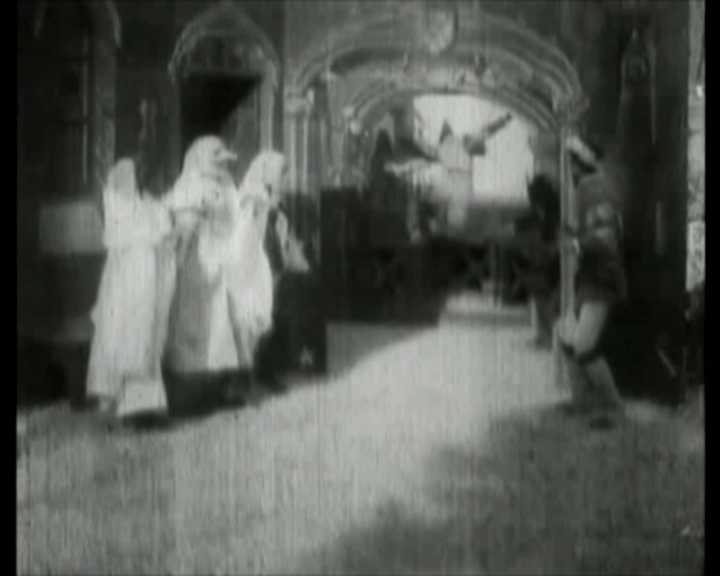
Indeed, in The Haunted Castle, the second cavalier throws himself off the balcony and, judging from how long Mephistopheles watches his fall, it was almost certainly a fatal leap. Dark Méliès strikes again.
The film’s original French title, Le Manoir du diable, is more properly translated as The Devil’s Manor and, just to make things more confusing, Méliès revisited the topic for a semi-remake in 1897 entitled Le Château hanté, which properly translates to The Haunted Castle but was released in the United States as The Devil’s Castle, while the 1896 film was The Haunted Castle. Still with me? That second film featured hand-applied color from the Thuillier firm.

Color had been used on magic lantern slides and had been immediately adopted for motion pictures. Thomas Edison’s first projected film screening was praised for its use of hand-applied color. Méliès made color a prominent feature of his work and, while most of his films have lost their original tints due to poor preservation practices, the few that do survive with them intact are most impressive.
The 1896 version of The Haunted Castle pre-dated Méliès’ association with Madame Thuillier and the design a different from the swirling, Art Nouveau stylings of films released just months later. The backdrops are simpler and more realistic (Méliès dabbled in both magic and actualities during this period) and they lack the business of his later work. Méliès used color to draw the viewer’s eye and his compositions tended to look busy and cluttered in black and white. Without that tool, The Haunted castle is crisper and more contrasted.

The 1897 version cannot be called a remake because it was 1/3 the length of the original and featured different action, even if the characters and setting were the same. Méliès again plays the cavalier, becomingly tinted red, and is confronted by strange happenings. The film cuts off abruptly and I believe the last few seconds are missing. The 1897 film still features the simpler set design of early Méliès and can be seen as a transitional work.
(We know that the 1897 version was meant to be shorter than the 1896 version because at the time, Méliès split his films into one-minute sections with catalog numbers for each segment, which could be purchased separately as the buyer pleased. The 1896 film lasts about three minutes and has three catalog numbers. The 1897 version has only one.)
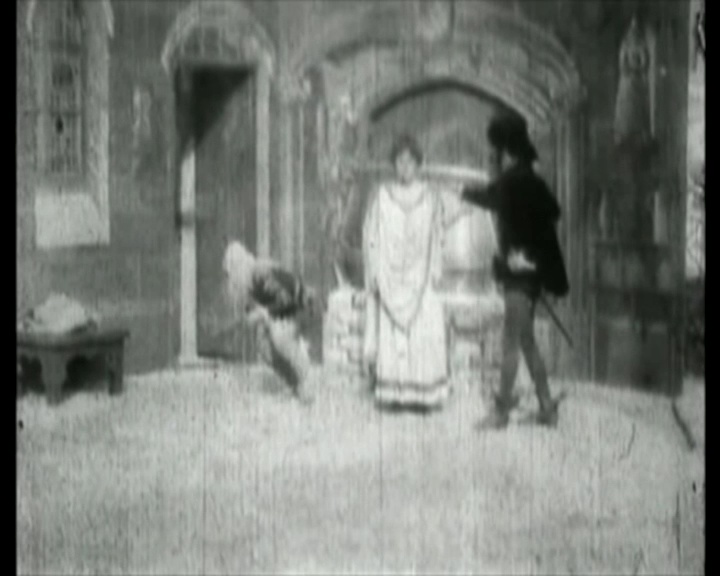
The Haunted Castle does not feel quite as complete as Méliès’ later work but it is still moody, funny and amusing. What it lacks in gingerbread, it more than makes up for with enthusiasm and that signature hidden darkness that Méliès liked so much. First horror film? Well, if you want to argue that, you can but I am not committing. Pioneering work showcasing thrills and chills along with laughs onscreen? Now that I can agree with.
Where can I see it?
Released on DVD as part of the out of print Flicker Alley’s Méliès Encore collection. The 1897 version is included in the original Flicker Alley set.
☙❦❧
Like what you’re reading? Please consider sponsoring me on Patreon. All patrons will get early previews of upcoming features, exclusive polls and other goodies.
Disclosure: Some links included in this post may be affiliate links to products sold by Amazon and as an Amazon Associate I earn from qualifying purchases.
 Movies Silently
Hi MS,
These very early films are fascinating – and entertaining. in regard to the color – do we know whether age has faded these colors and/or let the colors bleed compared to what they once looked like? It also occurs to me that we need to remember each colored copy was to a large extent, unique – it’s worth remembering that the color ‘A Trip to the Moon’ has what was undoubtedly the French flag colored to match the colors of the Spanish flag (in the copy recovered, I believe, in Spain), which certainly would not have been the case in the original French release prints.
Yes, some colors do fade. For example, the blue used for night scenes has faded into an obnoxious fuchsia in multiple prints. The hand-tinting was customizable with customers buying different levels of color for different price points, full color being the most expensive and “just the main characters” being more affordable. And, obviously, since these were made one at a time, each one was unique. A shame they are so rare.