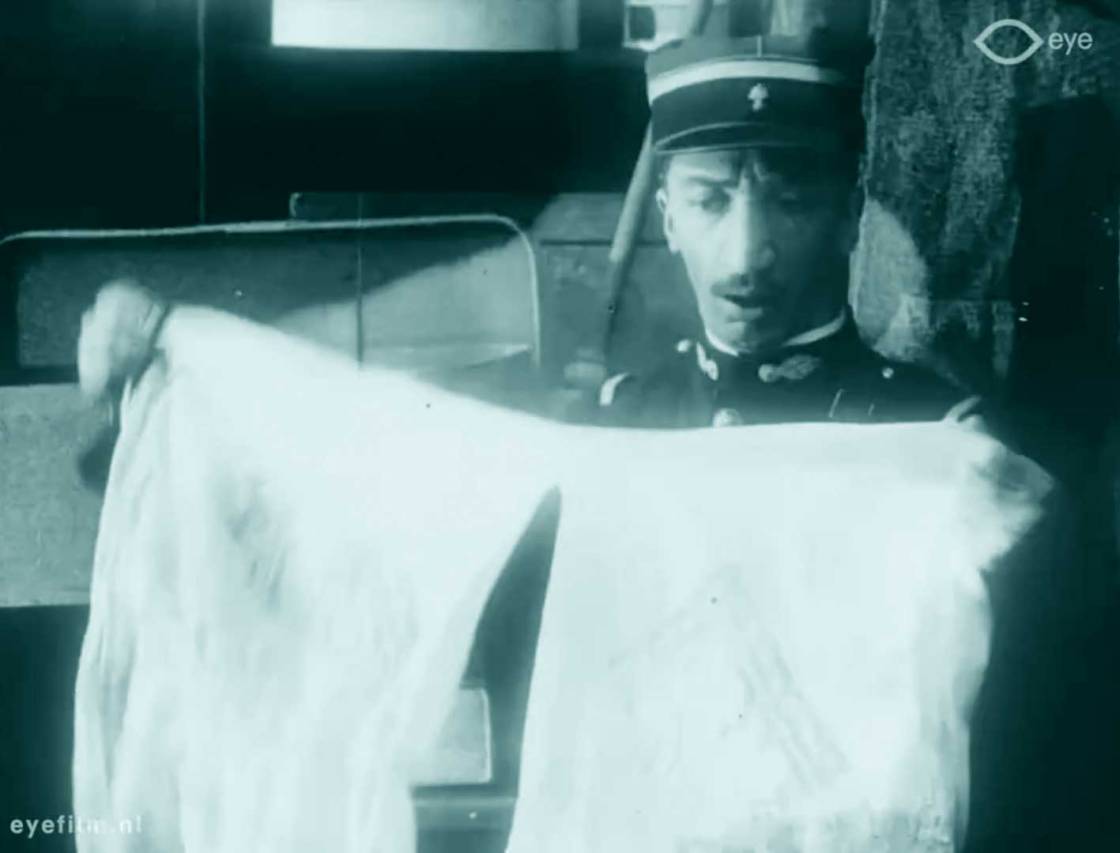
When a movie troupe discovers they have left part of a important costume behind, they try to persuade a local policeman to lend him his pants. He does and chaos, naturally, ensues.
Home Media Availability: Stream courtesy of EYE.
The dignity of the office
Louis Feuillade is best remembered today for his anarchic serials. Fantômas, Les Vampires and Judex are all considered classics of crime cinema and their stylish chaos is still appreciated by viewers. However, Feuillade wore many hats at the Gaumont company and dabbled in historical drama, modern stories and, of course, comedy.

The Pantsless Policeman stars Marcel Lévesque, who fans of Feuillade will recognize for his comedy relief roles as Mazamette in Les Vampires and Cocantin in Judex. Here, he plays a provincial policeman, Officer Foezel. He loves his job, he loves his wife, his wife loves him, life is good.
However, things take a turn when a troupe of actors motor in from the city in their gigantic caravan. They’re filming a crime drama and have come armed with costumes and props for three actors to play policemen. The problem? The costumer packed three police tunics but only two pairs of pants. Where will they get a pair of those distinct striped trousers?
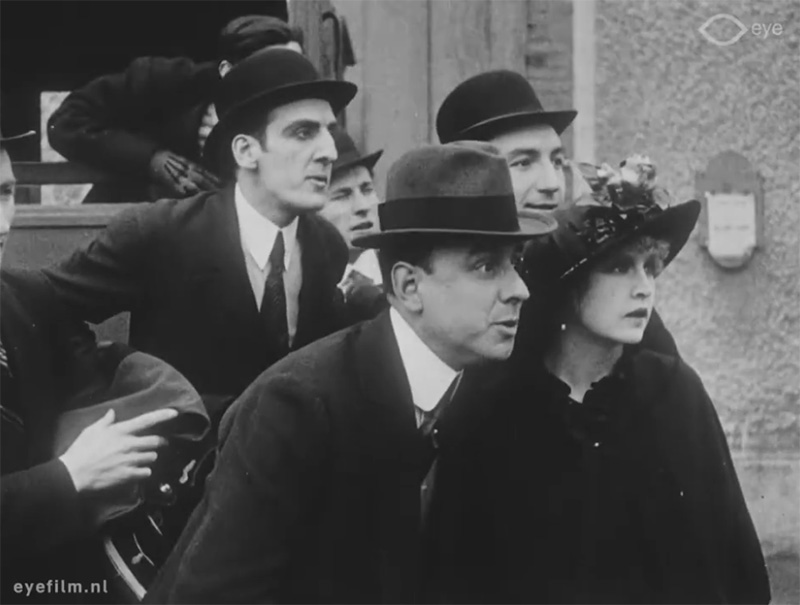
Into this wanders Foezel. The lead actress flatters him and finally pops the question: can she borrow his pants? After some convincing, Foezel agrees and the plan is for him to stay hidden away in a hotel room while the performers use the pants.
Of course, things quickly go south when Foezel accidentally locks himself out of the hotel room and is trapped in the hotel hallway in his long underwear. Other guests assume he’s some kind of flasher and he flees downstairs, where he spots a small hamper that has a label claiming “pantaloons” and steals it. Unfortunately, the hamper belongs to a woman with no interest in the then-daring practice of trouser-wearing. The only contents are filmy undergarments, including sheer step-in panties.
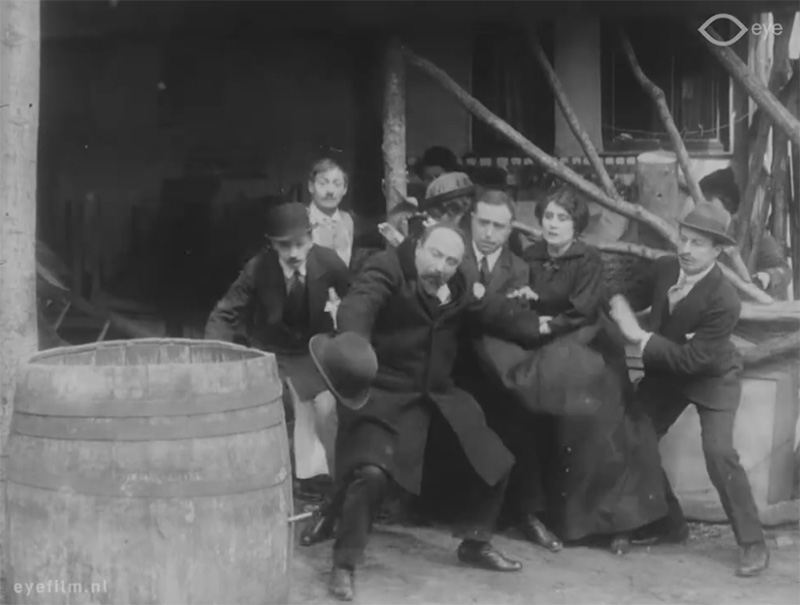
Our hero thought he was getting pants (American) and not pants (British) but the owner of the hamper discovers that it is missing and one fact has held true from 1914 to the present day: a man stealing a load of ladies’ undergarments is going to look suspicious. The staff and patrons of the hotel pursue the underwear snatcher.
Foezel hides in a rain barrel and attempts to get dressed in the stolen clothing. His pursuers find him but then his pistol sticks out of a hole in the barrel (kind of amazed this got past the censors), leaving them horrified. One of them tips the barrel and kicks it down the sloping street.
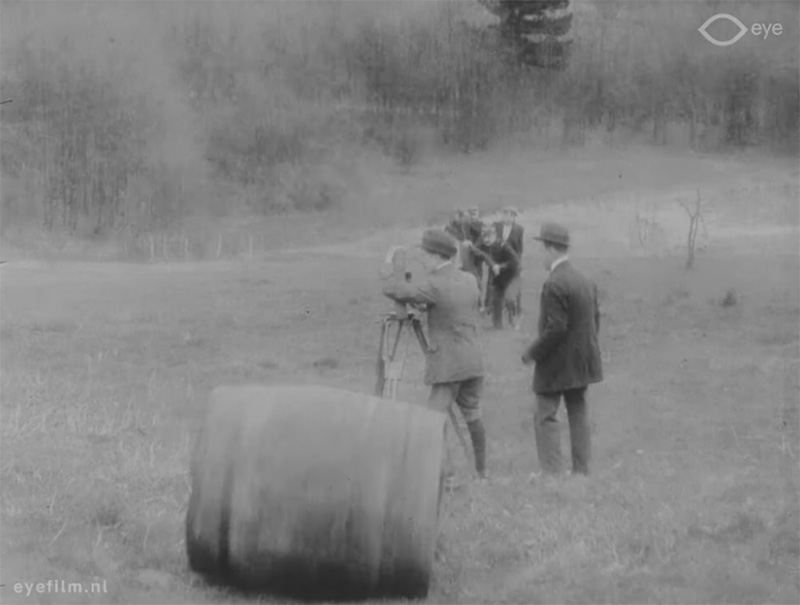
Barrel tumble comedy was always a popular joke during this era of filmmaking and Foezel rolls down hill and dale, managing to smash the movie crew’s camera and ends up spilling out in the village. By this time, he has dressed himself in the contents of the hamper, a long skirt and coordinating underwear.
He attempts to sneak home and change into his spare trousers (he really should have loaned those to the film people) but his wife and her mother see him changing out of a long skirt and lacy underwear. He indignantly declares that he has been undercover in a hush hush operation but they do not buy his excuses. To make matters worse, the movie leading lady has arrived to return his property…

The final joke of the film is particularly rewarding to Feuillade fans. Foezel is in trouble with his wife and he is in trouble with his boss—what business does an officer have stealing women’s underthings? But then, they find a blank card in the pocket of Foezel’s returned trousers, a prop left by the movie people. Slowly, words appear…
Fantômas!
Foezel declares that everything has been the work of the master criminal and promptly faints in terror as everyone else panics. At the time The Pantsless Policeman was made, the serial Fantômas had released its last chapter and Fantômania had gripped France. The public could not get enough of the supervillain master of disguise. I suppose this gag would be the equivalent of a modern film hero blaming all of his woes on the Joker.
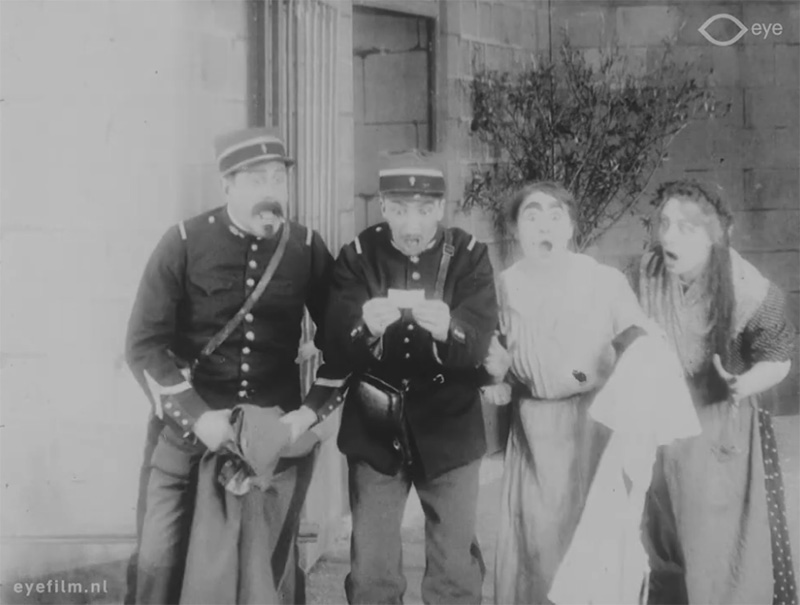
The Pantsless Policeman benefits from knowing even more context about the state of French movies in 1914. Film production during this period was lighting fast and delaying the entire location shoot simply to return for a pair of pants would have been unthinkable. However, this was particularly true in the case of a Louis Feuillade production.
In Figures Traced in Light, David Bordwell paints a picture of Feuillade as an ex-cavalry officer who was quite literally paid by the meter of film he produced and who enforced discipline with a whistle and the snap of a cane kept around for the purpose. The revolving door of arch-villains in Les Vampires was the result of Feuillade becoming enraged that Jean Aymé became ill and showed up late. He killed off his character on the spot and wrote his way out of the newly-dug plot hole with a new leader of the Vampires gang.

With this context in mind, it is doubly obvious why the Gaumont film crew could not just leave to retrieve the pants. Their jobs were on the line and it wasn’t worth risking their martial leader’s temper when a zany plan was at the ready.
I always enjoy the comical antics of Marcel Lévesque and he is to be praised for his wacky performance but I also enjoyed the tone that the entire cast struck in this picture. A movie called The Pantsless Policeman was never going to be subtle and everyone exaggerates their behavior but they don’t take it too far and they avoid self-aware mugging to the camera. Mugging and anticipating are major risks in any farce and it’s a big reason why so many Oscar Wilde adaptations fail: if the actors telegraph they are about to be naughty from ten miles away, the impact is deadened.

Feuillade’s team, though, get it just right and their timing is superb. For example, there is a cute business among the actors portraying the film troupe when they explain what they are doing in the country. “We’re making movies!” and then they mime the cranking of a movie camera in sync.
There are all sorts of little details like this. We can credit both their talent and, presumably, Feuillade’s liberal use of his whistle to keep things synchronized. I imagine that it got quite a workout during this picture!
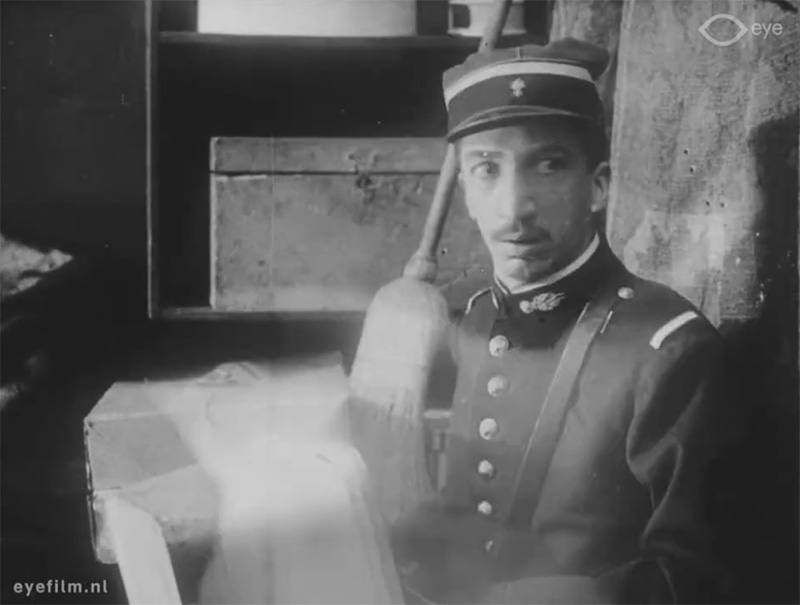
If you like Feuillade’s serials, this is a fun little companion picture that you are sure to enjoy. If you have never tackled a Feuillade serial, well, Judex is my favorite but this picture can still be enjoyed as a standalone comedy, though the final Fantômas gag is better if you know the Gaumont serial house style. Enjoy!
Where can I see it?
Stream with Dutch titles courtesy of EYE.
☙❦❧
Like what you’re reading? Please consider sponsoring me on Patreon. All patrons will get early previews of upcoming features, exclusive polls and other goodies.
Disclosure: Some links included in this post may be affiliate links to products sold by Amazon and as an Amazon Associate I earn from qualifying purchases.
 Movies Silently
I think there’s a joke in the French title. The “sans-culottes” were the lower-class rebels in the French Revolution, so called because they wore simple trousers rather than the garments called culottes. I don’t know enough French to know if the phrase would normally have been used in 1914 for someone without pants, but I suspect the phrasing “Le Gendarme sans Culotte” was a joke.
Entirely possible