
The popular comic strip character Happy Hooligan takes a ride on his cobbled-together bicycle/airship across the New York City skyline.
Home Media Availability: Released on DVD.
Stranger Than Fiction
In 1902, the Wright Brothers were still a year away from their heavier-than-air flight but the motion pictures were more than happy to imagine elaborate, if slightly impractical, flying machines. Airships and balloons of every shape and size figured into cinema and, while actualities of every description were popular, special effects took over where reality left off.

The Twentieth Century Tramp; or, Happy Hooligan and His Airship is a motion picture with a title longer than its plot. The new smash hit comic strip character Happy Hooligan is shown peddling a bicycle attached to a small blimp over the New York skyline. He happily waves to his public. That is the entirety of this one-minute, 37-foot film.
It’s also worth noting that, like many Edison films of this period, The Twentieth Century Tramp only survived as a paper print. Paper prints were reels of photo paper with the film frames copied onto them. Copyright law at the time did not know how to classify motion pictures— is each frame a photo? – so studios would deposit paper prints with the Library of Congress to establish protections.

Obviously, photo paper will not have the same level of detail as a film print, so detail has been lost but when a movie would have otherwise been lost, we can be grateful for anything that survives. The long story short is that the surviving print of The Twentieth Century Tramp is dark and fuzzy but it’s all we have.
The film was directed by Edwin S. Porter and involved J. Stuart Blackton of Vitagraph as Happy Hooligan and, likely, the mastermind behind the film’s double exposure special effect. A panoramic shot of the city was made with the top of the lens covered and then the airship was shot with the bottom covered. This created an illusion of the tramp floating high above the city, though the effect was somewhat spoiled by the hard line between the shots.

This picture was actually an unauthorized remake of Conquering the Skies (1901), a Ferdinand Zecca film with an identical concept and the same effect—a panorama of a French cityscape—but Zecca’s softer transition between the top and the bottom of the screen make his illusion more effective.
You may also notice that the Zecca film featured an elaborate art nouveau machine and a stylish rider, while the Blackton film’s airship looked more cobbled-together and its rider disheveled and ragged. This was intentional and gives us insight into the Edison company’s business model at the time.
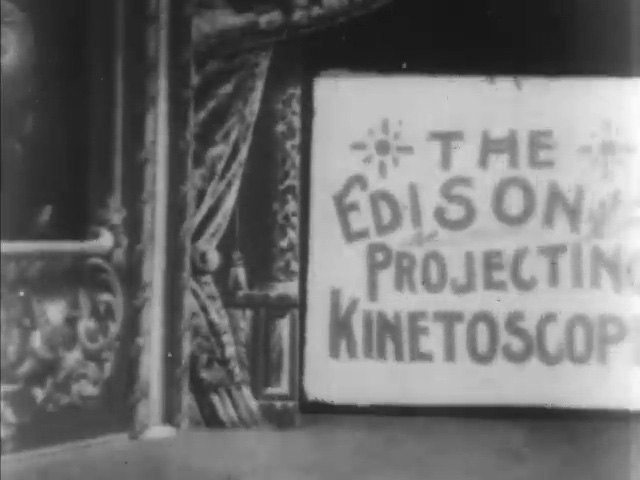
Edison was famously obsessed with copyrights and patents in order to prevent anyone from stealing inventions. However, the Edison company was prone to lifting creative pictures from other companies, reworking them very slightly and releasing them under the Edison banner and with added pop culture connections.
For example, the R.W. Paul comedy, The Countryman and the Cinematograph (1901), was remade and released by Edison as Uncle Josh at the Moving Picture Show in 1902. The Uncle Josh character was created by Cal Stewart and was a humorous country fellow who dispensed homespun tales of his interactions with the modern world. Stewart made Uncle Josh comedy recordings for Edison’s audio arm.

By the same token, the Zecca film was reworked as a vehicle for the comic strip character created by Frederick Burr Opper. Happy Hooligan was a, well, happy tramp who managed to maintain a cheery disposition despite his poverty. His signature was an empty soup can strapped to his head as a hat.
The Edison company was very interested in Happy Hooligan and shot a series of films about the character. (Biograph also got in on the act at the same time—I told you copyright law was odd.) There were also stage productions featuring the character and since stage and screen were deeply linked at the time, it would have made sense for theaters to add some Happy Hooligan cinema to supplement their live entertainment.
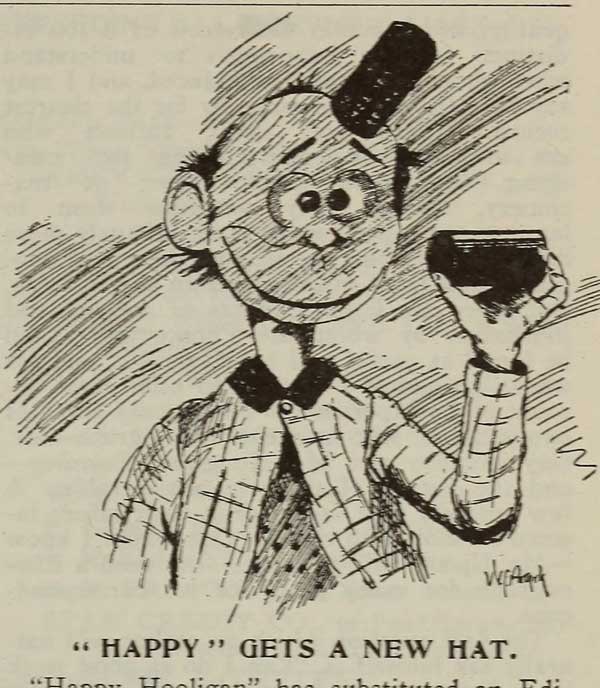
The Happy Hooligan films are sometimes described as the first adaptations of American comics for the screen but I am a bit hesitant to call first with early film because what we don’t know far surpasses what we can prove. However, it is safe to say that they were very early and an excellent example of the kind of multimedia reach that was possible in the 1890s and 1900s.
While it wasn’t exactly an adaptation so much as footage of dancers dressed as the characters, the Yellow Kid appeared in an 1897 Edison picture. Edison also adapted the humorous postcard portraying “The Whole Dam Family and the Dam Dog” for the screen in 1905. Meanwhile, Biograph adapted the Foxy Grandpa comic strip into its own film series. The Lumière film The Sprinkler Sprinkled (1895) was possibly based on a comic strip. In short, live action comic adaptations were big business.

While we are on the subject of adaptations and genres. The Twentieth Century Tramp is sometimes classified as science-fiction. In fact, Wikipedia currently claims that it was the first science-fiction film made in the United States.
There is a big problem with this particular boast: while Zecca’s wonderful airship had no balloon, the machine Happy Hooligan was shown riding was not drawn from speculation and was likely based on a real invention in use at the time. Carl Myers had demonstrated his pedal-powered balloon (dubbed the Sky-Cycle, Aerial Bicycle and Air Velocipede) in 1895 and patented his invention in 1897, though it remained more of a novelty than a practical means of transportation.
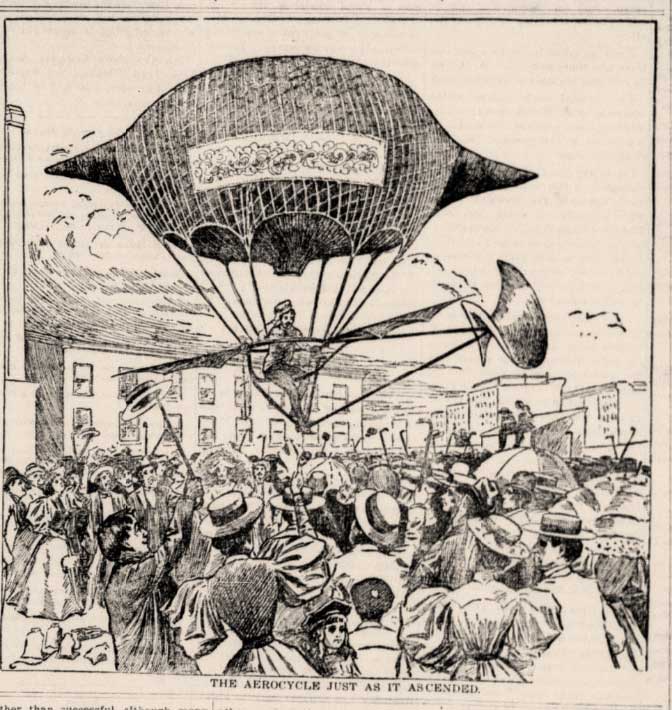
His demonstrations were performed in New York with his balloon branded by the New York World, which covered his antics breathlessly. Stories were syndicated nationwide, complete with illustrations of the magnificent flying machine. His wife, who styled herself “Carlotta, the Lady Aeronaut,” was already in on the act, ballooning—and sometimes crashing—herself.
As for how Zecca entering this airship equation, the powered airship and ballooning generally were a Frech specialty (Henri Giffard used steam in the 1850s), so a pedal-powered machine would hardly be outside the realms of their imagination but it is worth noting that Myers corresponded with French aeronaut Gustave Hermite regarding the purchase of atmospheric equipment, so the French influence can be found in both art and life. However, as stated before, Zecca’s film is safely science-fiction.

(Disclaimer: If I am cautious about claiming firsts for films, I am triply cautious for any claims related to human flight. My concern is not who invented what first but rather to establish that the pedal-powered blimp was a known quantity to an average New Yorker of 1902.)
Myers’ balloon was far larger than the tiny blimp we see in the Porter film—they likely reduced the size to assure that the entire machine would fit into the frame. The sky-cycle is stylized for the screen but for all intents and purposes, it is the same machine that Myers was flying. If anything, Myers’ machine looked more science-fiction than either film.
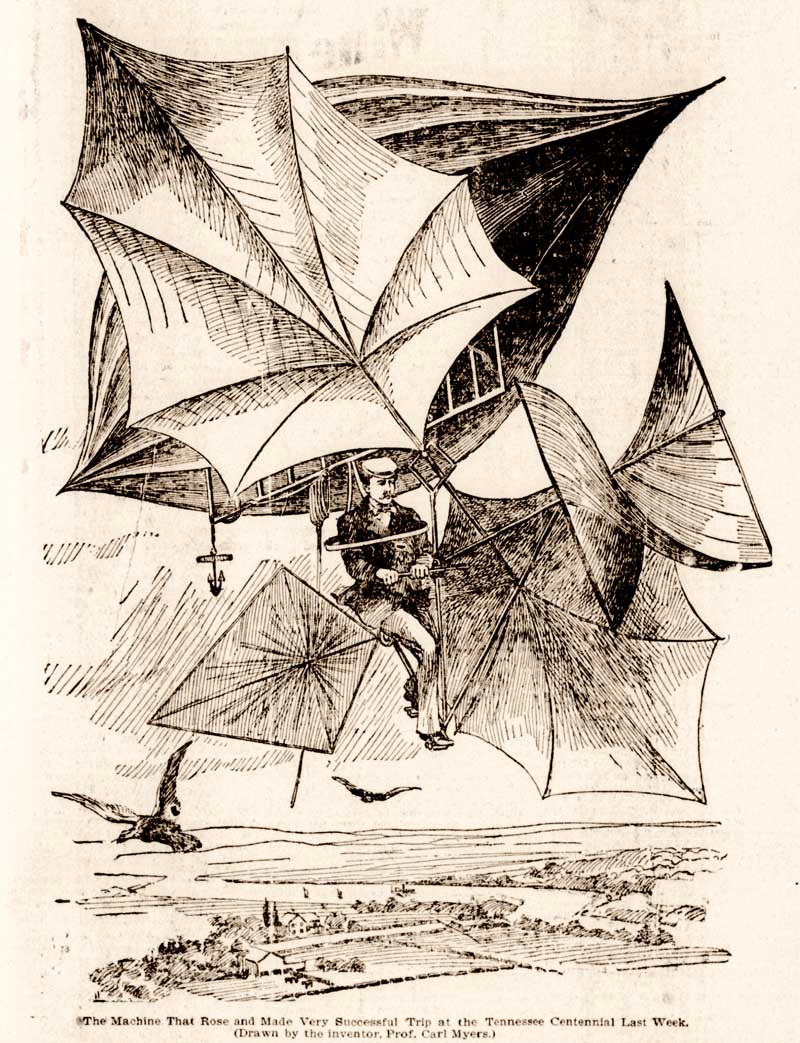
The Twentieth Century Tramp is not science-fiction, it is a comedy having a bit of fun with the flying craze of its era and also an example of how comics and films had been intertwined since the dawn of cinema. What it lacks in plot, it makes up for in historical significance.
Where can I see it?
☙❦❧
Like what you’re reading? Please consider sponsoring me on Patreon. All patrons will get early previews of upcoming features, exclusive polls and other goodies.
Disclosure: Some links included in this post may be affiliate links to products sold by Amazon and as an Amazon Associate I earn from qualifying purchases.
 Movies Silently