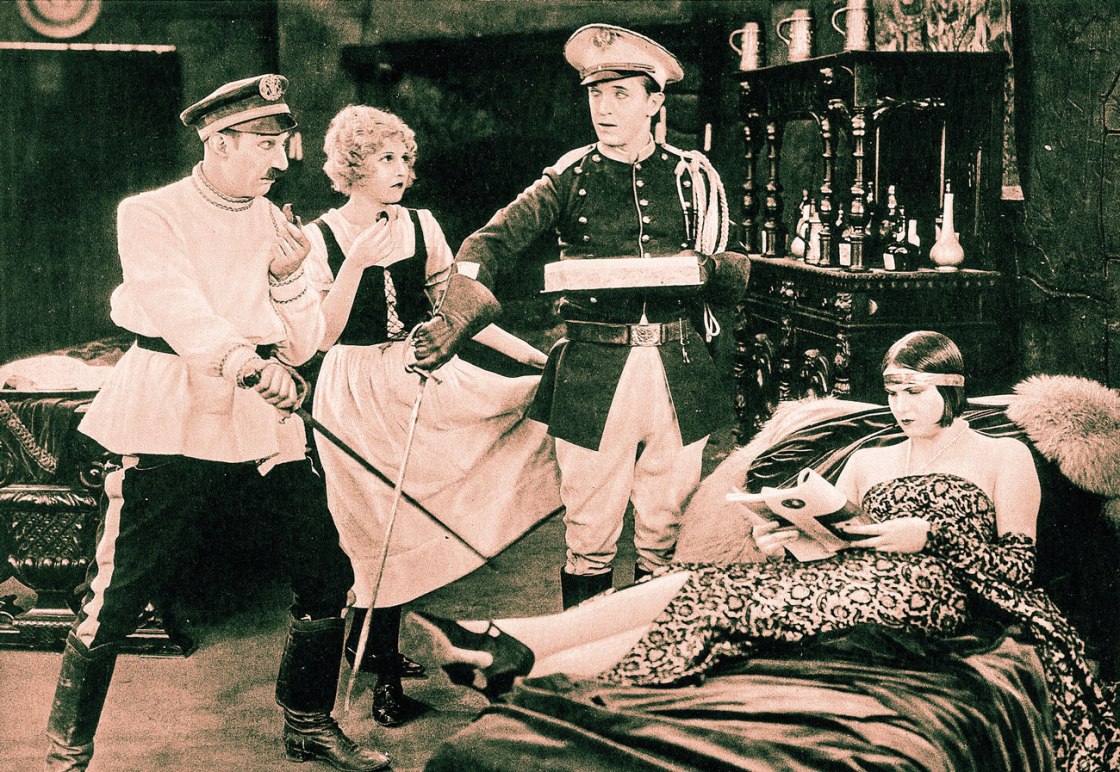
When Princess Minnie’s letter is stolen by the wicked Rupert, she calls in her husband’s doppelganger to save the day. A spoof on Ruritanian romance starring the one and only Sta Laurel.
Home Media Availability: Released on DVD.
General Delivery, Europe
Anthony Hope’s The Prisoner of Zenda has been filmed numerous times, adapted, reimagined, reworked, rebooted and generally tweaked. Hollywood couldn’t resist it. A commoner, who is the spitting image of a reigning Central European monarch, is forced to step in and save a kingdom with his swashbuckling? And he falls for his double’s fiancée? Movie catnip. “Ruritanian,” named for the fictional kingdom, became its own adjective as a result and the silent screen was awash.

And, like most popular things, Zenda received its own sequel from the pen of Hope, named not for its hero, Rudolph Rassendyll, but for its most memorable villain, Rupert of Hentzau. After the runaway success of director Rex Ingram’s The Prisoner of Zenda in 1922, filming this sequel was just as obvious. After all, Zenda had launched Ramon Novarro to stardom in his role as the charmingly psychotic Rupert.
The 1923 Rupert of Hentzau was produced by Selznick and had no connection to the Ingram picture, which was made for Metro (the first “M” in MGM). This later film also did not receive the universal acclaim of its 1922 predecessor but someone was taking notice…

Stan Laurel didn’t have Oliver Hardy as a partner yet in 1924 but he was steadily making a name for himself as a cinematic funnyman, ably assisted by James Finlayson. At this point in his career, he was enjoying success with short films mocking popular film releases and Rupert of Hee Haw was an obvious entry in the series.
The short opens with a proclamation that it is the sequel to The Prisoner of Zebra. (Remember your British vs American English and know that the wordplay works better if you pronounce “Zebra” to rhyme with “Debra.”)

If you know your Zenda, you will recall that the everyman hero, Rudolph, is in love with Flavia, the fiancée of the tipsy and irresponsible king, and she with him but the pair was forever separated by duty. In Rupert of Hee Haw, Minnie (Mae Laurel, her character’s name a pun on Minnehaha) is miserable in her engagement and the king (Stan Laurel) is a staggering drunk fool. She decides that his nose needs punching and wants Rudolph Razz (Laurel again) to return and do just that. With the support of the Duke of Bromo (George Rowe), she writes a letter to Rudolph.
However, the letter is stolen by the Duke of Aspirin (Pierre Couderc) and his henchman, Rupert of Hee Haw (James Finlayson). When Rudolph arrives, he has a new mission: recover that incriminating letter before the king sees it. There are multiple antics involving the drink king, Minnie’s penchant for dropping banana peels, and a cameo from members of Our Gang, but Rudolph finally tracks Rupert to his mountain hideaway in London, where the men engage in a mighty dual. Meanwhile, the stylish neighbor, Lady T. Pott Dome, cannot be bothered to look up from her chocolates and magazine as the fight rages.

(Bromo, or the medicine Bromo-Seltzer, shows up as a character name in multiple comedies. Lady T. Pott Dome is, of course, a reference to the Teapot Dome scandal, which was big news at the time.)
Will Rudolph recover the letter? Will Minnie finally discover what a trashcan is for? Find out in Rupert of Hee Haw!

Before he found lifelong success as one half of Laurel and Hardy, Stan Laurel made his share of spoofs. The spoof is among my favorite comedy flavors but if the target is a silent film, there is a risk that some of the references will be lost. Silent comedy is watched far more often than silent drama, so there is a very real possibility that modern viewers will be familiar with the joke but not its target, perhaps not even realizing that they are watching a spoof at all. This sort of thing leads to deep misunderstandings of the comedian’s message. (See my reviews of The Frozen North and Burlesque on Carmen.)
Laurel made one of my favorite comedies, silent or sound, Dr. Pyckle and Mr. Pryde, which deftly lampooned Dr. Jekyll and Mr. Hyde, specifically the wildly successful John Barrymore version. Laurel’s gift for taking something subtly absurd and then pushing it to the point of hilarity worked perfectly as he terrorizes London by playing extremely petty practical jokes. The fiend! He also deftly lampoons Barrymore’s writhing transformation scene.

But here’s the twist: The John Barrymore Jekyll and Hyde not only survives, it is one of the most readily available silent films. The 1922 version of The Prisoner of Zenda likewise survives and is readily available for viewing, so we can get some idea of Laurel’s cinematic influence for Rupert of Hee-Haw. However, the 1923 Selznick release of Rupert of Hentzau is considered to be a lost film with no surviving copies. This means that even the most dedicated silent film viewer is stuck in the position of processing a spoof without the original.
Well, now the tables are turned. We can easily pinpoint parallel plot points but without the original film, we won’t be able to enjoy the tiny visual flourishes that make up a good spoof, the mimicked gestures, the twisted title cards, and so forth. This sort of thing is not likely to be documented in a review or synopsis from the time of release (I checked).

Rupert of Hee Haw was praised as a successful—if broad—comedy and another successful lampooning for Laurel. Unfortunately, as is typical of comedy short reviews, there really isn’t a deeper breakdown of the gags. Bert Lytell played the dual role of Rudolph and the king, Elaine Hammerstein was Flavia and Lew Cody took on the title role of Rupert. Given Cody’s penchant for mugging, carrying on, and twitching, I am fairly confident that he was no challenge to Ramon Novarro as the best silent Rupert. (Douglas Fairbanks Jr.’s 1937 turn in the role is my all-time favorite, though.)
The lead choices are okay in my book but not spectacular. (Your mileage will always vary with Cody.) The supporting players, though, were a veritable who’s who of character actors: Adolphe Menjou, Hobart Bosworth, Elmo Lincoln, Bryant Washburn, plus Claire Windsor and Marjorie Daw. Yes, please!
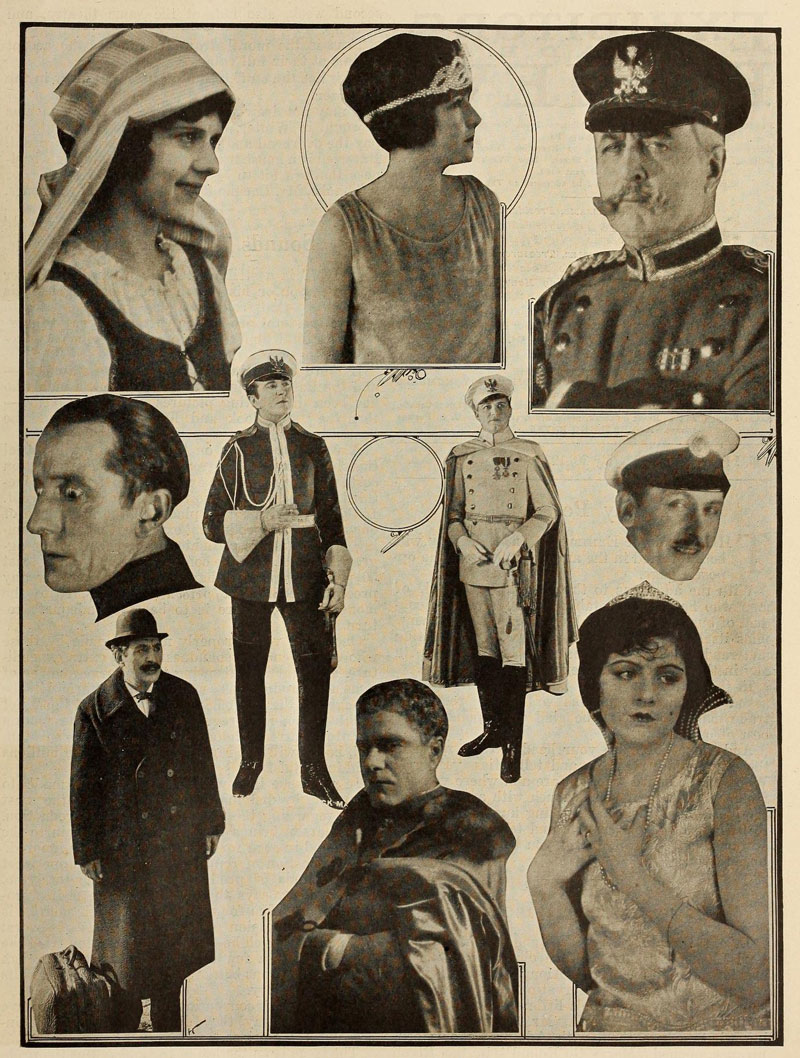
However, even if we do not have the finer details of the film, we do have stills and a synopsis of the Selznick Rupert, which does help a bit:
“The story reveals that Rupert of Hentzau, who was supposed to have been killed, actually escaped. Unable to longer stand the treatment of her by the king. Queen Flavia sends for the Englishman Rudolph Rassendyll. Rupert returning to Ruritania intercepts the queen’s letter and the action of the picture deals with the attempts of Rudolph and the queen’s loyal followers to prevent the letter from reaching the king. Rupert is finally killed after he had shot the king, and Flavia abdicates so that she may find happiness as Rudolph’s wife.”

Anthony Hope’s novel ended with Rudolph being assassinated while in the guise of the king and being buried with royal honors, while Flavia rules alone. (Needless to say, Hope’s novels were extremely English.) However, American films with Ruritanian settings from this period tended to be anti-monarchist, turning the kingdoms to democracies or even communism, or abandoning them altogether (His Royal Slyness, Long Fliv the King, Young April).
Flavia opting to abdicate for love over nobly ruling alone would have been an obvious choice for the very American producer Lewis J. Selznick, whose family emigrated from the Russian Empire to escape the pogroms of Tsar Alexander III, policies carried on by his son, Nicholas II. (Of course, abdication for love would never be an issue with any twentieth century royal family… right?)

Stan Laurel was one of the most English of English comedians in Hollywood, drawing heavily from the music hall tradition and constantly reworking the classic bits for a new audience. So, we have a case of an English novel being Americanized by Hollywood and the Americanized version spoofed by an English comedian.
Laurel opts to leave the monarchy intact at the end of his spoof but does have Minnie write another note… telling Rudolph that she doesn’t want to see him again and then she leaves with Bromo. Rudolph makes unsuccessful passes at Lady T. Pott Dome and the maid before giving up, asking Rupert to scootch over and taking his place beside him in defeat. Which, I suppose, is more realistic than either the Hope or Selznick endings.
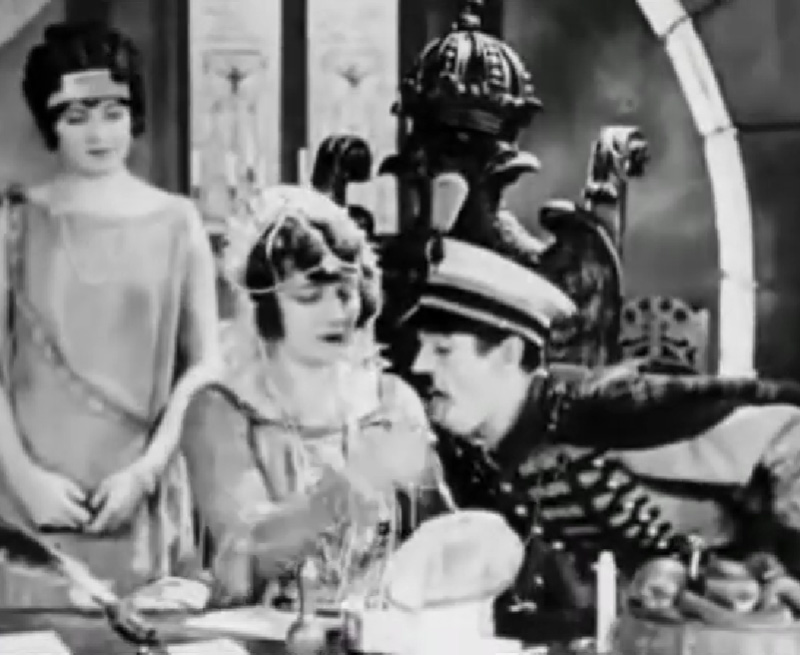
Having established that modern viewers are at a disadvantage in absorbing Rupert of Hee Haw’s gags, I do think this picture has more misses than hits. The dueling bits are marvelous, as are the characters getting caught in their military braiding. However, quite a few of the gags are generic comedy bits that could be used anywhere. The princess likes to eat bananas and drop the peels. You’ll never guess where this is going. (Spoiler: You will absolutely guess.) There are a great many pratfalls and kicked backsides as well.
Although… come to think of it, the Ingram version of The Prisoner of Zenda did employ an honest-to-John banana peel gag. (Rex Ingram was a brilliant visual artist but his sense of humor was… lacking.) So, maybe the joke is actually more Ruritanian than I first supposed.
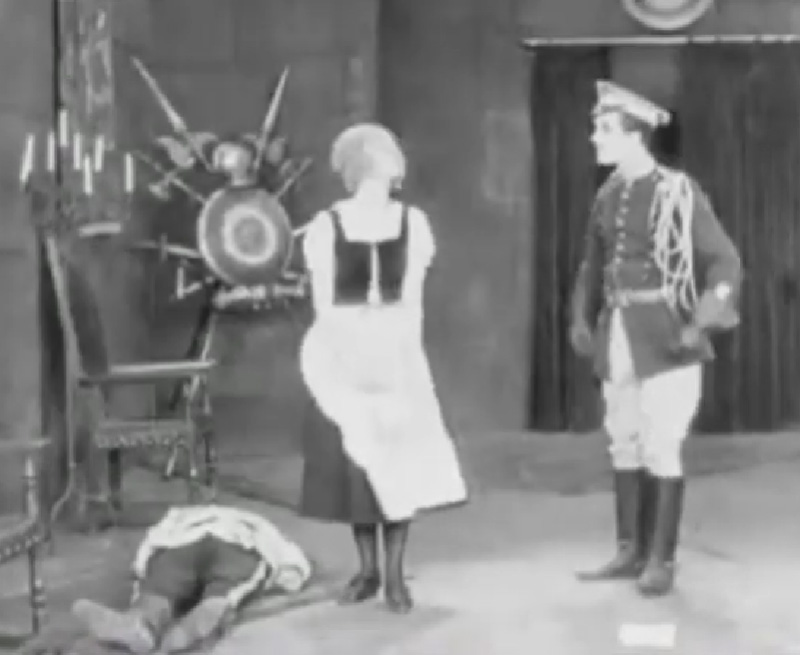
The best gags in the film are found near the end of the picture and are delivered by the ladies of the cast. The actress playing Lady T. Pott Dome has a wonderful deadpan eyeroll as she utterly ignores the raging dual and then wanders off with one of Rudolph’s courtiers. Ena Gregory delivers the final blow to Rudolph’s ego when she refuses to be sloppy seconds, or thirds in this case, (Minnie and Lady Dome already rejected him) and swaggers away.
Are there finer points of spoof comedy that I am missing because I cannot view Rupert of Hentzau? I am absolutely certain that there are. Situations like this really drive home how much knowledge of the silent era we have lost and will likely never recover but if Rupert of Hentzau ever emerges at a film market, in an attic or under some boxes in a friendly Argentinian archive, I will return to this review and revise my opinion.

Rupert of Hee Haw is a mixed bag. Some of the gags are quite amusing, many do not quite hit. The talent of Laurel, Finlayson and their two supporting ladies help buoy the picture for its short runtime but it has an unfinished feel. It was never meant to be viewed in isolation from its inspiration, after all. Fans of Laurel, like me, will want to see it under any circumstances but newcomers might want to dive into Dr. Pyckle and Mr. Pryde instead.
Where can I see it?
Released on DVD in the second volume of Kino Lorber’s Stan Laurel Collection.
☙❦❧
Like what you’re reading? Please consider sponsoring me on Patreon. All patrons will get early previews of upcoming features, exclusive polls and other goodies.
Disclosure: Some links included in this post may be affiliate links to products sold by Amazon and as an Amazon Associate I earn from qualifying purchases.
 Movies Silently
Dr. Pyckle and Mr. Pryde is great fun, but it has the frustration that the ending is lost, and it stops at the moment of greatest suspense. Some versions on the Internet stop at an earlier point to give the impression of a more definite ending.
Your discussion also puts me in mind of Harold Lloyd’s _His Royal Slyness_, which has a commoner doubling for a prince but isn’t as close to the Prisoner of Zenda mold. Lloyd’s lookalike brother Gaylord plays the prince.
Yes, just about every comedian took a stab at royal lookalikes, even Marion Davies!