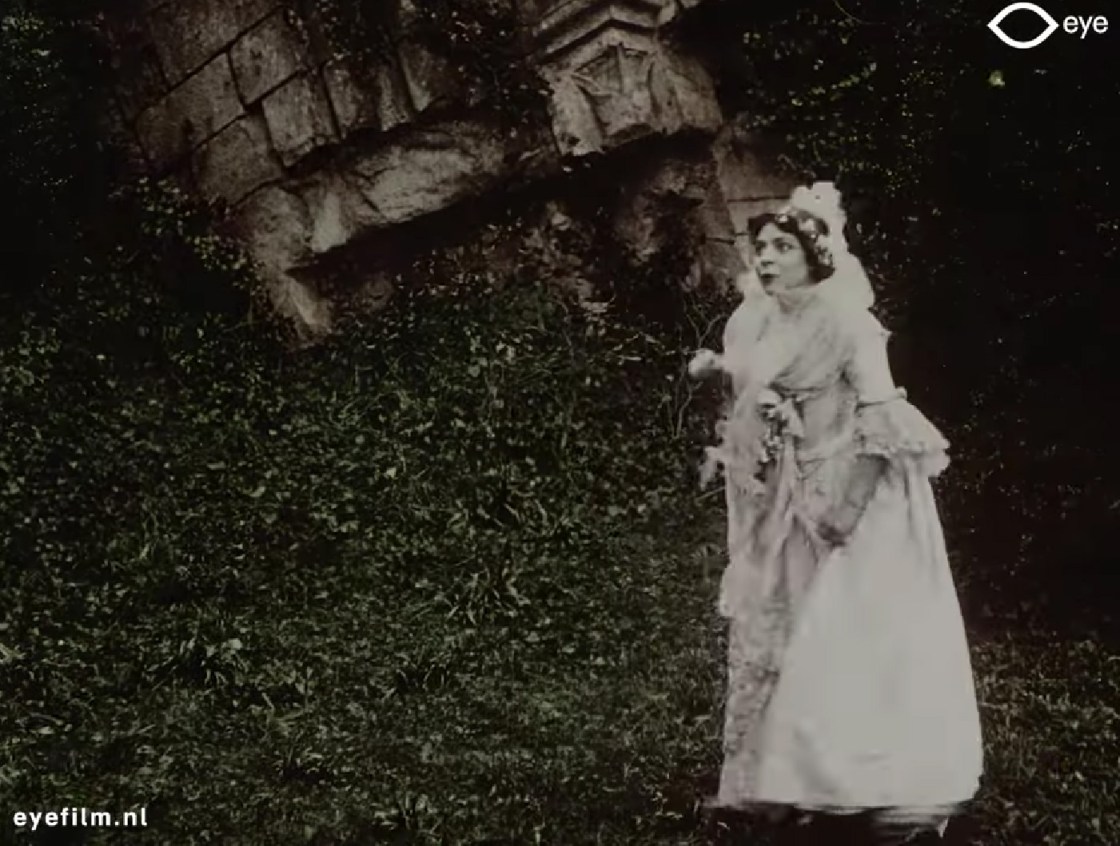
A post-wedding game of hide and seek goes terribly wrong when the bride discovers an ancient death trap and becomes ensnared in it herself. Will she share the same fate as another, long-dead bride, the trap’s original victim?
Home Media Availability: Stream courtesy of EYE.
Picard never thought of this maneuver
If you’re in the mood for something that is both creepy and tastefully tinted, the silent films of France are an excellent place to look.
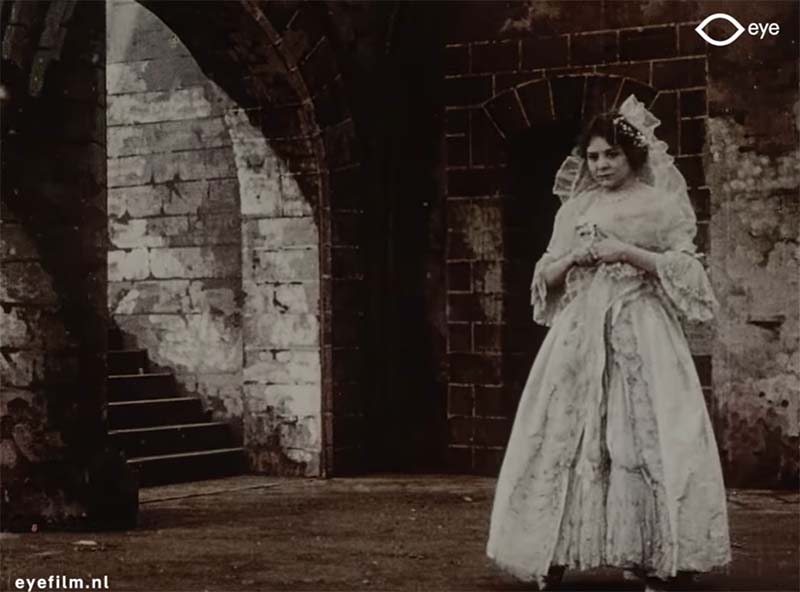
Today’s subject, The Bride of the Haunted Castle, checks both boxes with its moody gothic chills in lovely shades of pastel. The film opens with an eighteenth-century wedding party. With the couple wed and the feast consumed, the revelers head out of town to visit to ruins of a castle, as is tradition. (I have attended many weddings and this is easily the best custom I have ever heard of.) On their way out of town, they stop to fuss over a local tabby cat. The cat isn’t amused, goes off-script and attempts to bat at them. My kind of kitty!
The ruins are serene and the party decides that the best way to pass the time is with a game of hide and seek. The bride (Carmen Deraisy) is determined to discover the best hiding place, climbs a slope and accidentally falls through a crack in the wall. She finds herself inside the cellar of the castle and tries to find her way out. She tries a door, it opens and then closes behind her. Inside is a veiled figure sitting on a chair and no other exit. The door has locked itself and there is no way to open it from the inside. The bride is trapped and immediately faints.

Meanwhile, her husband (Victor Capoul) has found the others but the bride is missing. They begin to search for her but cannot find a trace of her trail.
Inside the room, the bride discovers that the veiled figure is a skeleton. There is a book on the table that has “You will not leave this grave alive” written on the cover. Not the best sign. As the bride looks on, the book reveals the tragic history of the death chamber. In a previous century, the master of the castle discovered that his wife was unfaithful. He had her taken to the room and left to starve.
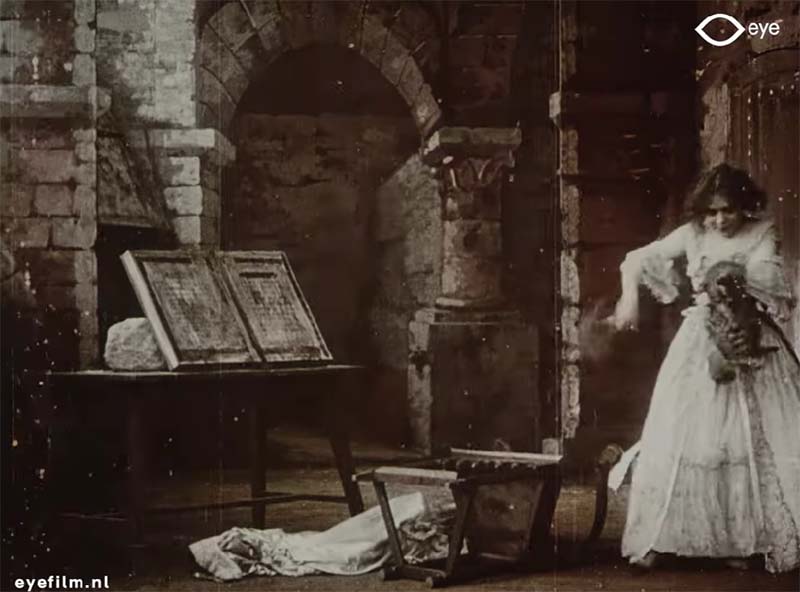
All hope seems to be lost—how can anyone find the bride underground and how can she hope to escape? But then, the savior arrives in the form of that spunky cat. The bride grabs the cat, fastens her veil around its neck and hopes that it will manage to fetch help. The indignant cat runs to its owner but the groom sees the veil and our feline hero graciously plays Lassie and leads the search party and worried husband to the trapped bride. All ends well, but they were fortunate that they had such a cooperative cat. Mine would have shredded the veil and led the search party to their bag of crunchy treats.
First of all, I have to say that this film is stunning. The sets and scenery (more on that in a minute) are perfectly complemented by the elaborate costumes and delicate stencil color. The color seems to have faded with time but I quite enjoyed the muted palette. The reds, infamously fugitive but very popular in applied color, likely were the first to go. Please note that the titles are tinted red and the color is still vibrant but these would have been prepared separately from the Pathé Frères stencil color process, was colored using a completely different chemical method and could have been made in Germany, where this particular print was released.
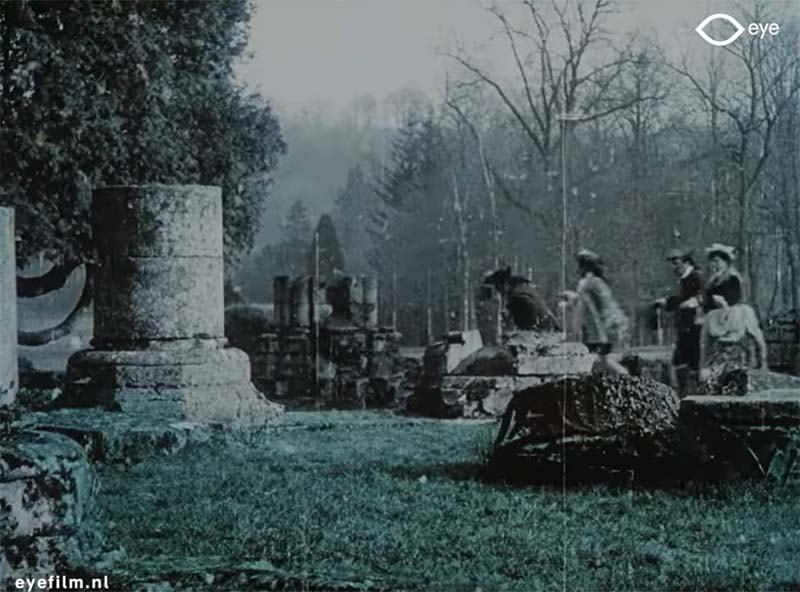
Faded colors or not, director Albert Capellani is to be commended for putting on such a handsome production.
I have to admit, I had only been half-listening to call for the films of Capellani to be included more regularly in the early cinema roundup. I had seen some of his shorts and features—he brought Hugo’s The Hunchback of Notre Dame and Zola’s Germinal to the screen pre-WWI and directed Nazimova, as much as anyone directed Nazimova, in The Red Lantern. It’s not that I wasn’t interested in expanding the canon, I always favor that, but I was busy with other, shinier objects. The Bride of the Haunted Castle, however, made me sit up and take notice.

In his invaluable French film history, The Cine Goes to Town, Richard Abel points out that France’s productions of 1910-1911 were broadening their horizons and telling their stories without the established tableau technique, a change that had been brewing since the 1900s. (Due to limitations in runtime, the earliest motion pictures would take a “good parts” approach, showing the biggest, most crowd-pleasing scenes in a series of tableaux.)
The Bride of the Haunted Castle tells a complete story (with flashbacks) and uses parallel editing to portray the panicked bride and her equally concerned rescuers all, as Abel points out, tied up in a “no adultery, ladies” bow. In short, technically well-made and designed to appeal to contemporary audiences. Capellani is correctly credited as one of the fathers of film editing.

However, what really won me over was not the editing but the setting and the overall mood. I am a sucker for some juicy gothic storytelling and The Bride of the Haunted Castle, from the title to the scenery, fits very snugly in that genre.
Capellini’s earlier productions featured the painted sets that were standard in French films of the era but his had a bit more depth and realism than the stage-inspired scenery of Méliès. It’s not surprising that, given a proper ruined castle to play with, Capellini would go to town, and include mood-building sequences of the heroine wandering through the ruins with her bridal veil lending an uncanny flavor to her appearance. Her glee begins to give way to terror as she enters the death chamber, a set but a pretty realistic one.

The idea of falling victim to a death trap designed centuries ago with both its inventor and victim long dead… that’s a macabre fantasy indeed, as is the notion of disappearing without a trace due to that trap. (The plot featured into the Star Trek: The Next Generation episode, Booby Trap, if you’re interested in following the trope into the television era.) And, while Capellani does include a happy ending for the unfortunate bride, this plot is exceptional nightmare fodder.
Capellani takes things slowly, despite his scant one-reel runtime, and allows the horror of the situation unfold, along with the backstory of the mysterious death chamber. Silent movies tended to be models of efficiency, fitting miles of plot into a tiny package, but a slower pace was the right decision for this picture and the excellent pacing—deliberate but never dull—is another point in its favor.

The Bride of the Haunted Castle is a gothic good time in the classic style. With bonus heroic cat. I enjoyed it quite a bit and emerged with increased respect for Capellani. A lovely little surprise.
Where can I see it?
Stream courtesy of the EYE Filmmuseum. The surviving copy has German intertitles (tinted red to discourage piracy) and there are optional English subtitles. If you want to dig deeper into the works of Albert Capellani, there is a very nice PAL box set (no English subs).
☙❦❧
Like what you’re reading? Please consider sponsoring me on Patreon. All patrons will get early previews of upcoming features, exclusive polls and other goodies.
Disclosure: Some links included in this post may be affiliate links to products sold by Amazon and as an Amazon Associate I earn from qualifying purchases.
 Movies Silently
Sounds interesting and unique — I will have to give this one a look, Fritzi!
– Karen
I think you will like it, very moody in a storybook way