
This Danish play was so nice, they filmed it twice in one year and that was after a short film that featured one of the dance sequences. The film industry of Denmark simply could not get enough of this royalty-approved folklore fantasy.
Home Media Availability: Stream courtesy of the Danish Film Institute. (Individual film links at bottom of review.)
An Elf a Day…
Since the dawn of projected cinema, the film industry had been interested in putting popular subjects on the screen but the push to class up the joint really took off in the late 1900s and early 1910s. This came in the form of adaptations of acclaimed plays, novels and operas, as well as hiring stage talent to act and even classical composers to score new releases.

So, while America was enjoying a not-quite-legal Ben-Hur adaptation, France was watching a historical assassination with original Saint-Saëns music, and Russia was singing along to a Ippolitov-Ivanov score, 1910 Denmark was inundated with adaptations of Elverhøj (Elves’ Hill) by Johan Ludvig Heiberg.
Well, perhaps inundated is too strong a word but two adaptations in a single year released in the same country is a lot of Elves’ Hills. Both films were limited to two reels and kept close to their revered source material. I will be tackling both productions at once, as well as discussing an even earlier instance of Elves’ Hill onscreen, and to limit confusion, I will identify the two pictures by their respective directors: the first released by Biorama and directed by Jørgen Lund and the second released by Fotorama and directed by Gunnar Helsengreen.
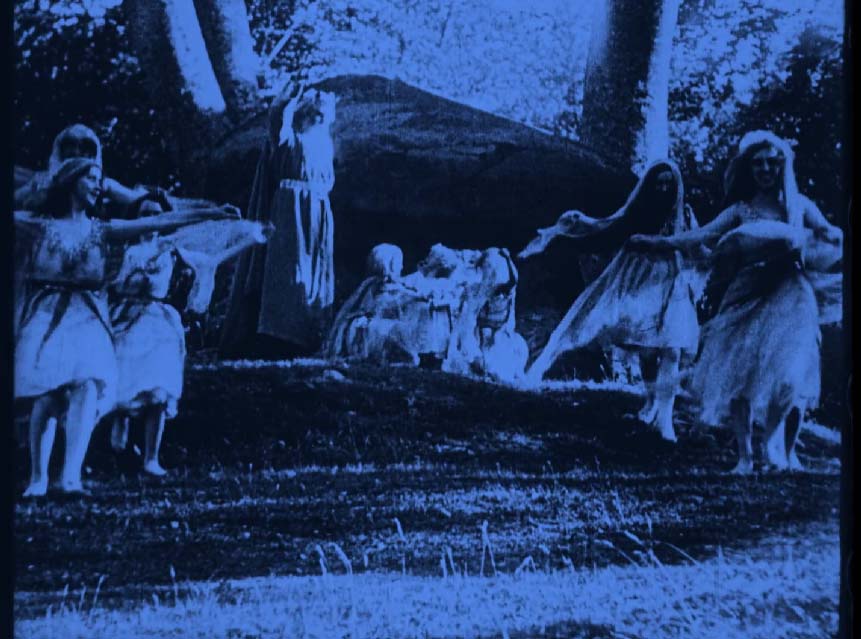
The 1828 play is set during the reign of King Christian IV (seventeenth century-ish) and centers around Agnete, a foundling and suspected elf. She is in love with Sir Ebbesen, one of the king’s knights, but he is engaged to king’s goddaughter, Elisabeth Munk, but she is in love with Ebbesen’s friend, Paul Flemming. Got all that?
Ebbesen and Elisabeth want to wiggle out of their engagement but nothing doing and the ceremony proceeds. Meanwhile, Agnete goes off to dig up the jewelry she was found with so that she can seal it up to avoid marrying the Elf King. However, King Christian shows up in the manner suitable to cinematic historical kings (see: most adaptations of Robin Hood) and unravels the mystery of Agnete’s origins.
The play had been a wedding gift from King Frederik VI to his daughter (certainly beats a blender in the wedding gift ranking) and it included ballet and a catchy score by Friedrich Kuhlau. (It’s still a reasonably popular repertory piece, enjoy a recorded performance here.) All this gingerbread was attached to a play that incorporated Danish folklore and helped define national culture in an era when everyone and their grandmother in Europe was rushing to define their culture through the arts.
I find myself in a similar predicament to the one I experienced reviewing the culturally significant Finnish film The Cobblers on the Heath: lack of English translation of the source material. So, I am at a slight disadvantage in discussing these adaptations, though I can extrapolate much from what they both include.

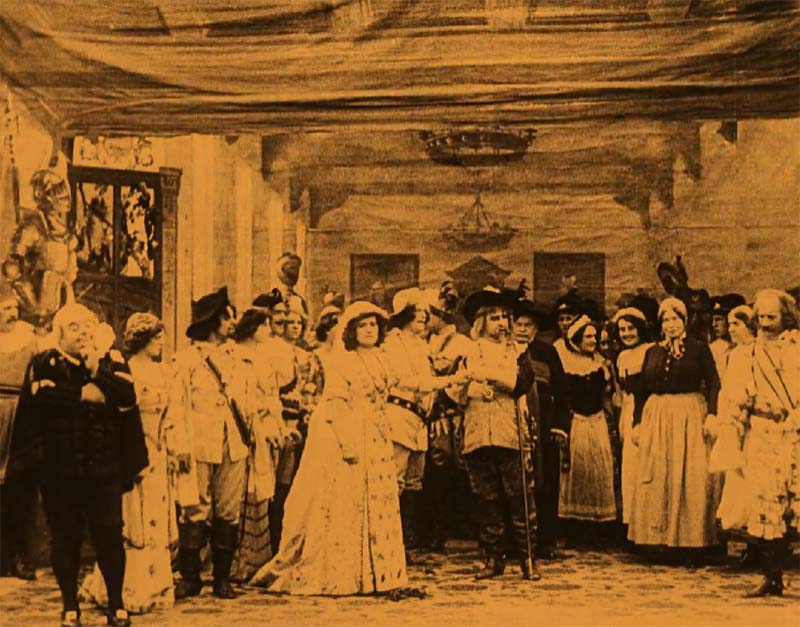
The Biorama/Lund version opens with a wonderful, special effects-laden sequence showcasing the Elf King and his subjects with double exposure and substitution splices. The Fotorama/Helsengreen version keeps its feet on the ground with a shot of Agnete’s cottage but makes up for its comparative lack of special effects and dodgy exterior sets with a larger cast and fancier costumes.
It’s a great pleasure to watch and compare these competing versions because they showcase different aspects of film during this transitional period. The Lund film makes better use of outside scenery and its camera pans are smooth as butter (not something you could depend on in films of this period, so most welcome) but it features awkward blocking, with a lead actress very nearly shoved to the back during a minuet scene in a cramped, dubiously painted set. Meanwhile, the Helsengreen film has good blocking and interiors, and a better chemistry between Agnete and her adopted mother, as well as a better portrayal of the central love triangle (love hypotenuse?) and its participants.

Both films were made by people keenly aware of the source material’s significance and popularity and seem determined to film the play as-is rather than fully opening up. This would have been very typical for the era (see the 1916 Sherlock Holmes that was essentially a filmed play) and the movie producers’ “if it ain’t broke” philosophy. I don’t hold this fact against either production.
Neither picture is particularly easy to follow but that was typical of the era as well. Feature-length films were not universally adapted for a few more years and production teams cut all nonessentials, working from the assumption that the plots of popular materials were already familiar to the audience, so exposition and a complete plot were optional. (The Helsengreen production has expository title cards added a later date, as evidenced by their anachronistic typeface, which help considerably. This modern non-Dane appreciated them very much.)

So, which version one is better? Honestly, I found much to enjoy in both versions and I can’t choose, so I won’t. You can see both pictures in just 40 minutes, so why not check them out for yourselves? One thing I can guarantee is a fun portrayal of the mischievous, child-snatching Scandinavian elves, and that’s always a plus in my book, especially when art nouveau costumes are involved.
But what about that earlier version of Elves’ Hill that I mentioned earlier? Well, the original play had been something of a multi-discipline extravaganza with ballet and opera incorporated. And movies were often projected at legitimate theaters as part of a full evening’s entertainment program. So, early filmmakers would shoot dance performances and comedy bits that would then be incorporated into a program alongside live entertainment.

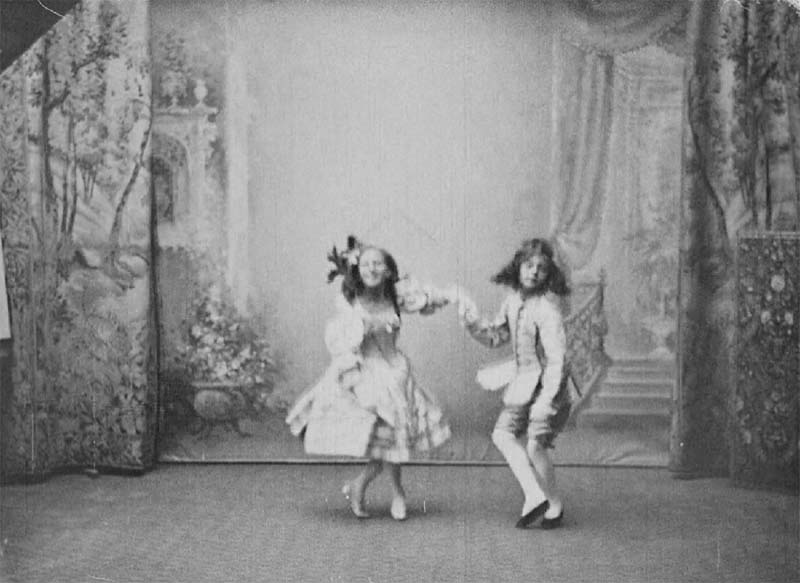
In short, Elves’ Hill ballet sequences were crying to be filmed and one was in 1902 by Danish pioneer Peter Elfelt. The Children’s Dance from ‘Elverhøj’ was taken from the play’s wedding sequence in which child dancers entertain the bride and groom. The dance is shot against a theater backdrop without any context save the title. Such sequences were a way for fans of the play to relive a popular sequence and for people who had not or could not attended a performance to enjoy a taste.
(As was customary for the time, both the girl and boy parts were played by girls. After all, you wouldn’t want to risk your lead child performer suddenly having his voice drop an octave and sprouting up half a foot in the middle of the season.)
This little trio of films is a wonderful showcase of early cinema production in a tidy, appealing fantasy package. We see the challenges of adapting stage to screen, challenges that are still not fully solved, and the pioneering ways that filmmakers tackled the task. I thoroughly enjoyed watching them and I think any curious viewer open to a challenge will appreciate them as well.
Where can I see it?
All three films are available for free streaming courtesy of the Danish Film Institute. (The Children’s Dance, the Lund film and the Helsengreen film.) There are no English subtitles and they can be a challenge to follow but your effort will be rewarded. (Unless you speak Danish, in which case, go ahead on!)
☙❦❧
Like what you’re reading? Please consider sponsoring me on Patreon. All patrons will get early previews of upcoming features, exclusive polls and other goodies.
Disclosure: Some links included in this post may be affiliate links to products sold by Amazon and as an Amazon Associate I earn from qualifying purchases.
 Movies Silently