
A young mother falls ill and dies, leaving her heirloom watch to her son. When he and his sister are adopted by different families, they lose touch but that old silver watch holds the key to their true identities.
Home Media Availability: Stream courtesy of EYE.
Untimely
1912 was an exciting year for the American film industry. The earliest confirmed all-at-once feature-length narrative film (say that three times fast) had been released and that adaptation of Oliver Twist was at the forefront of the industry-shifting switch to longform entertainment. The desire to tell bigger stories in one go had been bubbling for a few years. Filmmakers, theater owners and audiences all wanted them but the studios wanted to stick to the cheaper, less risky one-reel-at-a-time release scheme that had been working for them.
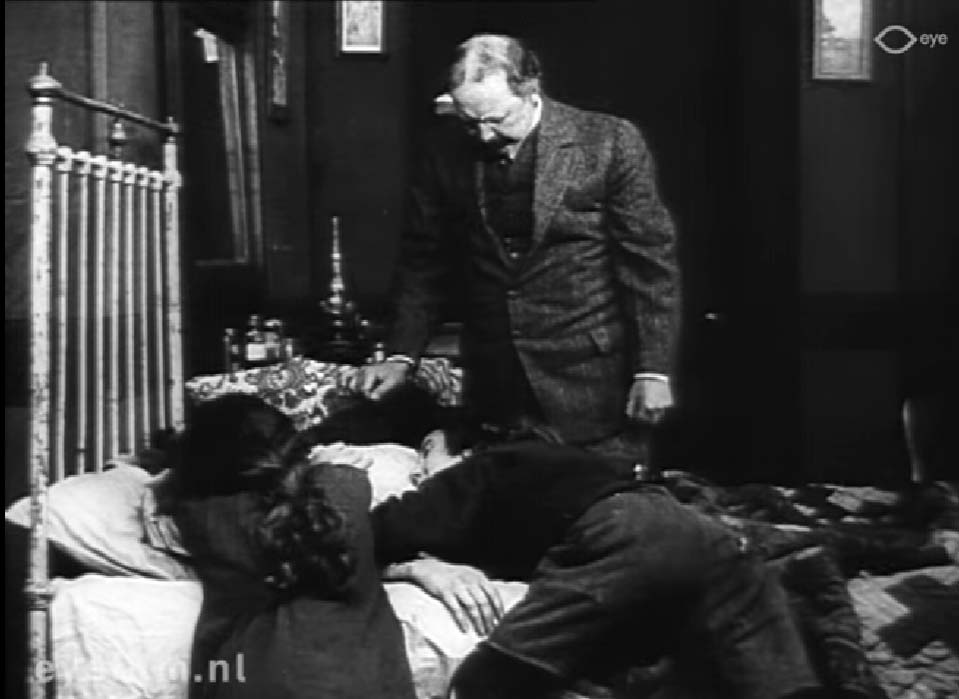
The Old Silver Watch is a dramatic one-reeler—feature-length films were four or five reels at least—but the tension between longer, bigger stories and the studio-mandated short format is palpable. You see, this picture is five reels of story in a one-reel bag and it is bursting at the seams.
The story opens with a young widow on her deathbed, likely suffering from tuberculosis. Her son and daughter, Frank and Mildred (Kenneth Casey and Adele de Garde), comfort her and pray for her recovery to no avail. She passes her prized silver watch to Frank and then dies.

(The inscribed photograph inside the watch shows that the mother’s name was Maria Collins. The family and landlady, played by Cork-born character actress Kate Price, are coded as Irish and probably immigrants, given the film’s tenement setting. A synopsis from the period states that the mother’s name was Scranton, I am unsure how or why the name change occurred.)
A doctor (Van Dyke Brooke, who also directed) arrives and, after establishing that nothing can be done for the mother, offers to take the children into his own home. Frank decides to run away instead and is adopted by a different family, while Mildred stays with the doctor and his wife (Helen Gardner).

The children grow up and are played by Maurice Costello and Leah Baird for the rest of the picture. Frank saves Mildred from a mugger and the pair quickly fall in love, apparently never actually discussing their backgrounds and hoping for the best. (Being an orphan was not viewed as particularly desirable at the time but you would think the fact would have come up I passing.)
Meanwhile, the mugger decides to avenge himself on Frank and follows him to the wedding ceremony. He shoots our bridegroom squarely in the brisket. A tragedy! But wait, the bullet lodged in the pocket watch Frank always carried with him. He’s bruised but otherwise uninjured.

Mildred recognizes the watch and her mother’s photograph inside. The pair realize their true connection and embrace. The end.
Wait, wait, wait, hold up a minute! We’re just switching from eros to philia without so much as a discussion? Everyone is just okay with this? I realize these were different times but I would think “The wedding is off because the groom is actually my brother” would cause some kind of tension and gossip. No? Okay, happy ending it is.

That was… a lot. Movies from this period were often truncated and relied on the audience to fill in the gaps but this is pretty sloppily put together, I must say, and the length is mostly to blame. More on that in a minute but I do have to praise Costello and Baird for holding things together with their performances. They are a bit emphatic at times, as the melodramatic material requires, but in general, they keep things grounded and reasonably believable despite the out there plot.
Though it should be noted that in the days before social security numbers, computers and the FBI, it was a lot easier to just disappear or lose track of someone. Misplacing Frank is probably the most believable part of the film. In fact, a trade review in Moving Picture World praised the film’s realism and even stated that members of the screening audience commented on it being a true-to-life scenario.

I am quite a fan of director Van Dyke Brooke’s work, particularly his goofy past life fantasy The Mystery of the Sleeping Death, but this picture doesn’t have any particularly dramatic visual flourishes. In fact, the direction is workmanlike, if anything.
So, we have some strengths but the big weakness is the rushed plot. I am actually quite a fan of dramatic short films, they can be powerful vignettes that still pack a punch at their best. However, an apples to apples comparison of films made before and after The Old Silver Watch show that the picture’s structural problems would have been evident when it was released. It didn’t need to be five reels long (feature-length films were not standard yet the year it was released, remember) but a bit more breathing room would have done wonders.

For example, Children of Eve (1915), made just three years later and running over 70 minutes in its current home media release format tread some of the same ground. It’s not an exact comparison as the missing relative is a daughter and the big reveal is between the heroine and her father but the film demonstrates how similar emotional beats could be powerful and effective when given more room to breathe. It’s the melodramatic story of a tenement teen going undercover in an unsafe cannery and there’s a lot of big emoting going on but director John Collins is able to pace the action so that these moments are poignant instead of goofy. Grade A tearjerker.
On the other side of the coin, the short film The Faithful Dog; or True to the End (1907) kept its story simple so that, even with a half-reel runtime, it managed to leave its audience in tears. (I, of course, have no firsthand knowledge of this and argue that I merely had hay fever.)

What I am saying is that The Old Silver Watch either needed less or more but by trying to cram such a complex story into such a tiny box, things went a bit odd.
However, I have no complaints about the ad campaign for the film. In the era of short releases, studios would often include multiple titles in their trade publication advertisements and taglines were optional. The Old Silver Watch, though, had this doozy. “Timely and up to the minute.” It’s groan-inducing, I love it.
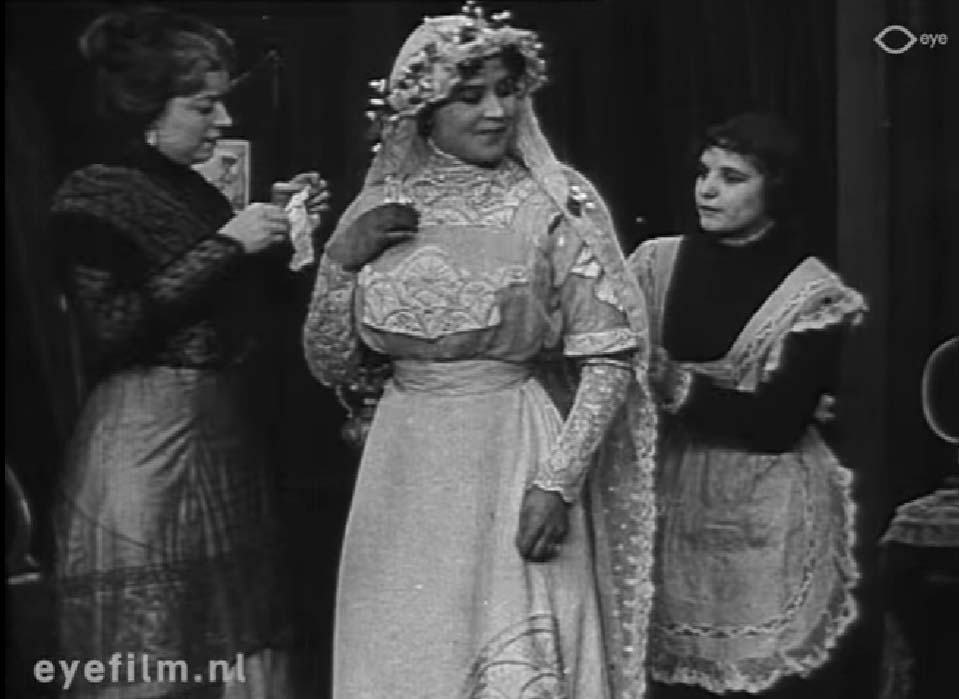
The Old Silver Watch is not the best film in the Vitagraph catalog and certainly not one of the better works of the underrated Van Dyke Brook but it does hold a certain interest for its “What in the what now?” plotline and its cast studded with names forgotten by the general public and barely discussed even in silent film circles. It’s a curiosity but worth your time. (See what I did there?)
Where can I see it?
Stream courtesy of the EYE Filmmuseum.
☙❦❧
Like what you’re reading? Please consider sponsoring me on Patreon. All patrons will get early previews of upcoming features, exclusive polls and other goodies.
Disclosure: Some links included in this post may be affiliate links to products sold by Amazon and as an Amazon Associate I earn from qualifying purchases.
 Movies Silently
The Old Silver Watch sounds like a film worth watching. I can’t help but think in this day and age of the short attention span, the anti-silent film folks would be more willing to tolerate a shorter one-reel film(?) Ah, who am I kidding. They just can’t handle black and white PLUS no talking (sigh). As for The Faithful Dog (True to the End) I’m staying far away. Nothing wrecks me more than a sad animal film. Thanks for the post!
Shorts are definitely a great tool for newcomers, I have had particular success with hand-colored French productions. Even the least interested bystander knows about the moon with a rocket in the eye, even if they can’t name the film or director!
This sounds like quite the flicker! I can appreciate its flaws, but you sure have piqued my curiosity! I look forward to checking it out.
— Karen
It is indeed!