
Well, you can’t accuse the title of beating around the bush. This gorgeous, stencil-colored short epic was directed by Louis Feuillade and covers the brief and decadent reign of Emperor Elagabalus. It also has lions. So many lions.
Home Media Availability: Stream courtesy of EYE.
When in Rome…
We tend to associate early costume epics with Italy and Italian films were indeed big, big, big. However, the French were not sleeping on the job and were busily producing their own massive, albeit short, films that covered large scale topics, both religious and historical. Pathé was diligently trying to cover the entire bible in the years leading up to the First World War, while Gaumont tackled one of the most notorious Roman emperors and that’s saying something.

As far as Roman history is concerned, I would rate myself average. I am good on the Julio-Claudian Dynasty and then after that, it’s basically a song that I know only some of the lyrics to. “Claudius, Nero… mumble, mumble, mumble, Vespasian, mumble, mumble…”
My point is that, by the time we get to the Severan Dynasty (193 to 235 A.D.), I am thoroughly out of patience with the stabby stabby stuff, five emperors a year was just wasteful and I begin to think Rome was a mistake and had they ever considered anarcho-syndicalism. If you told me there was an Emperor Bronchitis who ruled for six days in the year 196 A.D., I would believe you. I’m sorry if you happen to be a passionate scholar of Rome but, you see, I already study early Hollywood and that’s enough labyrinthine scheming for me.

In short, to contextualize, I am going to be reviewing this with my Silent Film and Its Influence hat on and not my How Accurate is This Roman History hat. For the most part.
You probably know the film’s director, Louis Feuillade, for his famous and famously salacious pulp serials: Fantomas, Les Vampires, Judex… So, you would assume that, given the film’s title, this picture would be on the trashy side. Well, I am here to report that you are absolutely right.
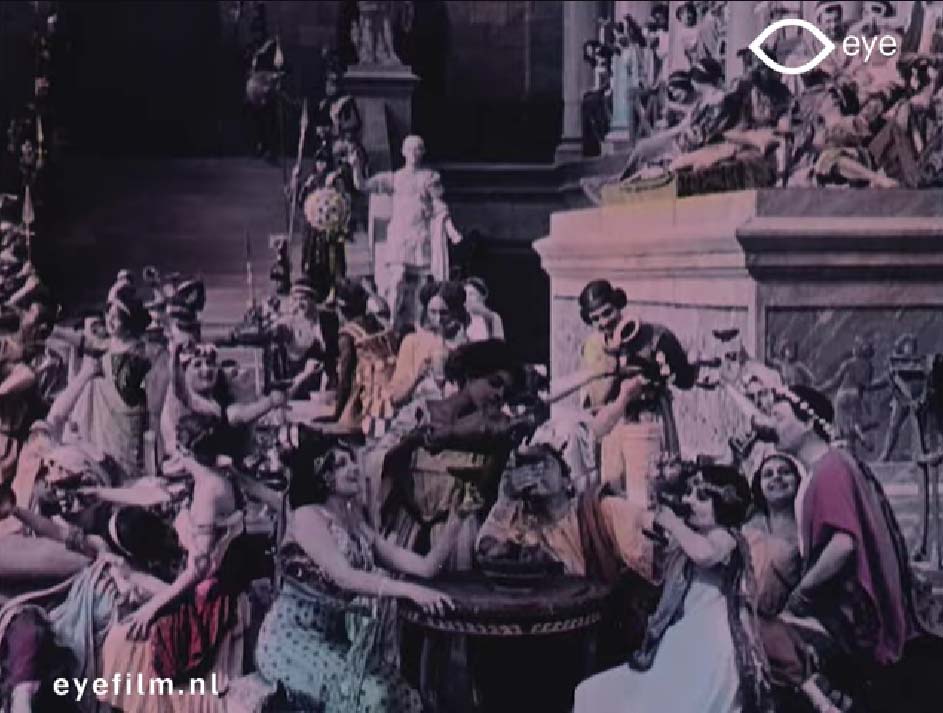
To be clear, there’s nothing explicit. No nudity or sex but the subtext… oh, yes, we have subtext. And, as mentioned in the header, lions. So, let’s discuss both.
Emperor Elagabalus ruled for four years, between the ages of fourteen and eighteen, and he kept busy. He attempted to force Romans to worship his god, the Syrian deity Elagabal (the name of his posthumous name), a long string of affairs/marriages with various men and women, at least one charioteer and, in a scandalous move, a Vestal Virgin. (They are what they say on the tin.) All of this boat-rocking was combined with almost spectacular incompetence that led to his assassination, likely orchestrated by his own grandmother.
Now, me, I would not put a fourteen-year-old boy in charge of a lemonade stand but I am also not trying to reinstate an imperial Roman line, so what do I know? In any case, tales of Elagabalus’ salaciousness were possibly exaggerated by political rivals and were further enhanced by later historians. Everyone seems to agree that he didn’t know his head from a hole in the ground but that’s about all they agree on.
But my point in all this is that a lusty Roman emperor was exactly the sort of subject that early cinema loved. Spicy content was far more easily forgiven by censors when hidden behind the fig leaf of historical accuracy (that’s how Theda Bara got away with wearing pasties, a sheer towel and a smile in Cleopatra).

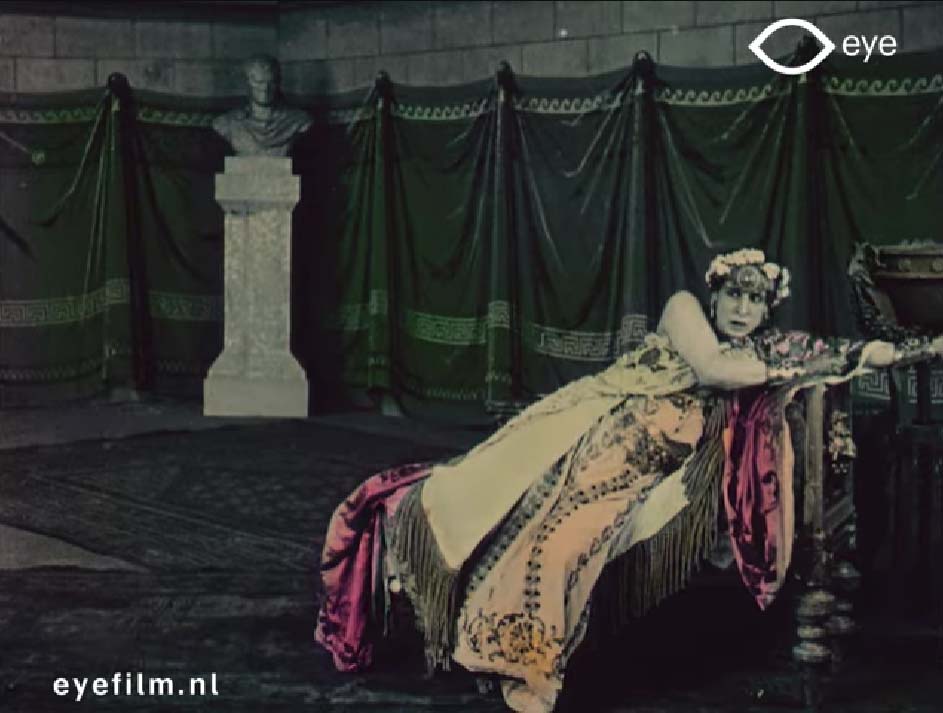
Feuillade portrays the court of Elagabalus as a playground of beautiful women, twirling and gyrating (albeit chastely) before the camera in their finest Orientalist Art Nouveau costumes. The stencil-applied color enhances these scenes and adds to the decadence. Male lovers are not portrayed but the actor playing Elegabalus, the decidedly-not-fourteen Jean Aymé, is dressed androgynously and displays what would be read as stereotypically effeminate mannerisms of the pre-WWI era, so French audiences likely got the message.
As far as production values are concerned, the whole thing looks great. The picture was given a general green or sepia tint and then the costumes and important props were stencil-colored in shades of pink, gold and orange. (Stencil color was just that: one tiny stencil for each color of each frame and then the prints were stamped individually. It was an arduous process that required a large staff of colorists, almost all women, who were well-paid for their skills.)
Feuillade was not content to portray a nudge-nudge-wink-wink orgy, no matter how sumptuously costumed. The film needed that special extra oomph, and in 1911, that meant it needed lions. Big cats in general were popular in silent films but lions were big business and the Gaumont Company, which produced L’orgie romaine, had made a name for itself in the lion film genre. An item in the April 27, 1912 issue of Moving Picture World declared that “the Gaumont Company is now beginning to style itself the firm of ‘Lions and Hand-Coloreds.’” L’orgie romaine certainly confirms this.
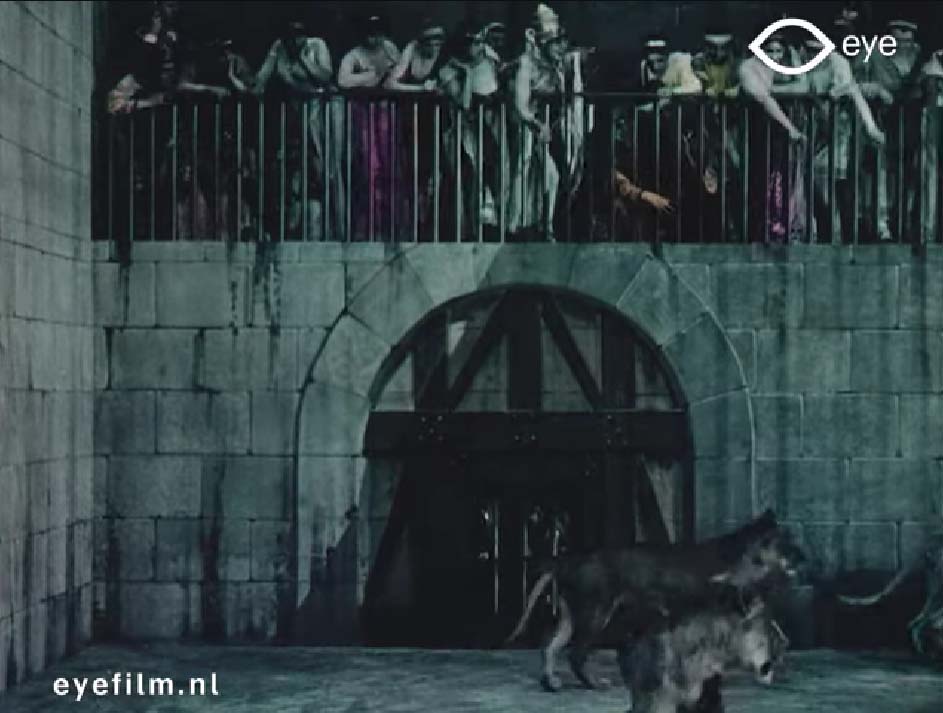
When a young slave accidentally cuts Elagabalus during a pedicure, the enraged emperor orders him thrown to the lions. The scene is cleverly shot, with the actor emerging from behind a portcullis and then dashing offscreen as the lions amble after him. The facial expressions of the courtiers watching from above tell the story of the slave’s fate.

Of course, too much was never enough for Feuillade and this merry maximalism is what makes his wonderful serials so durably popular. So, there are even more lions. Elagabalus continues his partying ways but is interrupted when the lions escape containment and invade the banquet hall. The emperor is whisked away by his guards but the courtiers are left to fend for themselves, fleeing through the hallways with the lions in hot pursuit.
Finally, the assassination by the Praetorian Guard—grandma’s hand in the affair is left out, as is the fact that Elagabalus was murdered alongside his mother—and, again, Feuillade makes use of off-camera space to portray violence. After a campy moment of panic on the part of Aymé, the guards stab at the groveling emperor and he falls, his head out of frame. The guards stoop down and emerge with the severed head of Elagabalus. That will teach him that when in Rome… (Aymé barely lasted longer as the Grand Vampire in Les Vampires.)

One thing I noticed while watching this picture was that it very much follows the formula that Cecil B. DeMille would later rely upon for historical subjects: show sin in loving detail, tut-tut, and then show some more, just to make sure everyone got the idea that this was naughty. DeMille didn’t invent it, I don’t even think Feuillade invented it, but it’s fun to see it on display at this early date.
(DeMille had likely not been an avid moviegoer before joining the industry in 1914 but he could possibly have run across L’orgie romaine or a similar production. He was known to watch films that covered topics he himself wanted to shoot as part of his research. For example, he was one of the last people to see the Fox print of Cleopatra before a vault fire claimed it.)

L’orgie romaine doesn’t have many fireworks as far as technique is concerned. Beyond his clever use of scene blocking, Feuillade basically made it his goal to catch all of the action and provide a canvas for the stencil color. However, I think that’s enough. We were promised a Roman orgy, we got bonus lions, Feuillade delivered exactly what he promised and not everyone can say that.
Where can I see it?
Stream for free courtesy of the EYE Filmmuseum YouTube channel with English subs and sans score. It is also included in the Gaumont Treasures DVD collection with a musical score but no stencil color.
☙❦❧
Like what you’re reading? Please consider sponsoring me on Patreon. All patrons will get early previews of upcoming features, exclusive polls and other goodies.
Disclosure: Some links included in this post may be affiliate links to products sold by Amazon and as an Amazon Associate I earn from qualifying purchases.
 Movies Silently