
When a diplomat in a foreign assignment marries again, he neglects to tell his new wife that his five daughters are not little moppets but wild teenagers. Chaos ensues but the stepmother has a few tricks of her own up her sleeve.
Home Media Availability: Stream courtesy of EYE.
Always outnumbered…
While slapstick is often viewed as the signature style of the silent era, particularly during Keystone’s heyday in the early-to-mid-1910s, more subtle forms of comedy had always been popular. French pioneer Max Linder had made his name portraying domestic and social pickles of a man about town starting in the 1900s. The American Vitagraph company made a point of pursuing a gentler form of funny in the 1910s and their biggest star was John Bunny.

Bunny didn’t have a stock character, he could be the instigator or the victim of his comedies, but his humor often revolved around domestic situations like accusations of adultery, remarriage with children, or a husband who just won’t stop gambling.
The Troublesome Step-Daughters features Bunny as Mr. Burton, the devoted dad of five young daughters (allegedly, two of them played by Dolores and Helene Costello, which would have been highly likely as their father, Maurice, was a Vitagraph contract player and the sisters were often cast in child roles). When he receives a diplomatic assignment to Turkistan or China, depending on which intertitles you see, he is advised to leave the girls at home for their safety. He remains at his post for six years, falls in love with a suitable lady (Julia Swayne Gordon) and can’t wait to return home to present his darling little girls with their new mother.

It never occurred to him to update the family photo he received six years prior, nor does he seem to realize that children at nine are a bit different from children at fifteen. And poor Julia has purchased dolls and teddy bears for the sweet kids she’s about to mother. Oh dear.
(On a related note, I shiver to think what Bunny was doing in Turkistan—or China— if that’s the way he handles his own family! I’m astonished he didn’t accidentally declare war.)

The girls have grown up into Norma Talmadge, Edith Storey, Dorothy Kelly, Lillian Walker and Edith Halleran and they decidedly do not want a new step-mother, so they set about trying to get rid of her. They pretend to be too old and stylish for parenting, mock the dolls and toys she has brought, steal and eat the contents of a dessert cart when she has guests and draw rude pictures of her with chalk.
Julia isn’t without tricks of her own. Once the shock of expectations vs reality wears off, she has a plan of action. The Burtons have been invited to a party where there will be a number of young cadets. Julia insists that the girls accompany them, dress in their finest and meet the cadets. All the daughters are quickly paired off and given permission to entertain their new boyfriends at home. Julia instantly goes from interloper to dearest mumsy in the eyes of the step-daughters.

And the moral of the story is this: teenagers can still be bribed with toys, you just need to find the right kind.
The Troublesome Step-Daughters has a very slight (even by one-reeler standards) and silly plot and if you’re here for John Bunny, there isn’t much of him in the film. But there are other reasons to find this picture interesting.

If you are at all familiar with the Vitagraph acting company, you probably will have already noticed that almost all of their biggest names are in the cast list. In addition to the step-mother and step-daughters, we also have Flora Finch, Bunny’s frequent co-star, as the governess, and Clara Kimball Young as the toy shop clerk.
So, if you are not familiar with the Vitagraph team at all, this picture has just about every big name in their company in one convenient spot. (I was going to mention that Vitagraph tween sensation Gladys Hulette was not present but it seems she had departed for Edison at the time.) This zany little domestic comedy is an excellent way to introduce yourself to a studio’s female stars all at once.

While John Bunny was the bigger star, Julia Swayne Gordon does an excellent job of gluing the film together as the ambushed and sandbagged new step-mother. Gordon is probably best remembered today by silent film fans as another maternal figure in the 1922 version of Scaramouche but she enjoyed a variety of roles at Vitagraph, notably donning a sheer bodysuit as the title character in Lady Godiva.
Gordon manages to convey the horror and exasperation of the new step-mother, while trying to keep her cool and finally coming up with a winning strategy to befriend the girls. The individual actresses playing the step-daughters do not stand out as much—so many of them on the screen at once and this is just a one-reel short—but it’s fun to see some familiar and not-so-familiar faces.
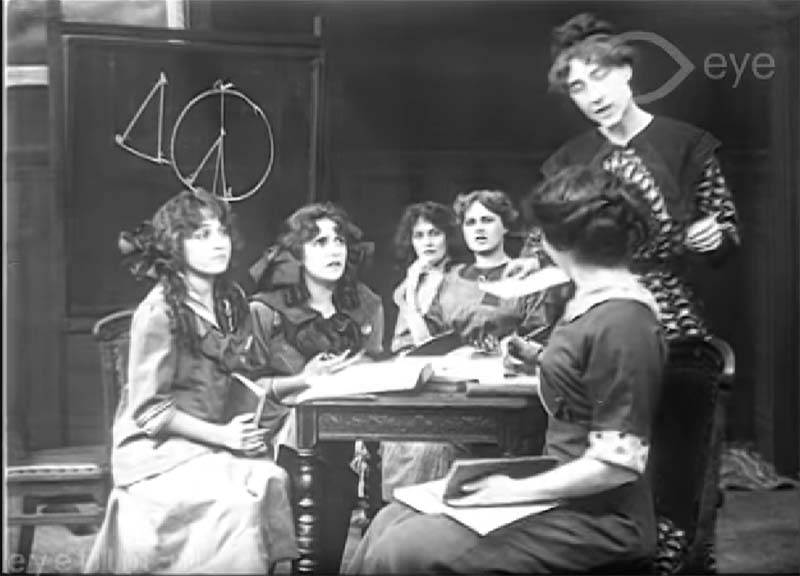
The Troublesome Step-Daughters didn’t seem to make much of an impact when it was released. It didn’t receive any sequels and was not mentioned in trade or fan magazines after the initial wave of advertisements. It probably wasn’t efficient for Vitagraph to put all their star eggs in one basket but I am glad they did it in this case.
The story is slight but the cast, particularly the young women playing the step-daughters, seem to be enjoying themselves as hoydens. It’s a bit of cotton candy that will dissolve in a moment but I’m glad that we have it all the same.
Where can I see it?
Stream courtesy of the EYE Filmmuseum. The title cards are from the Dutch language release but there are optional English subtitles. There are some subtle differences between these titles and the published plot synopsis, most notably the location of John Bunny’s diplomatic mission. It is Turkistan in the Netherlands release and China in the American synopsis. It’s worth noting that the “foreign” location is conveyed with generic orientalist sets and props, so I highly doubt anyone involved in the production was aware of the fraught history of the Central Asian region of Turkistan in relation to both Russia and China.
☙❦❧
Like what you’re reading? Please consider sponsoring me on Patreon. All patrons will get early previews of upcoming features, exclusive polls and other goodies.
Disclosure: Some links included in this post may be affiliate links to products sold by Amazon and as an Amazon Associate I earn from qualifying purchases.
 Movies Silently
It’s always good to read about Vitagraph – my grandfather started his career at the Vitagraph (Western Vitagraph) in the ‘teens.