
A husband stays home from a card party to play a joke on his wife. He has his neighbor tie him up so that he can pretend the house has been robbed. It’s all fun and games until a real burglar shows up.
Home Media Availability: Stream courtesy of EYE.
All Tied Up
Burglary was one of the most popular suspense tropes in the movies during the silent era and especially in the years leading up to the First World War when short and feature-length dramas existed side-by-side in the cinema. The punchy visual impact of a burglar terrorizing householders was an ideal way to keep audiences on the edge of their seats.
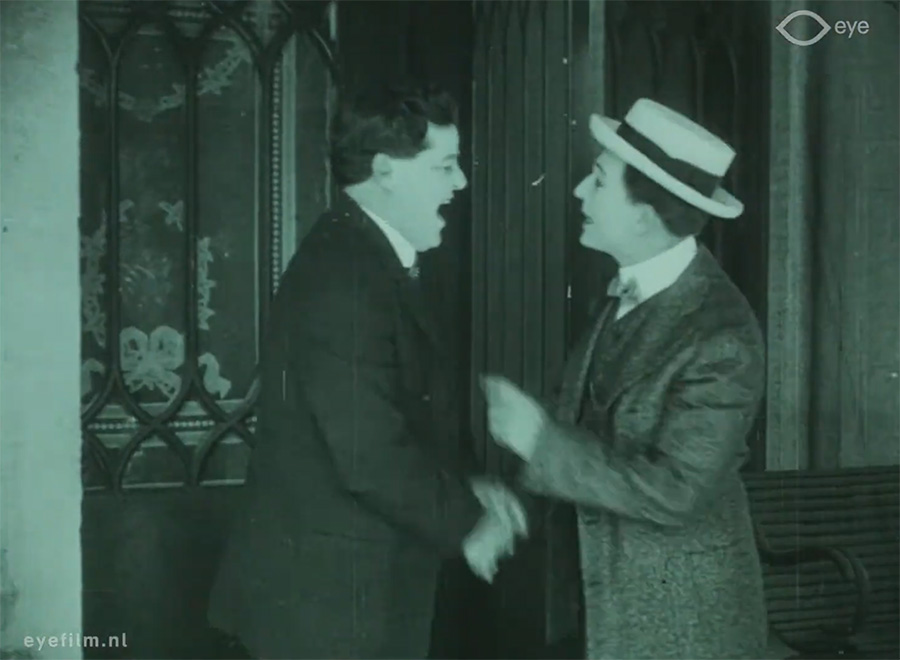
Naturally, anything worth doing seriously was worth spoofing as well and burglary spoofs quickly became popular as well with householders attempting to fend off invaders with slapstick tactics viewers might associate with Home Alone. A Joke on Jane is a sendup of burglar pictures and it sprinkles in another popular trope of the era: a backfiring prank.
Joseph Rich (Harry Pollard) and his wife, Jane (Margarita Fischer), quarrel and she leaves for a card party without him. He sulks for a bit and then has a brilliant idea: he will fake a robbery and make her think that the house was stripped. That will teach her a lesson! (What less, I cannot say, but as we will soon learn, Joseph is not exactly a brain surgeon.) He calls his neighbor, Thomas Wise (Joseph Harris), to assist.

Jane is having a lovely time at the card party. Meanwhile, at Joseph’s insistence, Mr. Wise ties him to a chair and gags him. Joseph has already taken the smaller valuables, such as his wife’s jewelry, and hidden them in his pockets. Now all he has to do is wait and shock his wife with the terrible thing that happened while she was away, leaving him unprotected.
Mr. Wise returns home and recounts the joke to his wife (Mary Scott) and son, Bobby (Kathie Fischer, Margarita’s niece). Once her husband is out of the room, Mrs. Wise lives up to her name and quickly scribbles out a note for Bobby to deliver to Jane, warning her of the prank so she can be prepared.

Meanwhile, Peter the porch climber (Perry Banks) has chosen this night to rob the Riches. He climbs up the side of the house, peeps in the window and is shocked to find Joseph still bound and gagged inside. Easiest robbery of his career! Peter searches the helpless Joseph and retrieves all the valuables, then wanders off to see what else he can steal.
Jane gets the note, has a good laugh and rushes home to perform her counter-prank on her husband. She finds him tied up and doing a surprisingly good job of acting distressed. Silly man! She knows what is really happening, why is he still pretending there is danger? Jane tickles his chin and tells him she will untie him in the morning.

She heads up to the bedroom, sees Peter rummaging through the closet and yikes! But not to worry, Jane thinks fast. She slams the closet door shut and locks it, then runs to her husband but calls the police before she unties him. Peter is fumbling to pick the closet lock but will the police come in time? See A Joke on Jane to find out!
Margarita Fischer is probably best known today for the much-reprinted 1918 wartime publicity stunt of tossing the “C” in Fischer onto a model map of Germany. The publicity read as follows:
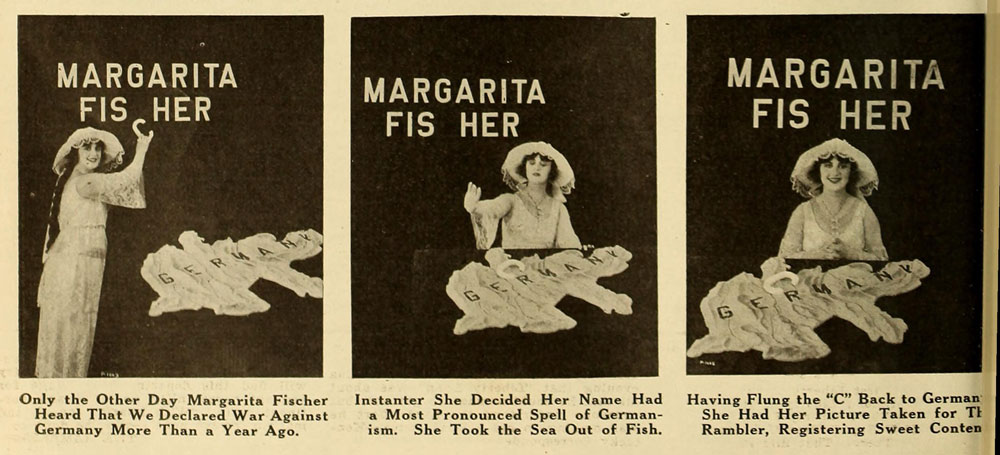
“Margarita Fischer kicked the “c” bodily out of her name last week by means of a little ceremony that indicated how much in earnest she was. She picked the offending, Germanish letter from the center of her last name and tossed it lightly onto the clay map of Germany that had been fashioned on a table for her ceremony.
“‘From Germany thou came seventy-five years ago,’ she said, watching the letter fall kersplunk into Germany, ‘back to Germany thou may go — and welcome. I was born in the good old United States, and every fibre of my body is boosting for America — the best country in the world’.”
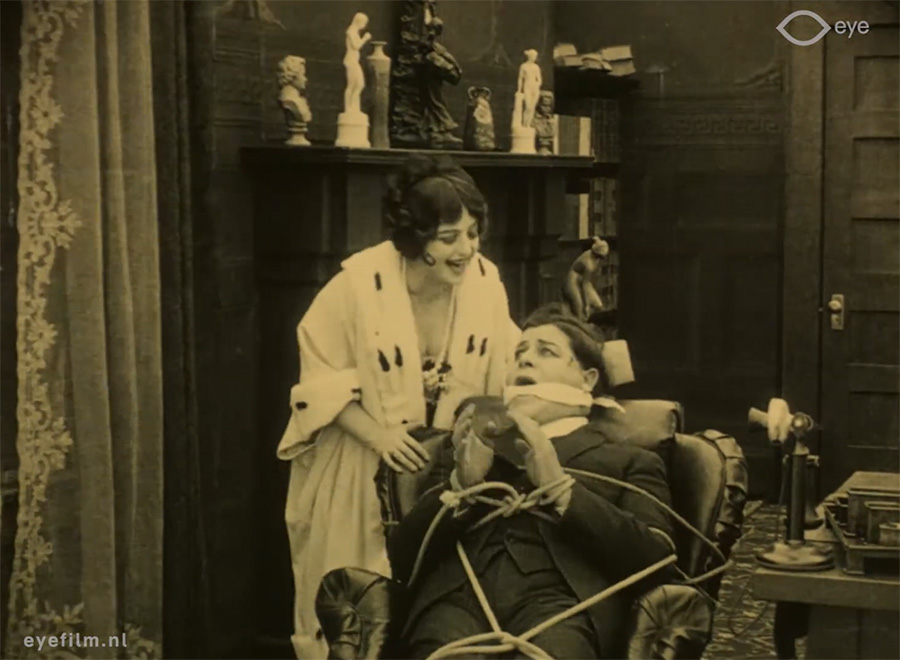
This was hardly the most extreme propaganda of the war years but it was visually striking and has often been reprinted as an illustration of wartime fever. Margarita Fisher didn’t last long and she was back to being billed as Fischer pretty quickly, especially with postwar Hollywood eyeing the massive German film market and actively wooing German industry talent.
However, the durability of the stunt leaves us with a rather dour and humorless portrait of Fischer, who was then at the apex of her career. While Uncle Tom’s Cabin (1927) is widely available, films from her early days are a bit thin on the ground. A Joke on Jane, made four years before the stunt, shows us what made audiences embrace her.
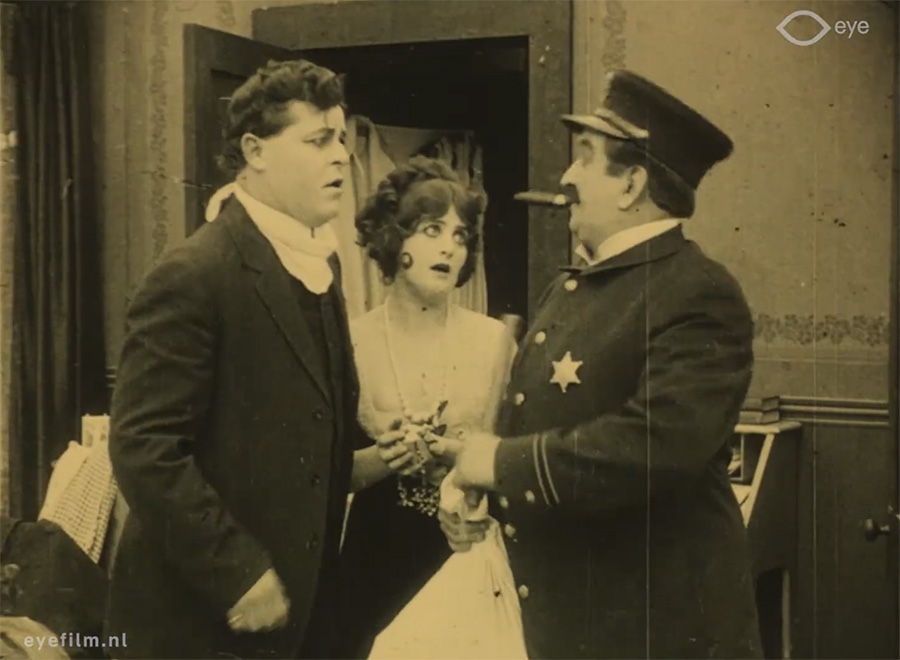
Fischer is delightful in the picture, lively and energetic. She takes everything with good humor and her gutsy and clear-headed actions during the finale save the day. The goal of Joseph’s joke seems to have been “See what happens when you go out, if only you had been here!” and Jane’s actions clearly indicate that, yeah, she probably could have handled the burglar if he had shown up when she had been home. I don’t think it was an intentional feminist message but Jane clearly wears the pants and deserves to.
Meanwhile, in the role of her husband, Harry Pollard overacts, exaggerating his character’s gestures like he’s playing charades to win. The director should really have reined him in, who directed this… Ah, Harry Pollard. But seriously, Fischer and Pollard, already married when they filmed A Joke on Jane, were something of a movie power couple and he went on to direct big budget pictures like the aforementioned Uncle Tom’s Cabin and the 1929 version of Showboat. It’s probably for the best that Pollard’s character spends most of the film trussed up and that he later switched over to directing exclusively.

A quick note that the film contains multiple scenes of characters turning electric lights off and on. It is probable that for its original American release, the film would have included yellow or amber tints for the lights on and blue tints for the lights off. The version I saw is a Dutch release print that is tinted yellow for interiors, green for exteriors and blue for the title cards (title card tinting was a common anti-piracy measure) but the more elaborate scheme was not used. I mention this because some scenes would have played better if there had been tints to convey darkness and this is an issue with the release color scheme and not the filmmaker.
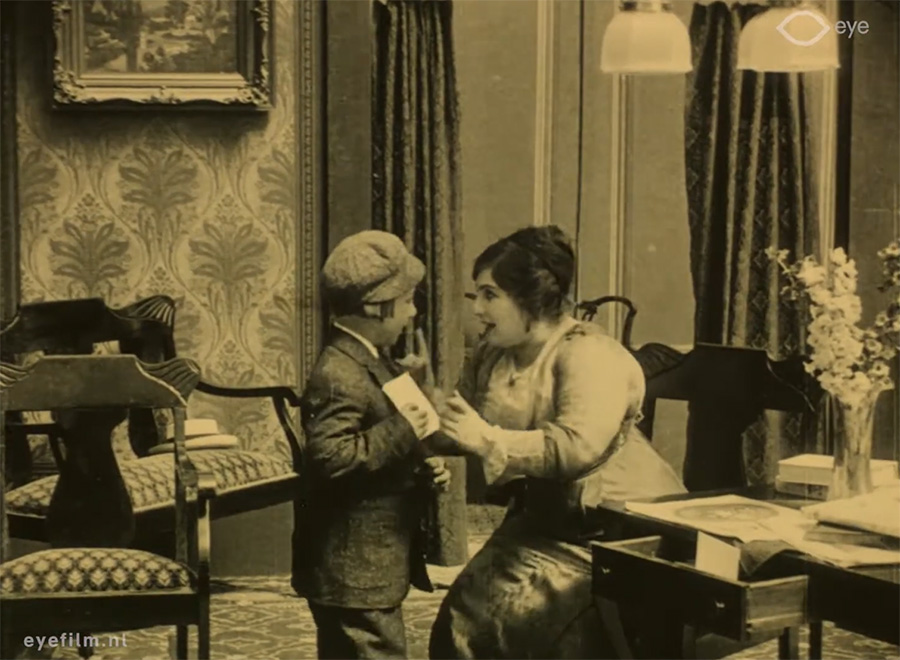
The film is generally directed well, with relatively few fireworks outside the suspense provided by the burglar but Pollard had the good sense to put Fischer front and center, where her charisma and humor could carry the picture. All in all, this is a fun little comedy typical for its era and an excellent showcase for Fischer in her prime. I think you’ll like this one.
Where can I see it?
Stream courtesy of EYE. The Dutch release print has, naturally, Dutch title cards but you can turn on optional English subtitles.
☙❦❧
Like what you’re reading? Please consider sponsoring me on Patreon. All patrons will get early previews of upcoming features, exclusive polls and other goodies.
Disclosure: Some links included in this post may be affiliate links to products sold by Amazon and as an Amazon Associate I earn from qualifying purchases.
 Movies Silently