
When a mischievous maid’s stove doesn’t light up quickly enough, she splashes in some paraffin… and a bit more… and a bit more! An explosive comedy.
Home Media Availability: Released on DVD and Bluray.
An Earth-Shattering Kaboom
George Albert Smith was on a roll in the 1890s and 1900s. His 1897 comedy The X-Rays used the substitution splice for see-through humor (the leading lady was Smith’s wife, Laura Bayley), his 1899 film The Kiss in the Tunnel had helped pioneer multi-shot films (of him kissing wife Laura Bayley), his 1900 film As Seen Through a Telescope contained possibly the earliest edited closeup (of wife Laura Bayley’s legs) and his 1903 comedy The Sick Kitten employed the closeup to capture his other favorite thing: cats.

Smith knew what he liked and he featured even more of it in his innovative 1903 comedy Mary Jane’s Mishap. Mary Jane (Bayley) is a goofy domestic who wakes up late, gives herself a soot mustache while shining shoes, and then tries to light the stove. Oh fiddlesticks, it’s not lighting and she’s late! To speed things up, she tips in some paraffin from a clearly-labeled can. Then, she kneels down to light the stove and, well, bye-bye Mary Jane.
I joke that George Albert Smith pioneered edited closeups entirely for cats and his wife’s legs but Bayley’s charisma in this picture makes it clear why he loved featuring her. The comedy is broad and her acting matches the tone of the picture but her sparkling joy in her own mischief is infectious and speaks to the audience across a century. In one memorable instant, Bayley breaks the fourth wall and winks as she continues to splash paraffin into the stove. Oh, yes, and there are also cats in every scene.

The picture also feels modern in its editing and closeups. Even dedicated viewers of early film become accustomed to polite, show-the-whole-actor cinematography and Smith cuts between wider shots of the kitchen and closer shots of Mary Jane as she plays with soot and fills the stove with paraffin. There are also wipes between scenes, another technique we tend to associate with later movies. In short, this was all cutting edge stuff in 1903 and it still looks good.
Now, as for the story, the notion of a domestic worker blowing herself to kingdom come was not a new one. It may have been based on a stage gag but it definitely appeared on the screen as early as 1900 with the Biograph film How Bridget Made the Fire with Arthur Marvin at the camera.
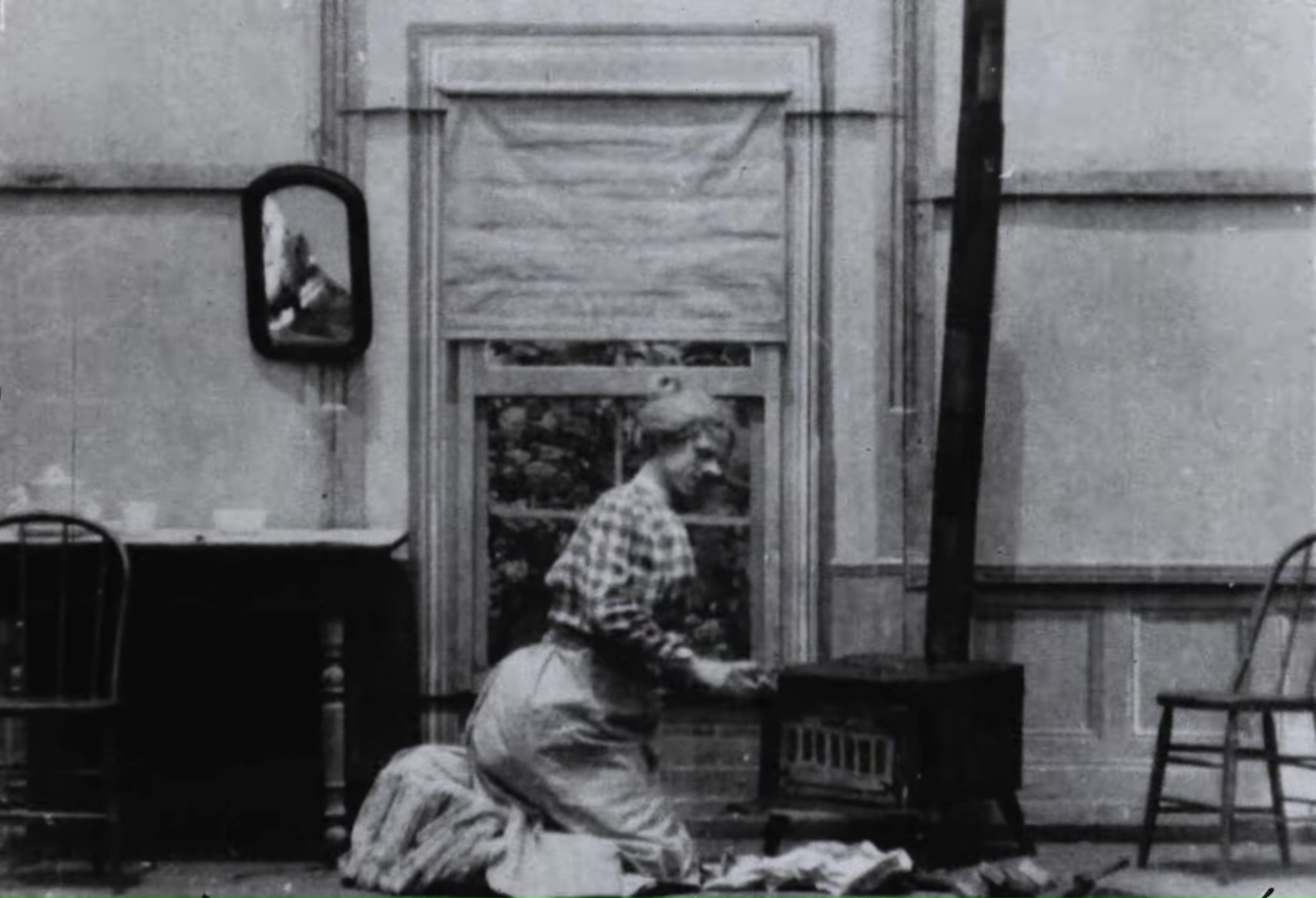
“Bridget” was the favored name for a stereotypical Irish immigrant in American films. (I cover portrayals of Irish men, often named Clancy, and women at work as policemen, servants and cooks in my review of How Bridget Served the Salad Undressed.) Irish cooks, cleaners and washers particularly were often portrayed as ignorant, incompetent, drunk, violent, or all of the above.
Bridget (possibly played by vaudeville drag artist Gilbert Saroni) attempts to build a fire in her squalid surroundings but crumpled paper isn’t enough. In a burst of temper, Bridget grabs the kerosine can and pours it onto the stove. There is an instant explosion and the film ends.

The next year, Edwin S. Porter of the Edison company tried his hand at the gag with The Finish of Bridget McKeen. This time, Bridget (almost certainly played by a male Edison employee in drag) is in classier surroundings with houseplants and tidy pots and pans hanging from the wall. However, her frustration is the same: that stove just will not light.
Porter allows the situation to build at about the same pace as the Biograph picture but instead of ending with the explosion, he holds the shot for a few seconds. Debris begins to rain down before the bulk of Bridget’s body lands with a thud, an early example of fine cinematic timing.
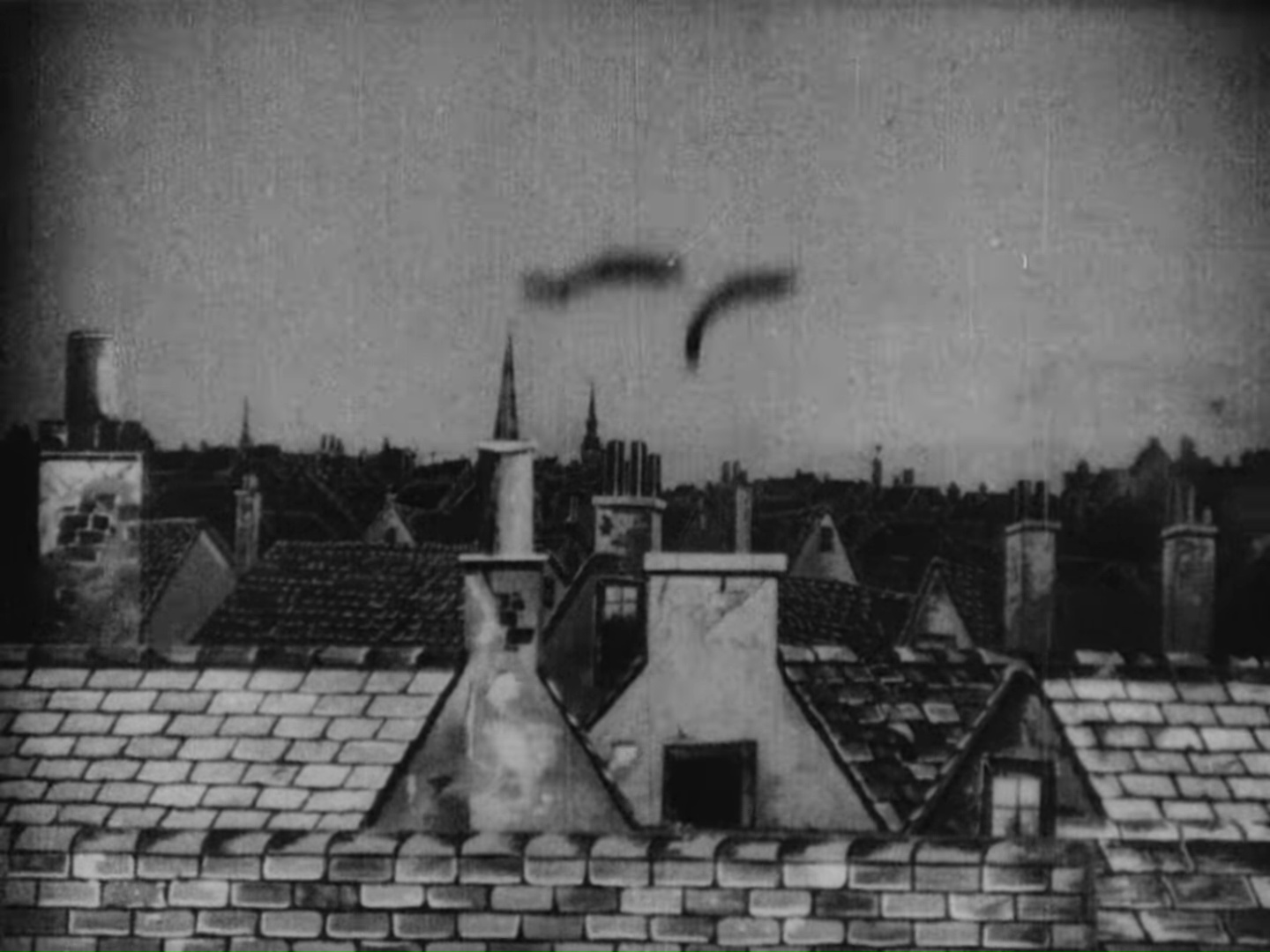
This additional bit of slapstick was further built on by Smith with Mary Jane’s arms and legs raining down over Hove. Smith and Bayley also play with audience expectations, teasing whether or not the heroine will light the paraffin that will send her to kingdom come, something we don’t see in the Biograph or Edison pictures. While Porter’s timing is very good, Smith and Bayley’s timing is exquisite.
Porter didn’t stop with comic body parts and added a second scene to the film, a shot of an artistic title portraying Bridget’s tombstone with a 1901 year of death. “Here lies the remains of Bridget McKeen, who started a fire with kerosine.”

Porter would return to the well of death-by-appliance later in 1901 with Another Job for the Undertaker, co-directed with George S. Fleming and released in May. In that picture, the victim is male, the Rube stock character. Rube was, well, a rube baffled by city ways and technology. In this case, it’s the gaslight.
Unfortunately, the surviving copy of the film is derived from a paper print, the film being transferred to photo paper for copyright purposes. While this saved many films that would otherwise have been totally lost, it tends to lose fine details and, in this case, the print is so blown out that lettering of the all-important sign needed to understand the story and punchline is unreadable.
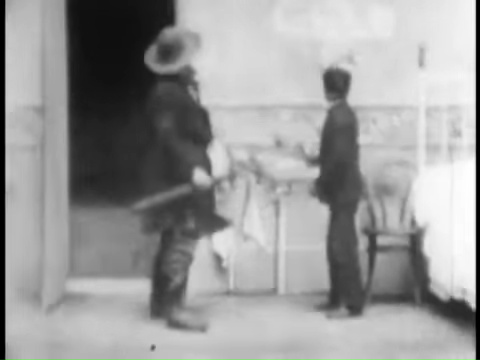
You see, the sign that the boy points to says, “Don’t blow out the gas.” Doing so without turning off the gas lamp would, of course, lead to asphyxiation and death. The boy then disappears with a Méliès-style leap and the rest of the runtime shows Rube’s clothing and belongings disappearing as well. Rube blows out the gaslight like a candle and then the film cuts to a shot of a funeral procession.
It’s a bit confusing, especially with the sign not being visible, and a preservation synopsis written before the film’s story was known suppositions that Rube died as a result of mystical forces. An understandable error but, no, just death by technology. Another Job for the Undertaker is confusing in other ways as it focuses its special effects on Rube’s wild night in the room instead of his death and, as a result, it lacks the punch and pizzaz of The Finish of Bridget McKeen and ends up muddled.

Gaslight, like kerosine and paraffin, was not brand-new technology in the early 1900s but all of these items were new enough for filmmakers to believably to rib hicks, immigrants and the working class and the theme continued with such things as automobiles, airplanes and motion pictures. This is another way that Mary Jane’s Mishap differentiates itself from the other kitchen explosion pictures: she is the queen of chaos and not the victim.
To recap, Biograph exploded, Porter added the tombstone. Of course, Smith and Bayley went several steps better. After the explosion, Mary Jane is shown flying through the roof of the house like a rocket before parts of her rain down over Hove. Like the Porter film, Smith cuts (or, rather, wipes) to her headstone: Rest in Pieces. But wait, there’s more, a whole epilogue more.

A group of domestics approach the grave to mourn Mary Jane and learn from her mistake. However, Mary Jane was never one to be obedient, so she rises from her grave, frightens away the mourners, and retrieves a ghostly paraffin can before returning to her rest. I don’t think the city of Hove has seen the last of Mary Jane! Rather than being a cautionary tale, Mary Jane’s mishap is almost aspirational.
I wouldn’t go so far as to say Mary Jane meant to blow herself up, rather that she didn’t actually care. Her winking glee as she glugs the paraffin into the fire is different from the temperamental grabbing of kerosine by both Bridgets. However, there were other female chaos agents of the period, the Leontine series or Gladys Hulette’s pyromaniac fairy in Princess Nicotine, for example.

We can also see the same spirit in later anarchic animated films, where characters could be temperamental or vindictive but their pandemonium was joyous, but those characters skewed male. Funny women embracing chaos to such a degree has been rare since those early golden days.
Mary Jane’s Mishap showcases how silent era comedy was less about original authorship and more about a filmmaker and star putting their own personal spin on a stock situation. I watched numerous earlier violent mishap films for research but none of them were as good as Smith and Bayley’s take.

This is one of my favorite early comedies and easily one of the most dynamic and innovative films of the early 1900s. It is shockingly modern, with its varying shots, cuts and the clear appeal and star power of Laura Bayley in the lead role.
Where can I see it?
Mary Jane’s Mishap, along with Bridget Builds the Fire and The Finish of Bridget McKeen, are available on DVD and Bluray as part of the Cinema’s First Nasty Women box set, along with many other movies dealing with feminine agents of chaos. You can also screen a lower resolution version of Mary Jane’s Mishap courtesy of the BFI.
☙❦❧
Like what you’re reading? Please consider sponsoring me on Patreon. All patrons will get early previews of upcoming features, exclusive polls and other goodies.
Disclosure: Some links included in this post may be affiliate links to products sold by Amazon and as an Amazon Associate I earn from qualifying purchases.
 Movies Silently