
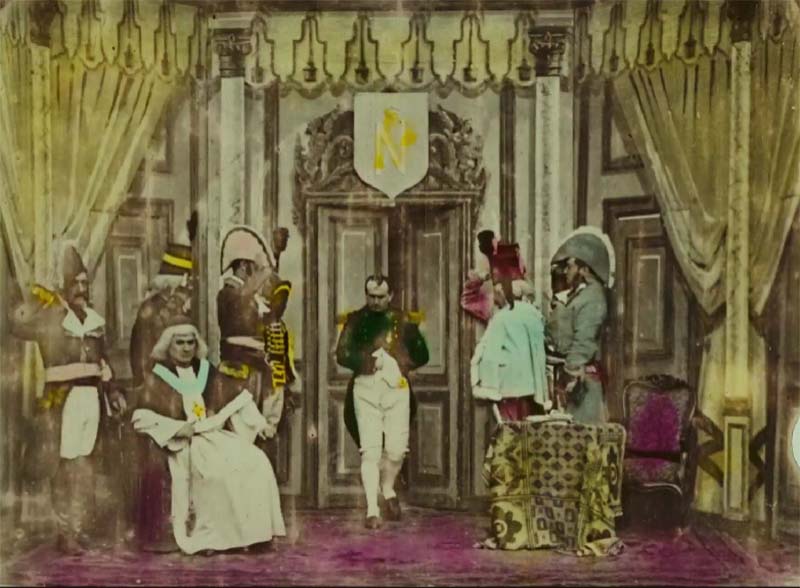
Movies were becoming big business and new genres were emerging. This historical film portrays a meeting between Napoleon and Pope Pius VII prior to the former’s imperial coronation.
Home Media Availability: Stream courtesy of Henri.
History in Living Color
One of the delights in digging deeper into early film is discovering the less famous works of iconic directors and studios. Georges Méliès is justly famous for his extravagant fantasies and illusions but he also filmed actualities and made torn-from-the-headlines news reenactments, covering everything from the Dreyfus Affair to the sinking of the Maine. The Lumière film company was known for its actualities and forays into comedy but it also dabbled the more formal genre of historical reenactment.
Allowing audiences to experience historical scenes through brief vignettes was not a new invention when the Lumière company embarked on its project in 1897. The Edison film company had presented the execution of Mary, Queen of Scots for peepshow exhibition in August of 1895. However, there was more than enough history to go around and, specifically, there was more than enough Napoleon to go around.
Meeting Between Napoleon and the Pope lasts less than a minute and is filmed like a stage play. It is also elaborately hand-colored with great attention to detail. Napoleon’s epaulets, the braid of the soldiers uniforms and the cross of Pope Pius VII are all tinted yellow and the armchair on the right side of the scene is tinted red, which adds balance to the composition.

France was the capital of colored slides and, as we see here, colored films, and producers were already relying on the skills of colorists to add a layer of luxury to their painted sets. This would have been particularly important because the big appeal of the Lumière brand was in reality: rustling trees and feeding the baby at first but also shots of real people and places from around the world as Lumière camera crews fanned the globe.
Actors performing a brief historical sequence against a painted backdrop? That could easily be seen live. In fact, putting on amateur historical tableaux was a popular hobby and magic lantern slides had animation and narration. Hand-applied color was not just a flourish, it was a requirement for this production to stand out in a sea of popular entertainment.
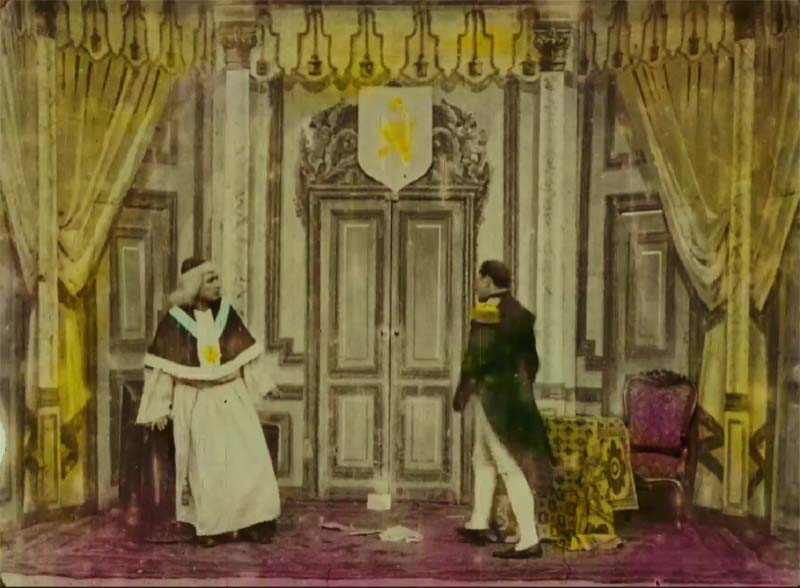
The action of the film is simple, as expected given the brief runtime. Napoleon makes a grand entrance and dismisses his entourage, leaving him alone with the seated Pius. An argument breaks out between them and it ends with Napoleon smashing a vase and storming off.
As I was rewatching the film for review, I noticed that Napoleon seems to produce the vase out of thin air. This is a straight historical picture, not a fantasy, so I took a closer look. Upon examination, the “vase” was there the entire time but it was painted over and merged into the wainscotting and tablecloth. It also seems as though the filmmakers either could not obtain a suitable vase or didn’t want to risk injury to the cast, thus the scare quotes around “vase.” It seems to be something weighted, maybe a small bag of stones or sand.

I wonder if the tinting crew was not provided with clear instructions to paint around the vase stand-in for the entire film, not just when Napoleon grabs it. Coloring film was still a new art but magic lantern slides had been colored for decades and I can see miscommunication occurring considering the number of frames in even a one-minute movie vs. a few dozen slides in a standard show kit. Such a mistake would not have happened even a few years later, they would have Chekhov’s Gunned that vase with bright pink or blue or white, as it appears when it is thrown in this film.
It doesn’t spoil the film but it does take you out of it for a few seconds and considering how short this picture is, a few seconds is a good chunk of the runtime. I’m not bringing this out as a complaint, more of an example of the growing pains experienced as older techniques were applied to the new art of cinema.

The director of Meeting Between Napoleon and the Pope was Georges Hatot with Gaston Breteau also credited. Hatot is not well-known today but he stayed busy in the historical and comedy genres before closing out his film career working in popular pulp series like Nick Carter.
In a 1948 interview with Hatot conducted by Heni Langlois and Musidora and made available online by the Cinémathèque française (link on streaming page for this film), the retired filmmaker recalled a madcap and whirlwind production schedule. The reminisces of industry veterans in their twilight years must be taken with a grain of salt as the fish they caught usually gets bigger and their walk to school often grows longer with every telling. There are exceptions, of course, but cautious enjoyment is the best approach.
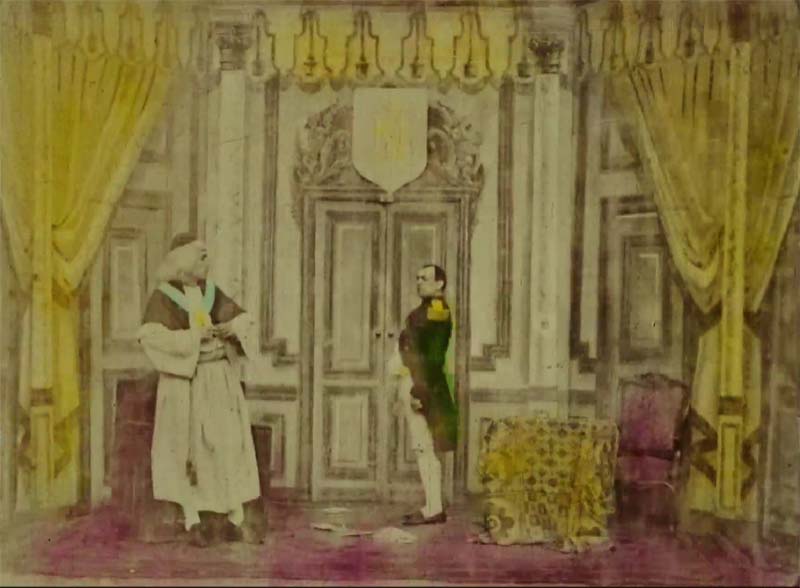
That said, Hatot’s colorful anecdotes throw light on the most forgotten period of film history. He stated that his small team was expected to haul scenery, which they propped up with paving stones, and to shoot three or four films a day on a fixed budget. They made the most of their sets and rented costumes by keeping to the same historical era. Hatot claimed that Meeting Between Napoleon and the Pope had not been planned but had been filmed on the heels of a portrayal of the Treaty of Campo-Formio. Nobody remembered what to do until Hatot said that perhaps this was when Napoleon smashed the vase.
(The fact that the film does not seem to have a fitting vase prop seems to lend credence to Halot’s account of events. I generally doubt “we winged our way to a masterpiece” tales but the visual evidence is on his side.)

The vase smashing is linked to an 1804 interview between Napoleon and the Pope in the runup to the imperial coronation. While tensions were high between the men and would remain so, the familiar sequence was based on Alfred de Vigny’s 1835 book Servitude et grandeur militaires rather than confirmed historical accounts. The semi-autobiographical work follows a young man’s military career and his growing disillusionment of Napoleon’s character and actions.
In the book, Napoleon lays out a list of demands for Pius at Fontainebleau and is called a clown for his impudence. Napoleon loses his temper and Pius then declares him a tragedian, which leads to the future emperor smashing a vase before confessing that he is indeed an actor and he will make his place in the world by force.

(If you’re interested in this topic, Vigny’s Unmythical Vision of Napoleon by Joseph Sungolowsky covers the author’s background and writings.)
That’s heavy stuff for a one-minute film with no dialogue that also pre-dated the introduction of intertitles. So, Hatot whittled it down to its essentials, something that could be easily conveyed in a purely visual manner.
Whether Meeting Between Napoleon and the Pope was a planned adaptation of a famous scene that had blurred the line between fact and fiction, or it was actually an impulsive and unscripted shot from a vague memory, the result was the same. Almost seven decades before The Man Who Shot Liberty Valance, Hatot understood that the future of cinema lay in printing the legend.

Like many narrative films of this period, Meeting Between Napoleon and the Pope benefits from a large share of context. The French audience of the period would have been familiar with the scene being portrayed and would have enjoyed the colorful presentation. The acting is forceful but hardly hammy and such a performance is what would be needed to put across a silent Napoleon. All in all, this is a fascinating detour for the Lumière company and a building block of cinema. Do check it out.
Where can I see it?
Stream for free courtesy of the Cinémathèque française.
☙❦❧
Like what you’re reading? Please consider sponsoring me on Patreon. All patrons will get early previews of upcoming features, exclusive polls and other goodies.
Disclosure: Some links included in this post may be affiliate links to products sold by Amazon and as an Amazon Associate I earn from qualifying purchases.
 Movies Silently